Once, when referring to “Made in China,” Western media often associated it with the production of clothing, toys, and other goods using cheap labor. Today, even American media has to admit that this image is no longer relevant.
"The high-tech market that was once controlled by the West is being taken over by China." The US newspaper The Washington Post reported on September 25th, stating that from electric vehicles to robots, Chinese companies are increasingly producing the world's most advanced industrial products. With automation, innovative design, a complete supply chain, and high efficiency, they are gaining an advantage in an increasing number of high-tech manufacturing fields.
The report first focuses on the Xiaomi automobile factory in Beijing. Over the past two years, more than 300,000 people have visited this “super factory”. Inside the factory, a large number of industrial robots are working around electric vehicle semi-finished products, with unmanned transport vehicles moving back and forth. On the vast production line, it’s hardly possible to see any workers.
American automotive industry consultant Michael Dunne remarked that the Chinese automotive industry has already “fully invested in automation and robotics,” aiming to reduce the use of human labor and improve efficiency. He said bluntly, “In the Chinese automotive industry, you can see some of the most advanced factories in the world, and they are far ahead of their peers.”
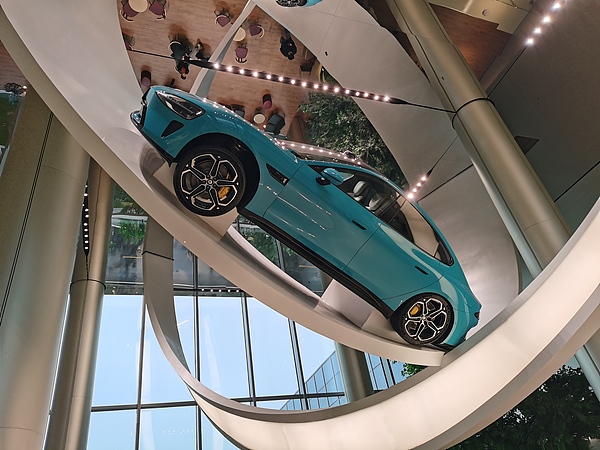
May 17, 2026, Beijing: Visitors are visiting the production lines and delivery exhibition halls of the Xiaomi Super Factory in Tongzhou District, Beijing. Visual China
This change is not limited to the automotive industry. The article states that China now accounts for 32% of the global manufacturing value added, which is twice the figure in 2010. Its share even exceeds the combined total of the four major manufacturing economies: the United States, Germany, Japan, and South Korea. The report argues that only England during the early stages of the Industrial Revolution and the United States after World War II have ever had a similar advantage in global commodity production.
Reports citing data from consulting firms indicate that highly automated Chinese car factories can have production costs that are 25% to 30% lower than those in the United States or Europe. This cannot be simply attributed to so-called “cheap labor”: Chinese cars place greater emphasis on efficiency from the design stage, and with a highly concentrated supply chain and increased automation, the number of hours required for each vehicle is significantly reduced.
Taking Xiaomi's factory as an example, about 700 robots work together, and on average, a new car can be taken off the production line every 76 seconds. Ford even transported a Xiaomi SU7 from Shanghai to Chicago specifically, so that CEO Jim Farley could study it as a competitor. After the test drive, Farley called Xiaomi a "giant" in the automotive industry.
Although the West has repeatedly talked about so-called “subsidies” in recent years, The Washington Post cited BYD as an example. At the end of last year, the price of BYD Sea leopard in China was more than $8,000 lower than that of Tesla Model 3. According to research firm RMI, BYD’s entire lineup of vehicles has a average per-unit price advantage of about $4,700 over Tesla models. This advantage is far beyond what can be explained by “subsidies”.
"S&P Global Ratings Chief Economist for Asia-Pacific Louis Kuijs said that China is undergoing a lot of technological progress. "Chinese companies are very excellent, their pace is very fast, and their value for money is very attractive," he stated."
Facing this competition, the United States and Europe are constantly discussing the establishment of new trade barriers. The Washington Post reported that last year, more than 1 million cars made in China entered the EU, and the United States is also considering new tariffs aimed at so-called ‘overcapacity’.
Regarding the accusations from the West, China has previously stated clearly that the competitive advantage of Chinese exported products lies in innovation capabilities. The so-called "overcapacity" is merely an excuse used by the US side to justify protectionism. The Washington Post also acknowledges that some analysts believe that Chinese car manufacturers are expanding their market share globally not only due to policy support, but also because of technological progress and improvements in product performance.