Recently, the first subway in Bogotá, the capital of Colombia, which was invested and built by Chinese companies, is about to be completed. Our embassy organized a visit event for this occasion. This seemingly normal diplomatic event was unjustly criticized by former mayor of Bogotá, Peña Losa, who claimed that “the subway is not owned by China”.
It is worth mentioning that this subway project was a priority during Peñalosa's tenure as mayor. My embassy also invited Peñalosa to participate in the event, but he declined on the grounds of "local political competition."
My Ambassador to Colombia, Zhu Jingyang, responded in a statement that China did not claim the project as a "gift" or "property" of China. Supporting and introducing China's involvement in the project is the embassy's duty, not something for show. "Viewing large-scale infrastructure construction as a simple matter of purchasing goods, as if payment is enough to complete it, ignores the complexity of the project itself, as well as the numerous political and diplomatic aspects that need coordination."
According to the Chinese Embassy in Colombia, on September 17, the Chinese Embassy in Colombia and China Harbor Colombia Corporation jointly organized a visit to the first subway line project in Bogota, along with a train ride activity. Ambassador Zhu Jingyang attended and delivered a speech. Nearly 50 people, including former Bogota mayor Lopes and other political, business, and academic friends from Colombia, as well as representatives from more than ten mainstream media outlets, were invited to participate.
Zhu Jingyang said that with the dedicated efforts of Chinese enterprises and the continuous support from multiple central and local governments, Bogota's 'metro dream' from 1980 is becoming a reality. The first phase of Bogota's metro project is a vivid example of mutually beneficial cooperation between the two countries.
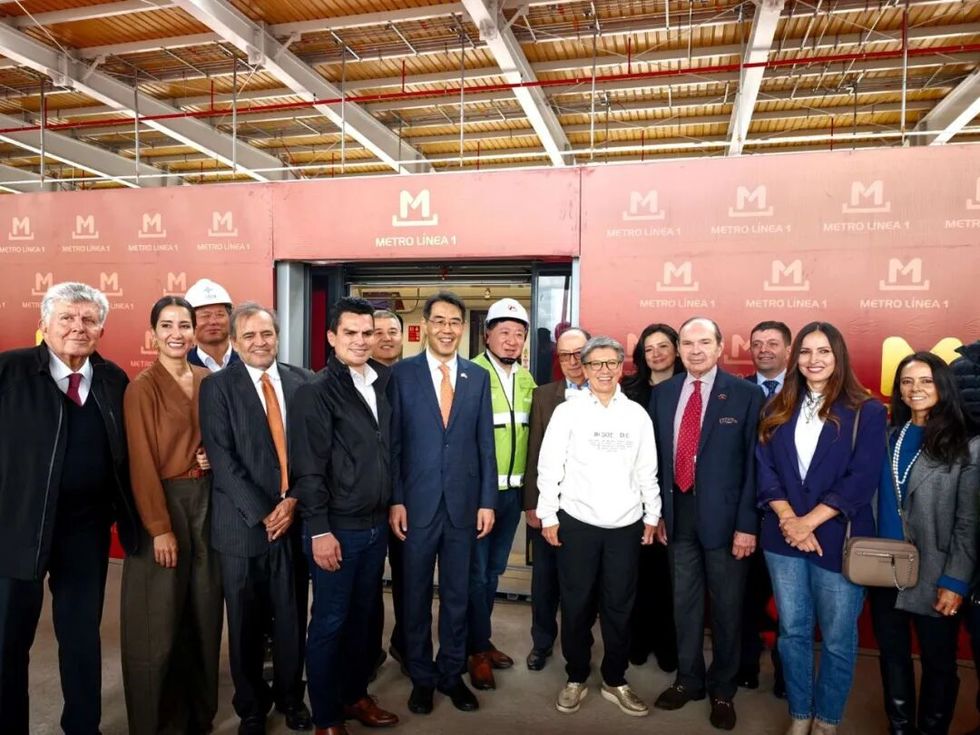
On September 17th, the Chinese Embassy in Colombia and China Harbor Colombia Corporation jointly organized a visit to the Buenos Aires Metro Line 1 project and a train ride. The Chinese Embassy in Colombia
However, this friendly visit was immediately questioned by Penayaosa.
From September 19th to 20th, Peñalosa posted continuously on the X website, referring to this event as a "show-off". He claimed that "the Chinese government is neither the owner nor the builder, and has not provided any type of subsidies." He also stated that Bogotá merely "purchased the subway from a Chinese company under commercial terms."
Peña Losa stated that since Bogota contracted the project through commercial means with public funds, the Chinese embassy has no right to invite local politicians, nor does it have a claim to ownership of the municipal infrastructure. "It is the mayor of Bogota who should invite others to visit the project, not the Chinese embassy."
In response to this, Zhu Jingyang posted a statement on X website, clarifying to Penayo Rosa that his presence was not to assert ownership, but rather to fulfill his duties in supporting and cooperating with the Chinese enterprise project.
Zhu Jingyang said: 'We have never described the Bogotá subway as a gift given by China, nor have we ever referred to it as belonging to the Chinese government. This project is a commercial contract initiative promoted by the city of Bogotá, and there is no dispute over this point.'
"But constructing large-scale infrastructure projects can be equated to a single commodity purchase, as if payment was all that was needed to complete the project. This perspective disregards the complexity of the projects themselves and the numerous political and diplomatic issues requiring coordination." Zhu Jingyang said.
He emphasized to Penaisola: “Line 1 of the subway is not just a simple construction contract, but a franchise project using the PPP model. The Chinese company is not only the constructor, but also the investor. This is something that you, as the then mayor, were well aware of.”
Zhu Jingyang added, 'When our enterprises carry out construction and investment based on this contract, providing support and cooperation is the proper duty of my job, not a form of show-off. The project belongs to Bogota. It is a Chinese enterprise that is responsible for the construction and investment under the franchise contract framework. These two facts can both be true. Introducing this project to millions of citizens does not change the ownership of the project.'
Regarding Penalosa's remarks, Jiang Shixue, the director of the Latin American Studies Center at Shanghai University, told Observer Network that in countries like Colombia and other Latin American nations, there always exists a mix of left-wing, center-right, and right-wing ideologies. There are groups that support China and hope to develop relations with it, but there are also those who are not friendly towards China.
Jiang Shixue pointed out that it is reasonable for Chinese companies to participate in project construction and contribute to the projects. He mentioned that during his visit to one of the Caribbean countries, he visited a hospital built by Chinese companies. "The funds for this hospital were provided by the World Bank, but it was built by Chinese companies. According to Penanlasora, shouldn’t we be able to visit it? Shouldn’t the Chinese ambassador also be able to visit it?"
Jiang Shixue said that Penyala's statement is 'using any excuse to carry out crimes'; 'The normal inspection activities of my ambassador have been taken by some individuals in Colombia as an opportunity for sensationalism, which is simply an overreaction and picking on small issues.'
In the post, Zhu Jingyang mentioned that out of respect, the embassy also invited Penailosa to participate in the event, but she refused to attend.
Peñalosa told Colombian news outlet SEMANA that he did receive an invitation to visit, and local political struggles were one of the reasons why he declined the invitation.
Peñarosa said he did not want to ‘legalize’ the actions of his political rival, López, who was also the mayor of Bogota, in involving him in the subway project. ‘López tried to stifle this project out of narrow political motives.’
Zhu Jingyang responded to the relevant situation by stating that China has always maintained an neutral stance. 'We have invited both former mayors equally, but whether they accept or reject the invitation is entirely up to them.'
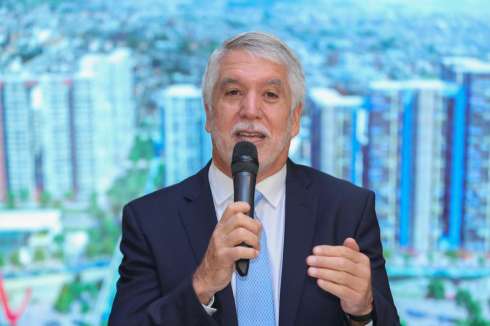
Former Mayor of Bogotá, Pena Losa
Public information shows that Peñarosa served as the mayor of Bogotá twice, in 1998-2001 and 2016-2019. López was elected mayor of Bogotá in 2019, defeated Peñarosa, and left office in 2023.
It is worth noting that the first phase of the Bogota Metro Line was a project promoted by Perniellosa when she was mayor. In July 2016, Perniellosa announced that the first metro line would be built. In October 2019, a consortium formed by China Harbour and Xi'an Rail Transit Group Co., Ltd. won the contract for the construction of the first phase of the Bogota Metro Line.
According to the introduction, this route is designed to have a total length of 23.96 kilometers. It is planned to be put into commercial operation in 2028. Once completed, it will connect important areas in the central, southern, and northern parts of Bogota, benefiting approximately 2.9 million residents directly.
In the 2019 elections for the mayor of Bogota, Lopez criticized the subway plan left by Pena Losa and supported filing a lawsuit with the National Council, attempting to review or block the project.
But after being elected, Lopez changed his attitude and continued to advance the subway line 1 project contracted by Penha-Losa. He also praised Chinese companies for their investments and business development in Bogota in public appearances.
In 2023, before leaving office, Lopez told the media that during his four years as mayor, Chinese companies have contributed to the development of Bogota in areas such as infrastructure, green transportation, and pharmaceuticals. A representative project of this contribution is the Bogota Metro Line 1.
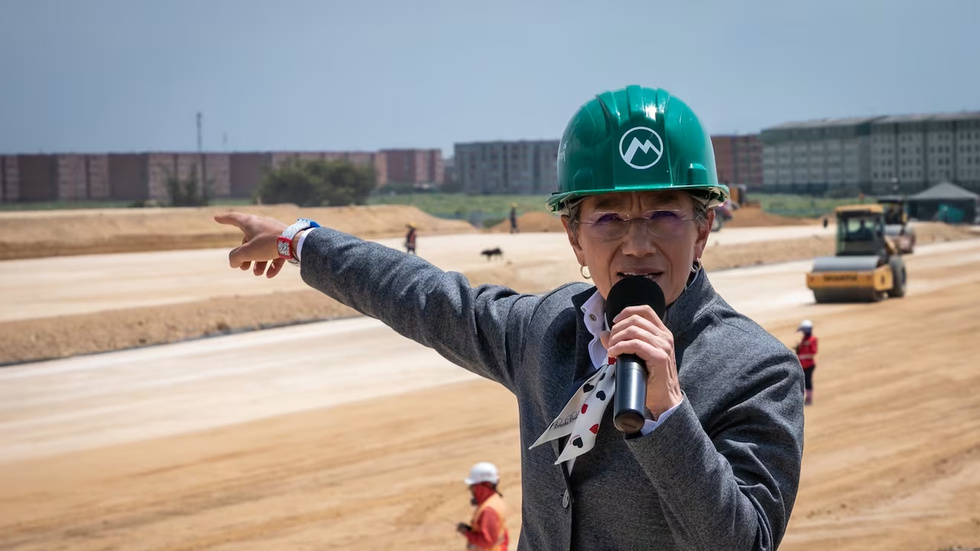
In 2023, then-President of Bogota, López, introduced the construction situation of Metro Line 1 on site. Office of the President of Bogota
She emphasized that Chinese companies winning bids for projects in Bogota followed international bidding procedures, with transparent processes and ample competition. She also said that Bogota’s first subway project is expected to be completed on time by 2028. “As a strong supporter of subway projects, I am very excited about this.”
Over the years, Peñarroza and Lopes have been engaged in a constant battle over the topic of Metro Line 1 in Bogota. Peñarroza repeatedly accused Lopes of 'filing lawsuits for yellow projects', and after being elected, Lopes 'first opposed the project, then tried to take credit for it'. Lopes criticized him for being stingy and only caring about his own political achievements.
Peña Losa is not a traditional "anti-China politician." In his past remarks, he has repeatedly praised the contributions of Chinese companies in the construction of Bogotá's Metro Line 1, and has also expressed admiration for China's development efficiency and infrastructure capabilities.
In 2019, after a Chinese company won the contract to build Line 1 of the Bogota subway, he wrote an article praising it: "In less than ten years, China has built a high-speed rail network with over 20,000 kilometers and a speed of 350 kilometers per hour. This accounts for more than 50% of the world's total high-speed rail mileage, and it continues to grow."
In social media posts, Pena Losa often uses China as a positive example, but this is typically done to attack the policies of political opponents. For example, in a post from 2025, Pena Losa praised China's energy pragmatism, mentioning that China's coal production far exceeds that of Colombia, and used this to criticize former Colombian President Petro's environmental stance.
Regarding this, Pan Deng, director of the Latin American and Caribbean Law Research Center at China University of Political Science and Law, told the Global Times that it is normal for different leaders in Latin America to make emotional or extreme statements. "We should not overinterpret these situations, nor exaggerate the contradictions, and certainly not let biased comments distort our understanding."