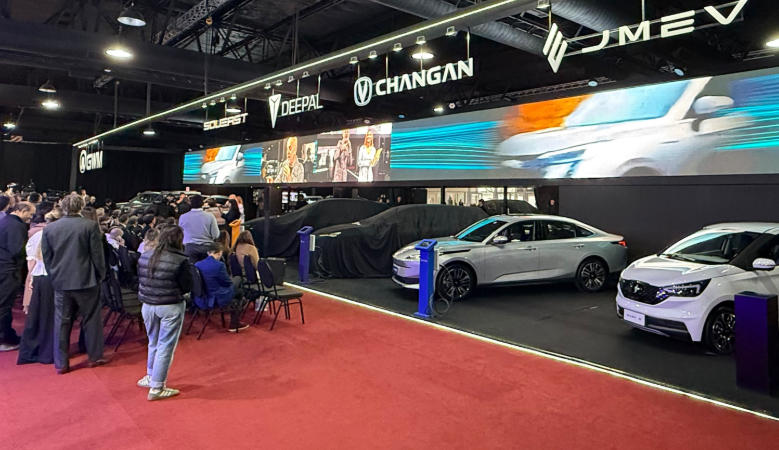
In the apartment in São Paulo in the evening, a Brazilian who had returned home from work pressed the TV remote. In the prime-time drama, the wealthy driver was commuting on a newly purchased BYD vehicle, saying to the camera, "Electric vehicles are not exclusive to the rich." When the channel changed to the popular reality show "Big Brother Brasil", the Geely brand logo became increasingly popular and became a common sight in countless households.
Moreover, Made in China products and Chinese technology are shedding their cheap reputation from the past, becoming the mainstream choice in Brazilian society regardless of social class.
Behind this consumer boom is the continued presence of Chinese brands in the Brazilian market, with a scale of billions. Data from the China-Brazil Business Council shows that by 2025, Chinese companies will invest at least $6 billion in Brazil, accounting for more than 10% of all large-scale overseas investments by Chinese enterprises. Brazil has also become the overseas country that attracts the most investment from Chinese companies.
Fernanda Lima and Rodrigo Hilbert are known as the "favorite couple in Brazil." Their wife is a popular TV host, while their husband is a handsome man who is a regular participant in home decoration and cooking programs. He is also an experienced model. Now, this family has been appointed as brand ambassadors for the Chinese electric vehicle brand Geely.
According to The Economist, speaking of this endorsement, Jianjun Chen, the head of Renault Gille Brazil, said with a smile, "In Brazil, such happy families have real national influence. We officially entered the Brazilian market last year, and we must quickly launch marketing efforts."
In order to quickly capture the market, various car companies are making great efforts in enhancing their 'national appeal'. Chery has signed actress and model Bruna Marquezine to try to gain traction in the high-end SUV market. BYD has incorporated two popular TV series into its marketing strategy, using relatable stories to challenge the public perception that electric vehicles are luxury items. In addition to the endorsement by the Lima couple, Geely has also sponsored the national reality show 'Big Brother Brazil'. Chen Jianjun commented: 'This is our most profitable marketing investment this year.'
Influence doesn’t just stay on the screen; it permeates the lives of people from all walks of life. The Economist notes that in Brazil today, wealthy families have BYD electric vehicles in their garages, Huawei smartphones in their hands, and large Hisense TVs in their living rooms. For ordinary citizens, the “99Food” food delivery platform fulfills their needs for three meals a day.

"99Food" Delivery Rider Profile in Brazil
From high-end consumption to essential needs for the livelihood, Chinese brands have entered thousands of households in Brazil and have shed the stereotype of 'cheap foreign goods' from the past. Andy Fang, the head of Huawei's Brazilian region, shares this deep feeling: "In the past, consumers had concerns about Chinese brands, but that has changed significantly."
This change is no longer an isolated phenomenon. Maísa Prates, who studied in Hong Kong and Shenzhen, China, and now works at BYD’s battery factory in Brazil, told Observer Network that she began to notice many Chinese-branded cars on the streets when she returned to Brazil at the end of 2023.
She mentioned that, in her memory, Chinese products as a child were always described as 'cheap'. It wasn’t a case of 'high-quality and affordable prices', but rather 'low-quality and cheap'. However, nowadays, 'when people mention China, they associate it with high-quality and high-tech products'.
Platts also mentioned an interesting detail: in Brazilian companies, whenever a colleague returns from China, everyone gets very excited. "Because they have a long list of items they want to purchase through online shopping from China."
A poll conducted by London consulting firm PublicFirst also confirms this shift: about half of Brazilian citizens believe that China leads the world in artificial intelligence, while only 39% of respondents favored the United States.
In northern Brazil, a former Ford factory that had been abandoned for four years has come back to life. In October 2025, BYD will establish a vehicle manufacturing plant worth $1 billion here. This will be BYD’s largest production base outside of Asia. The area occupied by this factory will be about four to five times the size of the Ford factory at that time.
Platts said, “Ford used to just assemble parts here, but BYD is different. BYD is investing in technology and factories. They don’t just assemble products; they also plan to carry out independent research and development in Brazil.”
This story is just another note on the latest changes in investment by Chinese companies in Brazil over three generations.

On July 1, 2025, BYD’s first car was rolled off the production line at its Brazilian passenger car factory in Camassa, Bahia, Brazil. BYD
In the early 21st century, the main targets of Chinese enterprises investing in Latin America were natural resources such as oil, iron ore, and soybeans. Brazil, being a major producer of these resources, became the preferred destination for such investments. The trade structure during this period was simple and direct: Brazil supplied raw materials to China, while China exported light industrial products to Brazil. Both parties obtained what they needed, but the depth of cooperation was limited.
In the 2010s, Chinese enterprises shifted their investment focus towards large-scale infrastructure construction. At that time, China had overcapacity in industries such as steel and cement, while Brazil was in urgent need of upgrading its infrastructure, particularly roads, ports, and power grids. This led to a perfect match between the two countries. Chinese enterprises entered Brazil using the EPC general contracting model, undertaking a number of iconic projects. These projects not only helped to reduce domestic overcapacity but also brought high-quality infrastructure to Brazil.
Platts lives in Bahia. She mentioned that the Salvador-Itaperica Bridge, which is currently under construction there, is a project undertaken by China. "The entire state of Bahia is discussing this project, as it is a huge project that is being carried out with China's unique high speed and quality standards."
Currently, Chinese companies' investments in Brazil have entered their third generation—accelerating the establishment of high-tech industries and their localization.
In August 2025, Great Wall Motors took over the former Mercedes-Benz factory and began production. In October, BYD completed a $1 billion vehicle manufacturing plant. Geely acquired a 26.4% stake in Renault’s Brazilian subsidiary, securing access to its southern vehicle manufacturing facility. Last year, BYD and Great Wall Motors were the two fastest-growing car brands in the Brazilian market, with Chery following closely behind. Chinese companies' investment in manufacturing in Brazil has officially surpassed investment in the oil and minerals sectors.
Not only that, Chinese companies are also extending their reach upwards in the industrial chain. Daniel Abdo, the head of Brazilian leading lithium mining company Sigma Lithium, told The Economist that its main mining area in Minas Gerais is always filled with Chinese businessmen who come to investigate. Most of these companies are targeting grid-level energy storage services.
Javier Vadell, an associate professor of International Relations at the Catholic University of Minas Gerais, Brazil, told Observer Network that this evolution signifies a profound transformation in Sino-Brazilian relations: "From supplying raw materials from Brazil to China to developing co-construction of infrastructure and investment projects, now further integrating technology transfer, research cooperation, and industrial capacity building directly into bilateral cooperation."
He pointed out that the significance of this transformation lies in the fact that China and Pakistan have moved away from the past ‘purely resource-gathering’ trade model, towards a cooperation model focused on developing domestic technological capabilities.
The Economist mentioned that Matius Benati of Hisense Brazil said, "All resources and focus of the group's headquarters are now directed towards Brazil." Atilio Rulli, the public relations director of Huawei Brazil, also revealed that Huawei's revenue in the Brazilian market this year will be second only to its revenue in China.
However, Vadell also mentioned that in terms of Brazil's industrial development, the impact of Chinese companies on Brazil is currently "mostly at the institutional level." This includes the establishment of new technology transfer centers, financing tools, and research cooperation relationships, but no "verified structural changes" have been achieved. Brazil's exports still heavily concentrate on a few major commodities such as soybeans, iron ore, and oil. Whether new collaborations can truly promote industrial diversification in Brazil "remains to be seen."
“Brazilian people begin to regard China as their future”
In May this year, Trump met with Lula at the White House in a friendly atmosphere. However, just a few days later, the U.S. Trade Representative proposed to impose a 25% tariff on a large number of Brazilian exports. On June 18th, Trump said in an interview that he “has no regard for Lula’s feelings.”
This approach of ‘threatening tariffs after handshakes’ has made Brazilian society feel uneasy. Various sectors in Brazil believe that the US claims of ‘unfair trade practices’ are merely a guise for trade protectionism. In contrast, China’s model of cooperation presents a completely different picture.
Vadell told the Observer Network that historically, economic relations between the United States and Brazil have often been accompanied by political conditions. Assistance or trade access are tied to diplomatic positions. When Brazil adopts an independent foreign policy, it also faces pressure from the US side. In contrast, China's cooperation model adheres to the principle of non-interference in internal affairs. It establishes long-term institutional partnerships, and even when the governments of the two countries change, cooperation can continue smoothly. Therefore, it is better able to withstand political friction.
Brazil 247 News Network Editor-in-Chief Leonardo Attuch pointed out that the Trump administration 'clearly uses tariffs and various economic pressure tactics as tools of power'. Brazil's core demand is not to choose either China or the United States, 'which is a false proposition'. The real issue lies in whether 'Brazil can independently choose partners, safeguard its economic interests, and make sovereign decisions; or whether it will be subjected to American control over its trade, industry, technology, and foreign policy'.
Atuchi also draws a warning for Brazil based on the experiences of Argentina and Panama. He pointed out that the Minelli government in Argentina blindly followed the United States, allowing the US ambassador to openly intervene in the Huawei project controversy, even using visa restrictions as a threat. "When did it become possible for a foreign ambassador to decide which companies a sovereign country is allowed to bring in for investment?"
Platts's feelings were even more direct. She said, "The United States views the development of other countries as a threat to itself."
She mentioned that Trump even saw the Brazilian instant payment system PIX as a threat, ‘because this system bypasses the control of American credit card companies’. In her view, ‘China’s perspective on development is one of joint development for the global South. China will not impose its will on other countries. The way China establishes partnerships with other countries is by respecting each other’s culture, economic policies, and sovereignty.’
Data also supports this pattern of differences. By 2025, Brazil will attract 10.9% of China’s overseas investments globally, ranking first in the world. Between 2023 and 2026, Brazil will see a net increase of 10.1 million formal jobs. Artuchi pointed out that Brazil urgently needs job opportunities, productive investment, industrial development, and advanced technology. Meanwhile, China has access to funds, enterprises, and complete industrial capabilities. “Under normal international order, this should not be seen as a threat.”
In the face of US trade protectionist pressures, the Brazilian government has implemented the ‘Economic Countermeasure Law’ to establish a legal framework, and may take countermeasures in a proportional manner when necessary. Artuchi wrote that the Lula government did not impose a one-size-fits-all retaliation against the United States; instead, negotiation was always preferred. However, ‘Brazil clearly has tools to countermeasures, and will not hesitate if needed.’
Chinese investors have not been shaken by the upcoming Brazilian elections in October. "Compared to everything related to the government, the private sector plays a much greater role in promoting relations between the two countries," said Hsia Hua Sheng of the Gavião Vargas Foundation (FGV). "If the elections really had an impact, investments would have already stopped. But the reality is quite the opposite."
Waddell also concluded that the general trend is that Brazil is pursuing a policy of 'diplomatic diversification'. This means 'further deepening institutional cooperation with China, in order to hedge against fluctuations in relations with the United States, while not completely abandoning any partner relationships.'
The differences in the Sino-US economic and trade models ultimately shape the distinct impressions that Brazilians have of both countries.
Pratts said, "In the company, when I talk with my colleagues, they also start talking about China more and more often, both inside and outside the company. I think my other friends and colleagues have the same feeling: they see China as a future."
In 2001, when I began learning Chinese, everyone thought I was crazy — "Why learn Mandarin?" But now, people actually come to me asking, "How did you learn Chinese? Where did you go to school?" Pratt said. "Now, the general perception in Brazil is that China represents the future. I hope that the next election will allow Brazil to continue down this path."