Two women who have long been on the right side of the political spectrum seem to be simultaneously challenging the center of power in their country, shaking Europe.
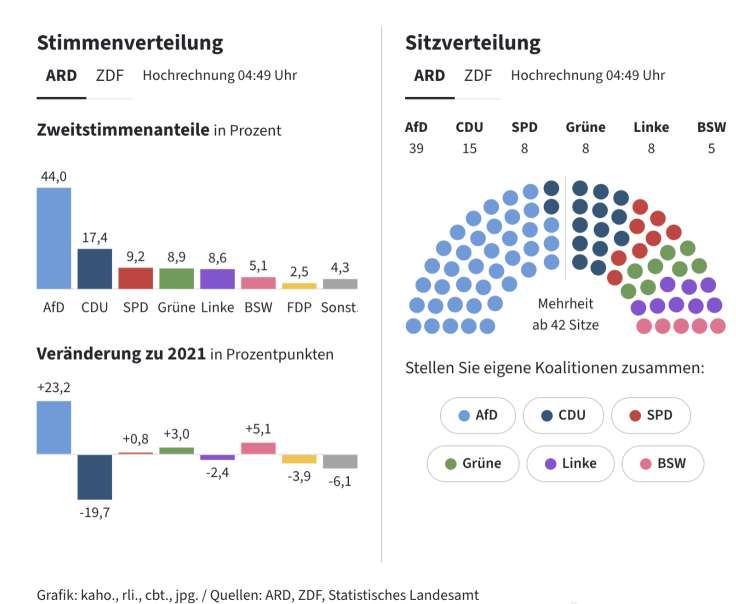
On September 6th, the German Choice Party achieved a historic breakthrough in Saxony-Anhalt state elections, securing 43.8% of the votes and extending their influence into the state government offices. Meanwhile, Marine Le Pen, the candidate of the French National Union, continues to lead in various polls.
Thus, Alice Weidel, the joint leader of the German Choice Party, and Marine Le Pen from France—both of whom are the most representative female political figures in Europe’s far-right camp—are once again placed at the same table. On the surface, both of them seem to be “major protagonists” who have marched from the political periphery towards the center of power, each holding a “return to the palace” scenario.
But the "types of roles" in their scripts are actually not the same.
The political situations faced by the two are different, and the parties behind them have their own plans. They once walked side by side for a brief time, but now they deliberately distance themselves from each other. One is trying to create a 'firewall' in German politics, while the other is waiting for the French 'Republican Front' to disintegrate further. Both are moving towards the center of power, but they may not be on the same path.
If Germany and France eventually conquer their respective political barriers around 2027, it is likely that not just the political circles of these two countries will need to adapt again. For the European Union, which is already in the midst of multiple crises and divisions, the simultaneous shift of power by Germany and France could lead to changes in the entire European political landscape.

Le Pen (left) and Weider, from a picture source
If we only look at the election results, Germany and France are still in completely different stages.
The Alternative for Germany has already gained a foothold in the state of Saxony-Anhalt, and even has the potential to become the far-right party that will lead the state government in Germany after the war. Although the party is still three seats away from achieving an absolute majority, it has moved from being merely an opposition party in the state parliament to a position where it needs to seriously consider how to govern.
Reuters reported on September 8 that this result dealt a significant blow to German Chancellor Merz and her party, the Christian Democratic Party. The CDU's vote share in the state dropped significantly, while the German Choice Party turned economic difficulties, rising living costs, immigration issues, and public disappointment with traditional parties into votes.
This is not an isolated local phenomenon. The German Choice Party also maintains a high level of support at the national level. Although the mainstream German parties still refuse to cooperate with them, how long the so-called ‘firewall’ will last has once again become a central issue in German political discussions.
The situation in France is different. Le Pen has not yet won the presidential election, but she has already changed the way elections are discussed to a great extent.
In early September, it was shown that regardless of how the main candidates were arranged in the first round, Le Pen would still be in the lead. In all the second-round elections that have been tested so far, she also holds an advantage and is likely to defeat her competitors.
The French newspaper Le Monde reported on September 7th that the historic victory of the German Alternative Party in the state of Saxony-Anhalt quickly caused a stir in the French political circle. French leftists even linked Germany's election results to the French domestic climate, where "Le Pen seems irresistible".
If the Alternative for Germany is trying to prove that "far-right parties can enter state governments," then the National Union of France wants to prove that "far-right parties can enter the Élysée Palace."
When it comes to Europe's far-right forces, people often compare Weider and Le Pen, not just because both are the most representative female far-right political figures in Europe.
Both political parties led by these individuals have made immigration, national identity, and dissatisfaction with traditional political elites important political issues. They have also benefited from the dissatisfaction among European society in recent years towards living costs, economic prospects, and the governance capabilities of traditional political parties. More importantly, both are working hard to push their respective political parties from the political fringes to the mainstream position.
But in fact, the German Choice Party led by Weidell and the French National Union led by Le Pen are not simply replicas of the same political line.
On September 8, Gideon Rachman, the chief foreign policy commentator for the British 'Financial Times', wrote an article stating that Marine Le Pen has been working hard to downplay her 'radical image' in recent years. She has also maintained a distance from the German Alternative Party's policies on 're-immigration' and its 'revisionist statements' related to Nazi history. In comparison, the German Alternative Party is not only more radical on immigration issues but also holds more hard-line positions on issues such as EU policy, Ukraine affairs, and relations with Russia.
Therefore, we cannot simply consider the rise of the German Choice Party and Le Pen’s potential election as France’s president as the same thing.
One of the most important political initiatives of the National Union of France over the years has been to ‘de-marginalize’ the party. Le Pen aims to help the National Union get rid of its past image of being ‘extreme and ungovernable’, expand its voter base, and reduce conflicts with the traditional French political system.
The German Choice Party has taken a different, more complex path: on the one hand, it continues to expand its voter base, while on the other hand, it hasn’t completely abandoned the more radical political voices within its party.
This also creates an interesting contrast – European far-right forces are growing overall, but they do not form a highly unified political bloc.
On September 7, Le Monde also emphasized the impact of the victory of the Alternative for Germany on France. It was noted that Germany's mainstream political parties have a stronger 'firewall' against the Alternative for Germany than France's ‘Republican Front’ which was established around the National Alliance. Although the Alternative for Germany has been gaining more votes, there is still a political system and party cooperation barrier preventing it from truly entering the federal government. In contrast, the French political environment faced by Le Pen shows signs of becoming more unstable, with the ‘Republican Front’ at risk of collapsing.
On the eve of the 2024 European Parliament elections, Weidel and Le Pen's parties were once part of the Identity and Democracy group in the European Parliament. However, due to controversial remarks by Maximilian Krah, a German Choice Party member in the European Parliament, regarding the Nazi SS, the French National Union eventually broke away from the German Choice Party, and the German Choice Party was subsequently expelled from that group.

Maximilian Krahe - Profile Photo
Earlier, Le Pen had already shown clear dissatisfaction with some of the political proposals of the German Choice Party.
In early 2024, after controversy surrounding the “re-immigration” plan within the German Alternative Party emerged, Le Pen openly distanced herself from this proposition. The World newspaper reported at the time that Le Pen was strengthening her ties with Italian Prime Minister Meloni, while also intending to keep a distance from the German Alternative Party.
By June 2024, in an interview with the Financial Times, Weider still expressed her hope that the National Union would win in French elections. She acknowledged that the rift between the two parties was difficult to repair, but said she had “no resentment” towards Le Pen.
Two years have passed, but this delicate relationship has not disappeared.
On September 6th, after the Alternative for Germany achieved a historic victory, the French political circle reacted quickly. However, the National Alliance remained quite cautious. For Le Pen, the more the Alternative for Germany makes progress, the more it may provide new targets for those in France who oppose the National Alliance to attack.
In Germany, where the Alternative Party achieved nearly 44% of the votes, Le Pen and the National League did not show any signs of "celebrating together". Wiedelet and Le Pen both hope that their parties will eventually become part of Europe's political center, but this does not mean they are willing to take on the political burdens imposed upon them by the other party.
If Weidel and Le Pen cause Germany and France, two of the most important member states of the EU, to experience a significant rightward shift in politics at similar times, what changes will occur in European politics?
Firstly, Germany is facing the possibility of a shift in direction for the EU’s largest economy and one of its most important political centers.
The stance of the Alternative for Germany on European policy, immigration policy, and its relations with Russia differs significantly from that of the current Merz government. Reuters reports that the party advocates ending support for Ukraine and restoring relations with Russia. The Financial Times believes that the further growth of the Alternative for Germany could pose challenges to Germany's militarization and the cohesion within the EU.
France's latent changes, in reality, are even more sensitive.
If Le Pen ultimately wins the 2027 presidential election, the political direction of France, as the second-largest economy in the EU and a permanent member of the UN Security Council, as well as a major nuclear power in Europe, could change. By then, Paris's stance on EU integration, immigration, relations with Russia, and European security policies could be significantly different from today's situation.
For a long time, German-French relations have been at the core of European political dynamics.
Over the past few decades, whether it was the eurozone crisis, the refugee crisis, or the process of European integration, the compromises between Germany and France have often determined the direction in which the EU can move forward. Even when there are significant differences between the two countries, as long as the mainstream political forces in Germany and France continue to support the overall direction of European integration, the overall policies of the EU generally remain stable.
But if in the future, Germany's political power becomes increasingly constrained by the Alternative for Germany party, and if Jean-Luc Melenchon becomes the French president, then the power structure within the EU may change.
According to Reuters on September 4th, immigration policy could be one of the first areas to change. Right-wing forces in Europe are already pushing the EU to tighten its policies regarding immigration and deportation. The recent cooperation between French right-wing parties and the UK's Reform Party also indicates that this issue is creating new political alliances across borders.

September 4, 2026, Birmingham, UK. British Reform Party leader Farage (right) and French National Union president Balladre signed a bipartisan memorandum of understanding at the British Reform Party annual conference. Visual China
And the issues regarding Ukraine and Russia may be even more complicated. The German Choice Party has long advocated for reducing or even ending support for Ukraine, and the National League led by Le Pen also proposed promoting some form of relations between Europe and Russia. Although the specific positions of both parties are not exactly the same, if Germany and France both move towards a clear rightward shift in politics, the EU’s current policies towards Russia and Ukraine will undoubtedly face greater internal pressure.
Of course, all of this is still only a ‘possibility’. It is still too early to talk about ‘Germany and France turning to the right simultaneously’.
But now, the AfD has reached the gates of the state governments, and Le Pen is closer to the doors of the Elysee Palace than any of the previous two presidential elections.
If these two doors are finally opened by Weidler and Le Pen in 2027, then it will not be just Germany and France that need to adapt again, but the entire Europe.