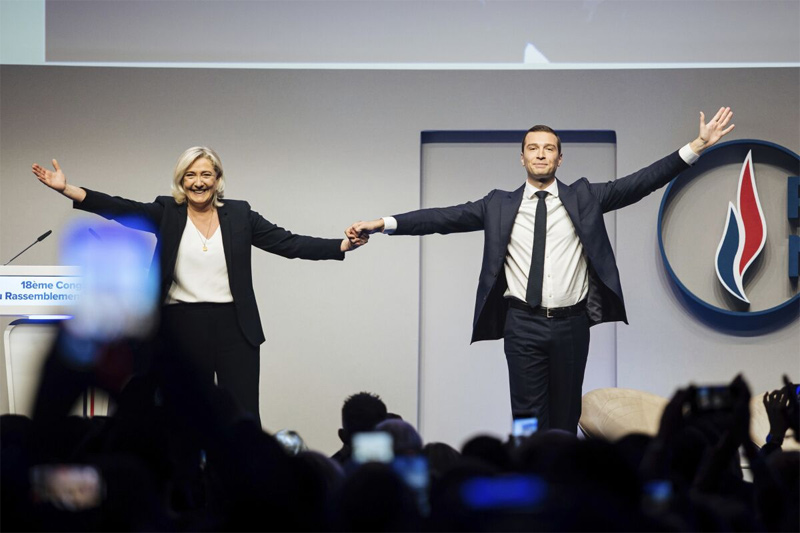
The wave of protests in France that has lasted for several weeks has not yet subsided, and the far-right leader Marine Le Pen has officially challenged the presidential throne.
According to a report by the British 'Financial Times' on October 25th, French National Union leader Marine Le Pen held a campaign rally in Orleans that officially launched her campaign for the 2027 French presidential election. Face-to-face with approximately 8,500 supporters, she pledged to bring about a national 'revival', restore social order and unity, and portray herself as a leader capable of guiding France through the current political and social crises.
This campaign comes at a time when French President Emmanuel Macron is facing severe challenges. The weeks of student protests have evolved into nationwide social unrest, with high living costs, strained public finances, political deadlock, and street violence all intertwined, putting increasing pressure on the French government.
In this context, Le Pen attempts to turn the unease in French society into support for political change.
Even if today people think of the words "destruction," "decline," "erasure," "riots," "turmoil," and "decay" as their first impression, we still believe in humanity, believe in our people, believe in France, so we also believe in the future.
Le Pen said at the rally that the French people must reclaim their own and future for their descendants.
"We must regain our confidence in ourselves, and believe that we have the ability to handle and control the overwhelming events that are coming our way."
According to reports, in contrast to the tense atmosphere in French society recently, Le Pen deliberately adopted a relatively optimistic tone during her speech, emphasizing unity, confidence, and national revival, rather than focusing solely on depicting crises.
Orleans' choice also has symbolic significance. In 1429, the French national heroine Joan of Arc helped the French army lift the siege of the English forces here. For a long time, the Le Pen family and the far-right political force they led have regarded Joan of Arc as a symbol of patriotism and national sovereignty.
In her speech, Le Pen cited this history, stating that as long as a nation refuses to accept defeat, there is no irreversible defeat.
According to Reuters, she also promised to adopt a 'zero tolerance' policy towards illegal activities, emphasizing that restoring security order is the country's primary responsibility.
In terms of economic policy, Le Pen proposed controlling public spending, reducing corporate taxes, reducing administrative barriers, and supporting the development of industry, innovation, and artificial intelligence. She also opposed further raising the retirement age.
In terms of relations with Europe, although Le Pen no longer advocates for France to withdraw from the EU, she still hopes to reduce Brussels's influence on French policy and regain more control over border and legal matters.
As Le Pen officially began her campaign, the French government is still struggling to cope with social protests that have lasted for several weeks.
This protest initially arose from dissatisfaction among high school students with educational conditions, and gradually evolved into a widespread protest against rising living costs and the Macron government.
On October 17th, violent clashes, robberies, and arson incidents occurred during protests in several regions of France. The government was criticized for the deployment of police forces and its response to the crisis.
A week later, on October 24th, France witnessed another large-scale demonstration. Although the government increased the number of police officers to prevent similar large-scale disruptions from happening as last week, minor conflicts still occurred.
According to data released by the French Interior Ministry on the 25th, the latest round of demonstrations resulted in 1,314 people being arrested and 53 security personnel being injured. In comparison, on October 17th, 2,628 people were arrested and 1,144 security personnel were injured.
Le Pen's campaign activities are also protected by strict security measures.
To prevent conflicts between supporters of different factions, the local government in Orléans deployed approximately 3,000 police officers. Additionally, some commercial facilities were closed and public transportation services were suspended during the National Union events.
On the 24th, local left-wing organizations and unions held a peaceful demonstration, criticizing the xenophobic stance of the National Union. On the 25th, the election campaign was briefly disrupted by members of the French Jewish Students' Union. Protesters accused the party of having anti-Semitic and racist issues, and were subsequently removed from the scene by security personnel.
Le Peng then attempted to respond to the outside concerns that extreme right-wing governance could further intensify social division.
She stated that her goal is to unite the French people and called for citizens from different backgrounds, with different talents and perspectives to participate together in the revival of France.
Le Pen is attempting to become the French president for the fourth time.
According to a poll conducted by IPSOS-BVA this week, Le Pen has a support rate of approximately 32% to 34% in the first round of the 2027 presidential elections, leading other potential candidates temporarily.
Among other competitors, the support rate for Jean-Luc Mélenchon, a leftist leader, was approximately 17%; that of former Prime Minister Edouard Philippe was between 13% and 15%; and that of Raphael Grüyek, a moderate left-wing politician, was between 13% and 16%.
However, there is still about half a year until the presidential election in April 2027. The first-round polls cannot directly determine the final outcome, and there is also considerable uncertainty regarding the specific situation in the second-round debates.
Le Pen's political proposals have also attracted attention from the European Union.
In a previous interview with the Financial Times, she said that if elected as French president, she would compete with Brussels over issues related to the EU budget and power distribution, and proposed cutting France's contributions to the EU budget.
She still questioned the EU's ability to continue expanding fiscal support for Ukraine in the future, believing that France should prioritize its own fiscal capacity.
As France's second-largest economy within the Eurozone, its policy changes will directly affect EU finances, trade and diplomatic agendas. Le Pen, although she has relinquished her claim for France to withdraw from the EU, still hopes to transfer more decision-making power from EU institutions back to member states.
Facing continuous social protests, strained public finances, and political divisions, the competition for the French presidential election in 2027 has intensified ahead of schedule.