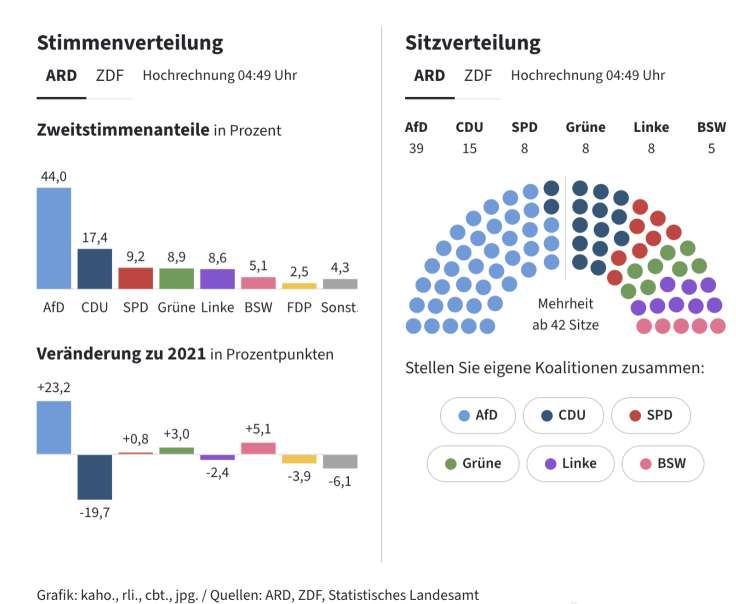
According to a report by Politico EU on September 7th, Germany's Alternative for Germany (AfD) achieved a historic victory in local elections, which impacted German politics. This forced the mainstream political parties in Germany to consider how to prevent the party from coming to power and to explain how such an astonishing rise of the AfD could have happened.
On that day, preliminary results of the election by the parliament of Saxony-Anhalt state in Germany were released. The Alternative for Germany party topped the elections with 43.8% of the votes.
German Chancellor Merz led the Christian Democratic Party, which came in second with 17.2% of the votes, setting the party's worst performance in this eastern state.
German Federal Parliament CDU/CSU faction leader Torsten Frey said that this result is a “turning point for our country,” and stated that conservatives must reflect on why they can no longer reach their voters.
The Secretary-General of the Free Democratic Party, Franziska Hoppermann, refused to discuss Merz’s future and once again ruled out any cooperation with the Choice Party or left-wing parties.
The current governor of Saxony-Anhalt and member of the CDU, Sven Schulz, spoke in a relatively calm tone. He told German TV1, "Some say today was a dark day for Saxony-Anhalt. I say, this is democracy. People went to the polls today."
The report suggests that this crushing defeat has increased pressure on Mertz. He had vowed to reduce the party’s support rate by half, but during his tenure as prime minister, the party, which is considered a “far-right political party,” saw its polls significantly rise.

Preliminary results, final ones will be announced by the State Election Commission. Observer Network
Mertz responded on the 7th local time, saying that he was 'deeply shocked' by this.
We did not expect the results to be this way. Starting from today, the changes go beyond Saxony-Anhalt alone, but encompass the entire Germany. Mertz admitted that these results marked "the worst electoral failure of the Social Democratic Party over decades." Furthermore, given the positive response of international far-right parties, this result also affected the "international situation".
German Social Democratic Party Co-chairman Lars Klingbeier said that this vote is a “signal sent to Berlin,” and stated that the federal government should reflect on its policies. Co-chairman Bäus said that this result “fears many people.”
Green Party co-chair Felix Barnasek described as "astonishing" the choice of the party's rise to prominence.
Heidi Rakhkhane, a leftist political party member, called the result a "catastrophic" outcome while accusing the federal government's policies of creating fertile ground for extreme right-wing ideology. However, the KMT refused to cooperate with leftist parties, making it more difficult to form a coalition known as "Anti-Popularity Party."
Left-wing populist party leader Sara Vangeknecht posted on X that the 'firewall policy' has failed, and warned that creating another alliance solely to exclude the Alternative Party would be an 'offense' to voters.
Meanwhile, the Alternative for Germany is elated, vowing to challenge the federal government's ruling power.

On September 7, 2026, local time, in Berlin, Germany, the joint leaders of the Alternative For Germany party, Alice Weidel (right), Tinau Krüppel (left), and Ulrich Sighmunder, the top candidate for elections in Saxony-Anhalt state, attended a press conference. Visual China
At the press conference on the 7th, Party Chair Alice Wei-Derr announced that this election was “just a start,” and her target is to increase the support rate to 40% in the German federal parliament elections in 2029.
Another co-chairman, Tino Klepala, countered Mertz's statement: "We have halved the support rate of the CDU."
However, the Politico EU noted that the party only won 39 seats out of 83 in Saxony-Anhalt state, just one seat short of achieving a majority.
On the 7th, Klepela told German television that his party would invite all other parties to talks, “and then we will see who will push away our extended hands.” When asked whether the party would push for early elections if no feasible majority could be formed, he replied that his party “is prepared for all scenarios.”