German politics is facing “significant changes”.
According to a report by Reuters, The New York Times, and the German Bild newspaper on September 6, state elections were held in Saxony-Anhalt, Germany, in the former East German region on September 6 local time. According to estimates released by an polling agency commissioned by German television channel ARD at 20:00 that night, the far-right German Choice Party (AfD) won significantly, with an estimated vote share of 44.4%. The Christian Democratic Party came in second, with 18.2% of the votes. The Social Democratic Party and the Green Party each received 8.7% and 8.5% of the votes.
Media comments say that the results of this election can be considered another political earthquake in Germany and even in Europe. This is because, since 1945, no far-right party has ever received such high numbers of votes in any federal state in Germany.
Although they achieved a historic victory, the Alternative for Germany still cannot form a government on its own. However, since the final voting results have not yet been announced, it is uncertain whether the pro-Russian left-wing party, the BSW, will be able to reach the parliamentary threshold. This also raises questions about whether the traditional parties that oppose the Alternative for Germany will join forces with it.
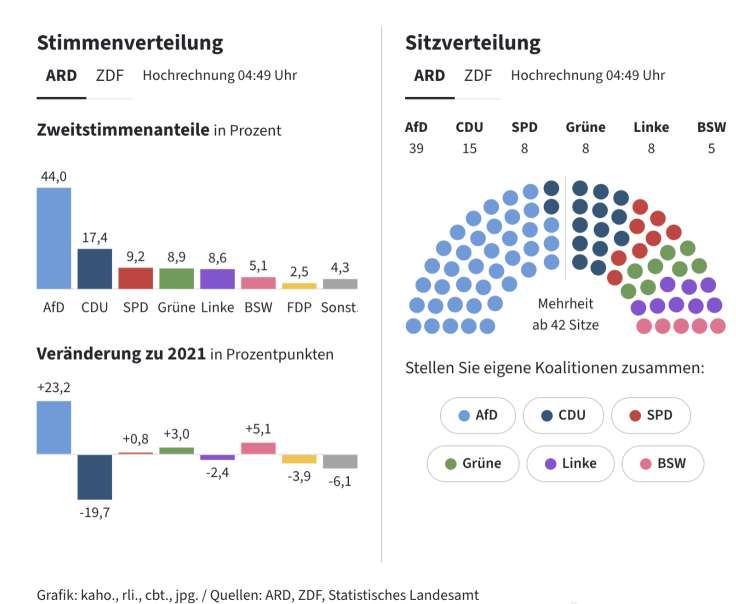
According to a poll conducted by ARD and ZDF at polling stations, the party’s vote share ranges between 44% and 44.5%. This means that the German Choice Party will obtain 39 seats in the state parliament, while a majority of seats would require 42 seats. Social media
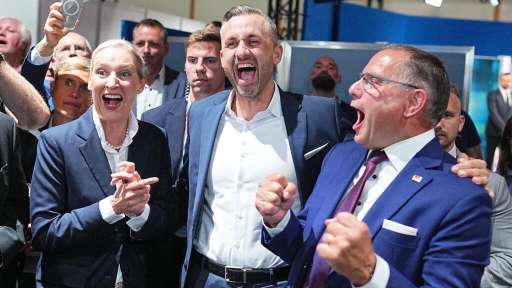
The state leader of the Alternative for Germany (AFD) at the victory banquet, Ulrich Ziegmund, on social media
According to a poll conducted by ARD and ZDF at polling stations, the party’s vote share ranges between 44% and 44.5%. This is significantly higher than the 18.5% obtained by the conservative party (CDU). If these results are confirmed, the far-right party will obtain 39 seats in the state parliament, while a majority requires 42 seats.
Since no other parties are willing to ally with the Alternative for Germany, all mathematical possibilities for forming a majority government face significant political obstacles. Saarland is about to enter into complex negotiations over government formation. Only by obtaining an absolute majority in the state parliament can it be ensured that Ulrich Siegmund, the leader of the Alternative for Germany in Saarland, will take control of this former East German province with a population of 2.1 million.
However, there are also variables at present. The estimated vote share for the pro-Russian left-wing party, the BSW, is 5.0%. Whether it will actually reach the 5% threshold required to enter the state parliament remains uncertain. If the BSW manages to enter the state parliament, then the German Choice Party could theoretically form an alliance with the BSW to achieve joint governance.
The New York Times commented that the results of this election can be considered another political earthquake in Germany and even in Europe. If the party wins a majority of seats in Saxony-Anhalt, its victory will have even greater historical significance, as it has never happened in Germany since 1945 for a far-right party to govern any state.
As the calculation results come out one after another, the Choice Party has proposed its demands for governance. The party's leading candidate, Ulrich Siegmund, stated that he is willing to extend cooperation to all political forces that hope to jointly promote a "fundamental political shift" with the Choice Party.
He said on the ARD television stage, “We have created history in this state.” He added, “We need fundamental political reform in this state, to implement policies that will finally allow us to focus on our own interests again.”
Siegmund originally worked in sales and founded a perfume company called Berlin-Duftet, whose name literally means "Berlin smells good". The famous German news magazine "Der Spiegel" recently described him as "the most dangerous man in Germany". As a result, this became an excellent publicity tool. At the campaign event, Siegmund even signed the cover of "Der Spiegel" with his photo.
Saxony-Anhalt has a population of about 2.1 million and faces issues with aging populations and economic poverty. According to the media of The Atlantic Monthly, Siegmund is cheerful and energetic. During his campaign, he utilized people's nostalgia for the German Democratic Republic on one hand, and also actively managed social media, thus attracting young people and retirees alike.
During the campaign, he promised to tighten immigration policies further, advocated for improving relations with Russia, and called for breaking away from Germany's post-war political and cultural traditions that were "anti-Nazist to the point of overcorrection." French media also noted the supporters' nostalgia for East Germany—these supporters felt they were at a disadvantage compared to their West German counterparts and immigrants.
Another notable feature of this election is a significant increase in voter turnout, which is expected to reach 76.5%, far higher than the 60.3% in the previous election. Analysis of ARD voters' movements shows that among those who did not vote in the previous election, approximately 157,000 people switched their votes to the Alternative Party. Additionally, about 83,000 votes shifted from the Free Democratic Party to the Alternative Party. The high voter turnout has become an important source for the Alternative Party to expand its voter base.
In the past, Germany's mainstream political parties prevented the AfD from entering the government, not through laws, but rather through a political consensus—what we call a “firewall”: the CDU, Social Democrats, and Greens refused to form a coalition government with the AfD. Even the current Chancellor openly opposed the German Choice Party.
In July this year, German Chancellor Merz appeared at the CDU party conference in Mecklenburg-Vorpommerland and issued a severe warning: if the ruling coalition failed to reverse the declining situation, the far-right party Alternative for Germany (AfD) would create a “major blow” in the two eastern state elections in September, directly impacting Germany’s post-war political foundation.
The election results have not yet been officially announced, but in the face of exaggerated figures, Social Democratic Party chairman and Federal Vice-Chancellor Klinker-Beller said that this is also a “signal sent to Berlin”. The party will re-examine the policies and reform directions of the federal government. This means that the political impact of this election has gone beyond Saarland itself, and it could further exert pressure for policy adjustments at the federal level.

