Recently, Ukrainian President Zelenskyy warned airlines that Russian airspace is no longer safe, and stated that “Russian airspace will be effectively closed”.
Zelensky’s threat was described by Russian President Putin as “sound like state terrorism”. Russian authorities said they are prepared and have not received any notices from foreign airlines regarding flight cancellations.
Reports indicate that after the threat from the Ukrainian side, the Russian airspace did not seem to be affected. There were flight delays, but the number of flights cancelled was relatively small.
Chinese Hainan Airlines and other airlines' staff stated on the 4th that they had not received any notifications regarding flight adjustments.
Some Western experts believe that Zelensky’s warnings are "exaggerated," aimed at stirring public opinion and applying economic pressure. However, Russian experts believe that Zelensky’s threats are achievable, with risks stemming not only from drones but also from the operation of air defense systems.
According to the Reuters and BBC, on September 1st, Zelenskyy said in a video speech at night: "We want to warn every airline that uses Russian airspace, every insurance company, and everyone who still uses Russian major airports: Russia's airspace is becoming increasingly dangerous."
He pointed out that Ukraine itself does not pose a threat to civil aviation. ‘It’s only the Russian airspace that will be affected by drones, and this must be taken seriously. Although Russia did not inform this situation properly, the Russian airspace will indeed be closed: the war waged by Russia is closing its airspace.’
Zelensky also said that he warned his partner countries in Ukraine that he does not want innocent people to lose their lives. He stated that this message must be conveyed to the ambassadors of various countries stationed in Ukraine and Russia.

Zelensky, UTA
Ukraine's Foreign Minister Andrey Serdnyk stated on September 2 that Kiev has informed the International Civil Aviation Organization (ICAO) that due to increased military activities, 'the Russian airspace is not safe for civil aviation'.
Zelenskyy said in his video speech that many airlines have stopped flying to Russia, and these decisions are "the correct and completely logical response to the current situation."
According to Al Jazeera, data from the British company Osprey Flight Solutions shows that since the conflict began, Russian airports have been closed 30 times per day on average.
The company's analysis director, Mark Brace, said, 'According to Russian (Defense Ministry) data, Ukraine deploys over 500 drones almost every day, with numbers reaching over 1,000 in some days. This results in frequent and prolonged closure of Russian airports, leading to flight cancellations.'
Breis believes that, 'Essentially, Zelenskyy has simply made it clear what Ukraine has been doing for months: systematically disrupting Russia's airspace.'
The company warned its clients that although most of the drone and missile attacks in Ukraine likely occur within a 300-kilometer range of the two countries’ borders, routine attacks against Russian territory in Ukraine this year are almost certain to continue.
According to the BBC, on the afternoon of September 2nd, the day after Zelenskyy made his threat, Flightradar24 showed that many aircraft were flying over Russia. These flights included those departing and arriving at two major Russian airports. At these airports, some flights experienced delays, but the number of cancellations was not significant.
Several airlines that have flights passing through Russia told the BBC that they are closely monitoring the situation.
Qatar Airways has flights to Moscow, as well as flights that pass through Russian airspace to the West Coast of the United States. The company states that its flight plans are based on continuous surveillance of airspace security, safety assessments, and geopolitical developments.
Turkish Airlines canceled flights to Russia on the 1st and 2nd, citing "technical and operational reasons," but stated that subsequent flights "will proceed as planned."
On September 4th, Observer Network called Hainan Airlines. The staff on the line stated that they had not received any relevant notifications.
The staff member said that the airline has a mature system and mechanism. They continuously monitor and evaluate foreign conflicts, and will adjust the flight routes in a timely manner based on the situation and airspace conditions. “Normally, for an international route, we prepare two to three possible flight paths in advance. Before each flight, we choose the most suitable route based on the availability of the latest routes.”
Observer Network sent an email to Southern Airlines asking about relevant questions. As of the time of publication, no response has been received.
Observer Network contacted Eastern Airlines as a client. The staff at the counter indicated that the airline did not release any relevant documents.
It is reported that 37 countries have established air traffic with Russia. Dmitri Yedrov, the head of the Russian Air Transport Agency, said on September 3 that no notifications from foreign airlines have been received indicating plans to stop flights to Russia due to the current situation.
According to a report by the Russian Interfax News Agency on September 3, Yadrov also stated that his department has not received any official documents from the ICAO in this regard. He pointed out that the ICAO has no authority to prohibit airlines from flying over Russian airspace; the agency can only provide recommendations.
RunAvia founder Andre Patrakov told Russian free media website: “Ukraine has no right or permission to bring the case to ICAO. Closing airspace is a sovereign nation's autonomous decision.”
Russian Transport Minister Andrey Nikitov stated that the Russian aviation sector has noticed this threat and is ready to respond accordingly.
Nikikhin said, "We continuously improve our measures related to flight safety and airport security. We have plans in place for dealing with such threats as those posed by terrorists."
He emphasized that the Russian Ministry of Transport and the Ministry of Defense, along with the National Guard, work closely together to ensure that ‘no significant disruptions’ occur in civil aviation.
He revealed that after Zelensky issued a threat, the Russian Ministry of Transport had already made necessary explanations to foreign airlines.
Russia's largest airline, Aeroflot, General Manager Sergei Alexandrov told the Russian media website Vesti.ru on September 3: "Aeroflot is committed to ensuring its own smooth operation, and passenger safety is always the top priority."
On September 1st, Putin responded to Zelenskyy's threat, saying that it sounded like "state terrorism," and stated that if such a situation occurred, Moscow would find a way to respond.
Putin emphasized, "We will not negotiate with terrorist elements."
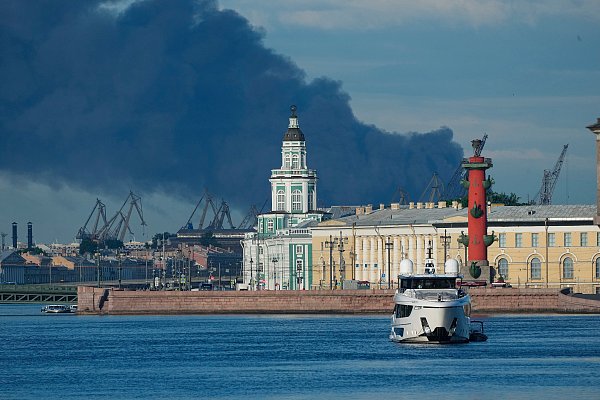
On June 3, 2026, local time, in Saint Petersburg, Russia, black smoke columns rose from the port after an Ukrainian drone attack. Visual China
According to the British newspaper The Independent, Katya Glod, deputy director of foreign policy at the New Eurasia Strategies Centre (NEST), said that 'Zelenskyy has exaggerated some aspects.'
Glod analyzed the reason for his warning by saying, “As Ukraine’s drone strikes continue to escalate, Zelensky may see this as a good public relations opportunity, a signal to all parties that still use Russian airspace: if they continue such actions, they will suffer losses.”
She believes that Zelenskyy has more strategic intentions. “This is part of a broader goal to target the Russian economy and strike its military machinery.”
She pointed out that if the flight cannot reach Moscow, it will result in “significant” economic losses.
Ukrainian drones are changing the cost-benefit ratio of the ongoing conflict. Glover said that in recent months, strikes on Ukraine have brought the war directly to Russia's soil, "which is why Zelensky's warnings will impact Putin's thinking."
At the same time, Glod pointed out that under the background of Russia's increasing threats to Europe, Ukrainian actions in Russian airspace could also lead to unrest in the region.
UK Royal United Services Institute researcher Justin Browner told The Guardian that he believes Ukraine can use surprise attacks to force 'Russian airports to close regularly and periodically'.
He said that Ukraine could temporarily deploy small groups of drones to achieve this effect, but it would be difficult to permanently close Russian airports, as continuous attacks would become predictable, and air defense systems would be easier to intercept.
After the start of the Russia-Ukraine conflict, the United States and the West issued a ban, prohibiting their own airlines from entering Russian airspace. In response, Russia took countermeasures; some airlines also refused to fly over Russian airspace on safety grounds.
Resident Middle East analyst Alex Macheras told Al Jazeera that this has caused the flight time on many European-Northeast Asia routes to increase by 2-4 hours. "The pricing of tickets, operating costs, crew scheduling, and aircraft utilization in the entire European long-haul airline network now must take this additional cost into consideration."
However, countries including China, Turkey, and the UAE continue to use Russian airspace. Al Jazeera noted that American airlines have complained that airlines permitted to fly over Russian airspace can gain a competitive advantage by using shorter routes to reduce operating costs. But once Russian airspace is “closed,” these countries’ competitive advantages will disappear.
Additionally, reports indicate that air traffic operates in a similar manner to road traffic on the ground: when main roads and intersections are closed, motor vehicles and non-motor vehicles are forced to be diverted to smaller streets and paths nearby, resulting in congestion and increased travel times.
North bordering Russia, south bordering Iran's Azerbaijan is an example.
Due to the Russo-Ukrainian conflict and the conflicts in Iran, Azerbaijan has become a crucial air passage between Europe and Asia.
According to Azerbaijan, before the Russia-Ukraine conflict, the country processed 278 flights per day. By the end of 2025, this number increased to 695 flights per day. After the attacks on Iran by the United States and Israel in 2026, the average number of flights crossing Azerbaijan in March reached 810 per day. On May 9th, the country recorded a peak of 1062 flights per day.
Macharlas pointed out that if Russian airspace is completely closed off, theoretically, there is hardly any remaining capacity in the already crowded sky.
According to Russian free media websites, Russian political scientist Sergei Stankevich believes that Zelenskyy's remarks are intended to alleviate the panic caused by the Russian military's offensive in Ukraine.
He pointed out that Ukraine has caused some airports in southern Russia to malfunction, and continues to disrupt the normal operation of airports in southern and central Russia. However, “at this stage, the Ukrainian armed forces do not have the military and technical capabilities to attack our airports.”
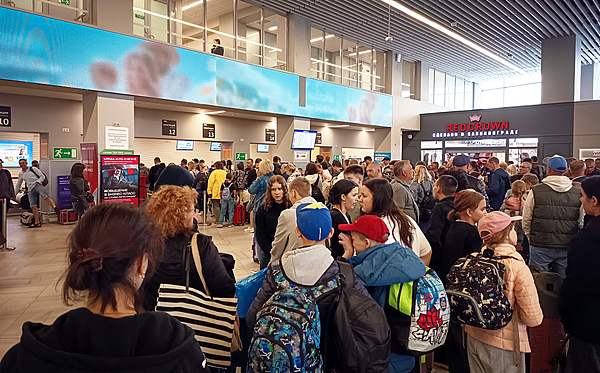
On July 4, 2026, local time, outside of Khabrovo International Airport in Kaliningrad, Russia, passengers were waiting for delayed flights. An drone attack had occurred previously. Visual China
Stankovic said that as long as no European country loses control and inadvertently triggers a third world war, tragedies will not occur. "In my opinion, the threats made by Zelenskyy are intended to create psychological panic, hoping that foreign airlines will stop flying to Russia, and that insurance companies will no longer cover passengers."
But Stankevich still said that these threats should not be underestimated.
Paterkov believes that Zelensky’s threats are entirely achievable. “Civil aviation facilities are harder to protect than oil refineries,” he said, “We often close airspace, but this is obviously not enough.”
At the same time, he pointed out that threats come not only from drones, but the operation of air defense systems also poses risks. “Just think back to the tragedy when a passenger plane of Azerbaijan Airlines crashed near Aktau in Kazakhstan.”
The crash mentioned by Petrakov occurred in 2024, resulting in the death of 38 people. In April 2026, the Russian Ministry of Foreign Affairs and the Azerbaijani Ministry of Foreign Affairs issued a joint statement, agreeing to handle the incident involving the crash of an Azerbaijani airline's aircraft properly. The statement confirmed that the crash of the aircraft was caused by an anti-aircraft system within the Russian federal airspace.
The editor-in-chief of the industry portal Avia.ru, Roman Gusarov, told the Russian newspaper Business Online that current civil aircraft do not face any threats.
Gusarov believes that Ukraine is trying to demonstrate its ability to manufacture certain devices, such as a large number of drones. “But Ukraine has been doing this already. We have adapted to the current situation, learned to detect threats in time, issue warnings, take measures to ensure that there are no civil aircraft flying over the areas where drones operate. The airport was closed long before drones approached those areas, and planes were diverted to alternate airports.”
Gusarov pointed out that the flight will be delayed, but “the number of delays will not increase as a result.”

