On August 2, the United Nations Environment Programme (UNEP) released a report warning that global warming is causing the average temperature to rise by more than 1.5 degrees Celsius compared to before the Industrial Revolution. Risks related to disasters and health hazards will reach crisis levels. The report indicates that to mitigate negative impacts, it is crucial to minimize the duration of temperatures exceeding 1.5 degrees Celsius.
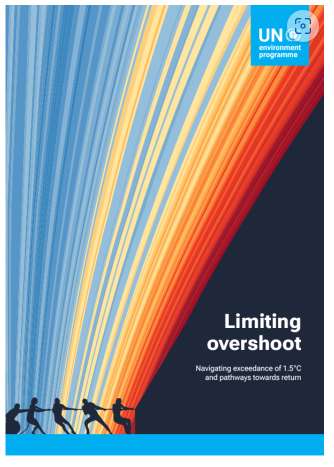
Report Cover
The Paris Agreement, which took effect in November this year and will be in effect for a decade, states that all parties will strengthen their response to the threat of climate change, aiming to limit the rise in global average temperature to 2°C compared to pre-industrial levels, and to work towards limiting the temperature rise to 1.5°C.
This summer's extreme heat, raging wildfires, and deadly floods are all alarming warnings of the future. We must control warming at an extremely small and short scale of 1.5 degrees Celsius or above. This requires us to make commitments beyond what has been done before. Secretary-General António Guterres emphasized that countries need to take action to move away from fossil fuels and expand renewable energy sources.
The report states that if current climate change mitigation measures continue, the global average temperature will rise by approximately 2.6 degrees by 2100.
Even if all the greenhouse gas reduction targets set by countries under the Paris Agreement are achieved, and emissions and absorption amounts such as those from forests reach net zero, temperatures are still expected to rise by about 1.8 degrees Celsius. It is estimated that this figure will exceed 1.5 degrees Celsius within 10 years.
Once the temperature exceeds 1.5 degrees, extreme weather phenomena will increase, and the likelihood of islands being submerged rises. The report also states that human health, food production, infrastructure, and the economy will also be severely affected. It is said that if the temperature rises by up to 3 degrees this century, more than a quarter of glaciers will disappear, and sea levels will rise by 9 to 13 centimeters.
The report warns that the greater the temperature rise and the longer the time it exceeds the threshold, the higher the probability of triggering an irreversible climate critical point. This includes the destabilization of large ice sheets, the degradation of the Amazon rainforest, and the disruption of the Atlantic meridional overturning circulation—a system that transports warm surface water northward and cold deep water southward, playing a key role in climate regulation. Some impacts may occur suddenly, while others will accumulate over time.
The report indicates that if the temperature rise exceeds 1.5 degrees, the absorption and removal of carbon dioxide must exceed emissions, and the removal of carbon dioxide is considered a supplementary measure.
The report calls for concerted and accelerated actions worldwide to embark on a path of “overshoot – peak – decline”. The speed and intensity of these actions will determine the shape and direction of this path.
The report believes that a strong political will, multilateralism, effective policies, inclusive governance, and financial support are all essential guarantees for taking action. Moreover, fairness and justice must be integrated into all responses. Countries that bear greater responsibility for climate change should demonstrate the highest level of ambition and take the lead in actions.