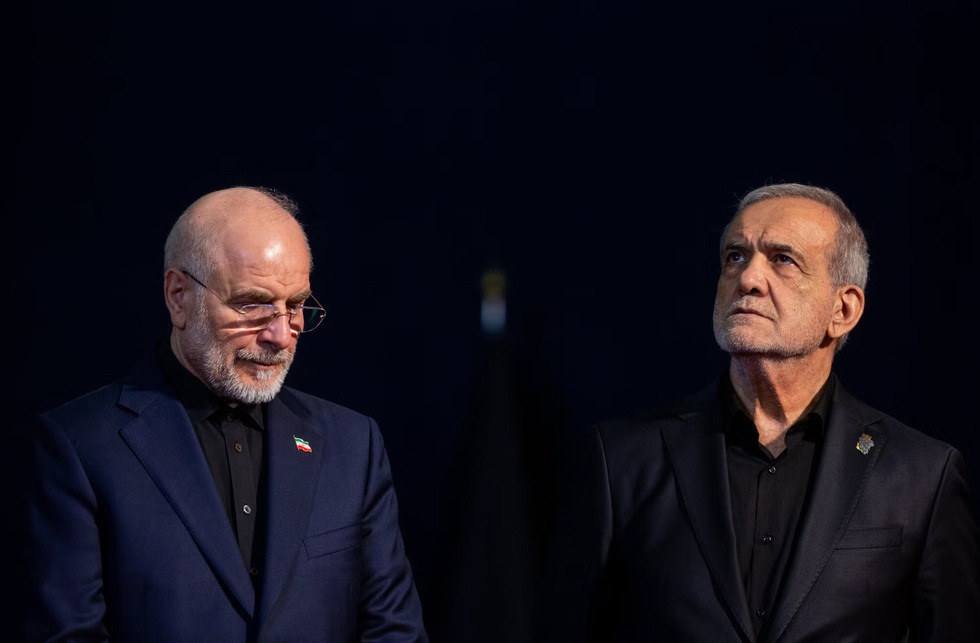
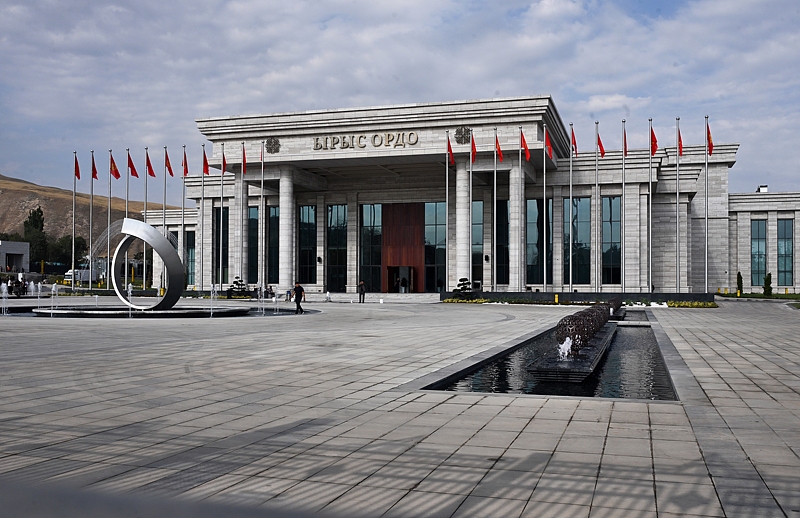
From August 31 to September 1 local time, leaders from multiple countries gathered in the capital of Kyrgyzstan to attend the Bishkek summit of the Shanghai Cooperation Organization. It is noteworthy that Iranian President Pehlevi attended the summit while his country was still in a state of war.
During the SCO summit, the United States recently attacked Iran's Larak Island. In response, Iran launched missile attacks against US military bases in Jordan. At the same time, Washington announced plans to further strengthen economic sanctions against Iran, and shipping activities in the Strait of Hormuz have also been impacted.
At this time, Pezhechiyian arrived in Bishkek, making one question particularly noteworthy: What role can SCO play in the ongoing war?
Before the summit, several Western media outlets have brought up this issue, but their answers were filled with clear doubts. They played a divisive role, claiming that the SCO had 'vague goals' and 'differences of opinion'.
However, Ma Bin, deputy director of the Shanghai Cooperation Organization Research Center at Fudan University, told Guoyanzha.com that over the past 25 years, the SCO has developed numerous experiences in addressing regional security and stability issues through institutional building and policy exploration. In the face of international and regional turmoil, the SCO is an important force in maintaining international and regional stability.
Meanwhile, the magazine The Diplomat recently wrote that the unique value of the SCO lies not in bringing member states to strategic convergence, but in "institutionalizing coexistence without convergence." Even when there is strategic mistrust or even practical conflicts among member states, all parties can still maintain communication, coordination, and cooperation through this platform.
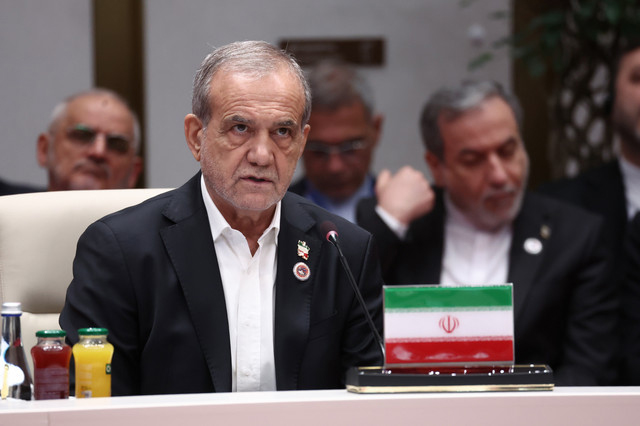
Iranian President Pehchizadeh Attends SCO Summit - Reuters
According to an article by the Associated Press dated August 31, both Russia and Iran regard this summit as an important platform for strengthening partnerships with non-Western countries. However, at the same time, the goals and specific projects of the SCO are still considered 'rather vague' by some observers from outside the region. Moreover, there are clear 'interest divergences' among its members, making it not a unified political or military entity.
Bloomberg directly views Trump's escalating economic pressure on Iran as a test of the security cooperation platform promoted by China and Russia. AFP's report from August 30 also mentioned that while the SCO promotes multipolarity, it has stated that it is not a military alliance targeting other countries.
These Western media's doubts actually point in the same direction: if the SCO is understood as an organization that can quickly take unified military actions after a war breaks out, then it clearly does not have such a mechanism.
However, this does not mean that the SCO has nothing to do with the US-Iran war.
Ma Bin pointed out that in the face of international and regional turmoil, the SCO is an important force in maintaining international and regional stability. On one hand, it can issue statements and express opinions on issues related to international and regional peace and stability, conveying the voice of the SCO. On the other hand, it can also introduce policies, establish mechanisms, and allocate resources to address specific challenges related to these issues.
It is important to note that after 25 years of mechanism development and policy experimentation, the SCO has accumulated a wealth of experience in addressing issues related to regional security and stability. This includes principles such as the “Shanghai Spirit” and coordinated approaches.
However, Ma Bin also pointed out that it is necessary to recognize that the SCO, as an international organization with 10 member states and 17 partners, is still in the process of construction and development. It does not have the intention or ability to participate in all matters related to security and stability. Instead, it actively plays a positive role according to the actual situation, safeguarding the interests of its member states and upholding international justice.
This actually sets a clear boundary for what the SCO can do: it does not need, nor can it intervene in a war, but it can provide a platform for political expression, diplomatic communication, and regional cooperation in the context of war.
The British Broadcasting Corporation (BBC) also cited various analyses on September 1, stating that the focus of the trip to Tehran is not to seek collective military intervention, but rather to hope that the summit document continues to define ‘the use of force’. This would serve to highlight Tehran’s support among international communities, in order to garner funding for reconstruction and to unlock assets that could provide additional support.
In March of this year, the SCO member states issued a statement regarding the situation in Iran, emphasizing the need to safeguard Iran’s sovereignty, security, and territorial integrity. They also called on all parties involved to exercise restraint and resolve differences through political and diplomatic means. Additionally, the SCO member states urged all parties to avoid taking any actions that could further escalate the situation.
On July 24th, foreign ministers from SCO member states held a meeting in Kyrgyzstan. During the meeting, they once again expressed concern about the situation in the Middle East and Iran. They reiterated their previous stance of condemning military strikes against Iranian territory and supported resolving international conflicts through political and diplomatic means.
At this summit, the Bishkek Declaration on the 25th anniversary of the Shanghai Cooperation Organization mentioned that member states express serious concerns about developments in the Middle East region and around the Islamic Republic of Iran. The declaration reaffirms the position of the SCO in condemning military strikes against Iranian territory, which have caused heavy civilian casualties and severe damage to the country's economy. Member states reaffirm their support for the sovereignty and territorial integrity of the Islamic Republic of Iran, advocate for resolving conflicts through political and diplomatic means, and welcome any efforts that contribute to improving the regional situation.
On August 30, the Iranian Student News Agency (ISNA) published an article stating that this Shanghai Cooperation Summit is an important opportunity to strengthen cooperation between Iran and China, and to create new opportunities for cooperation in Iran’s "post-war era". The report paid particular attention to the interactions between leaders from various countries and Pezeshizian, noting that this summit is of great significance for Iran to enhance its cooperation with the member states of the Shanghai Cooperation Organization.
If there are differences among the members of the SCO, as Western media claim, then why does Iran still value this platform?
Looking at the journey of the SCO since its establishment 25 years ago, an article published in the American diplomatic affairs magazine "Diplomat" on August 27 offers another noteworthy perspective.
The article’s author, Professor Swaran Singh of the Indian National University, did not avoid the problems faced by the SCO. Instead, he listed a series of real contradictions between the members of the SCO and their partners at the beginning of the article: the Russia-Ukraine conflict, the US-Iran war, cross-border conflicts between Afghanistan and Pakistan, border issues between China and India, and long-term antagonism between India and Pakistan.
But he believes that SCO has ‘institutionalized a unique form of coexistence that does not require uniformity’. In fact, this statement redefines the criteria for observing SCO, no longer constrained by so-called ‘Western values’.
China, Russia, India, Pakistan, Iran, and Central Asian countries cannot adopt completely consistent positions on all international and regional issues. A unique mechanism that has been established over the past 25 years by the SCO allows countries with strategic distrust to still maintain communication through continuous institutionalized interaction.
Put this mechanism in the context of the US-Iran war, and its significance becomes even clearer.
Iran does not need to convince all its members to take exactly the same stance towards the United States and the Middle East before participating in the SCO summit. India also does not need to abandon its relations with other countries just because of cooperation with Iran. China and Russia can also cooperate with Iran while maintaining their respective foreign policies.
What makes the SCO truly noteworthy is that even when the interests of different countries do not completely align, it still manages to maintain a common diplomatic negotiation table.
For Iran, which is in a state of war, the significance of this “table” lies precisely in the fact that the more intense the war and the greater the external pressure, the more important it becomes to maintain diplomatic and regional cooperation channels.

On September 1, 2026, in Bishkek, Kyrgyzstan, Iranian President Hassan Rouhani met with Russian President Vladimir Putin. IC Photo
After providing such an opportunity as the G20 summit, a more realistic question is: Can Iran, under the pressures of war and sanctions, use this platform to expand its economic cooperation opportunities?
Ma Bin pointed out that at present, the SCO economic cooperation mechanism is in the process of accelerating its development. Great progress has been made in areas such as trade, investment, finance, transportation, and technology. This is not only the result of 25 years of accumulated experience by the SCO, but also an adaptation to the new demands posed by the current changes in the world economic situation.
The analysis by the Korean East Asia Research Institute (EAI) of the Bishkek summit of the SCO on August 30 provided an important observation. EAI pointed out that although the summit was a multilateral event, some meaningful cooperation developments were still carried out mainly through bilateral channels. Examples include the cooperation between China and Russia regarding the 'Siberia Power 2' project, as well as the nuclear power cooperation between Russia and Iran.
Therefore, multilateral and bilateral cooperation in SCO is not an either-or situation.
In fact, for Iran, China, Russia, India, and other countries, the existing bilateral relations remain the most direct channels of cooperation. SCO serves more as a broader regional cooperation framework, providing more opportunities for integration between different countries in areas such as energy, transportation, trade, finance, and technology.
Ma Bin also believes that for the member states of SCO, economic cooperation within the framework of SCO and the SCO Economic Cooperation Mechanism are important resources for stabilizing and developing economies. However, they are often not the main resources or platforms, let alone the only resources and platforms. This economic cooperation network based on openness and inclusiveness has a resilience standard that differs from traditional regional economic integration organizations. The internal resilience of SCO as a regional economic platform, as well as its external resilience as a regional economic participant, has been increasing in recent years. Therefore, its role in promoting economic cooperation among member states becomes even more evident.
It seems that this is particularly important for Iran. It does not need to move all its foreign cooperation into the framework of the SCO, but can continue to advance specific projects through bilateral channels. At the same time, it can use the SCO as a multilateral platform to maintain broader political and economic ties.