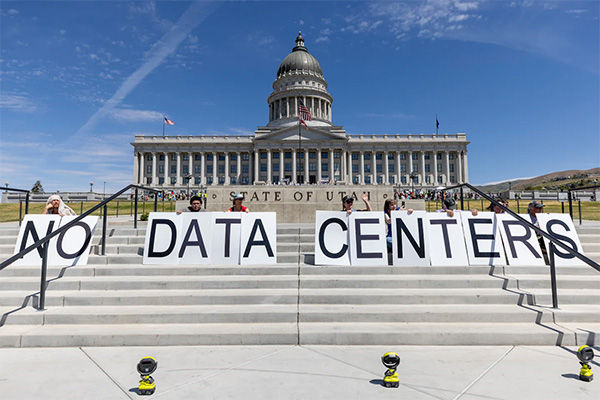
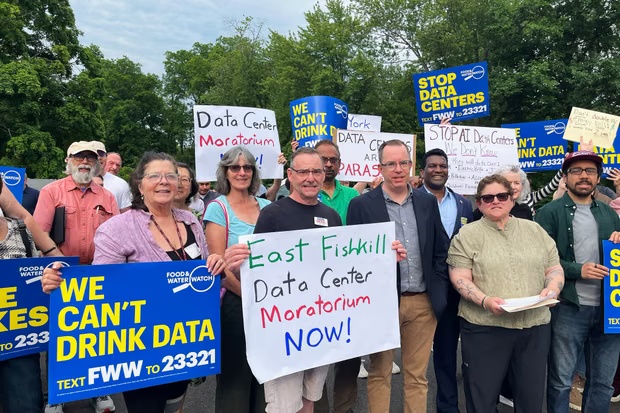
Recently, while the United States has been vigorously promoting the construction of data centers to meet the growing computing demands of the AI industry, there have been many protest groups in the US that oppose the construction of data centers and express their dissatisfaction with the related facilities.
On August 31 local time, U.S. President Trump posted a message on social media, accusing the relevant opponents of being wrongful.
"American communities nationwide oppose the establishment of data centers, solely because they want to lag behind in poverty," Trump wrote, "If they want to succeed in prosperity, enjoy lower taxes and abundant job opportunities, then let data rule everything."
He said, “The good news is that there are still many other places that need data centers. If we kill the goose that lays the golden eggs, it’s only our own fault.”
On this issue, China once again "got caught in the crossfire".
Trump claimed that China is "extremely delighted" by this anti-data center movement in the United States, and "simply cannot believe that all of this really happened."
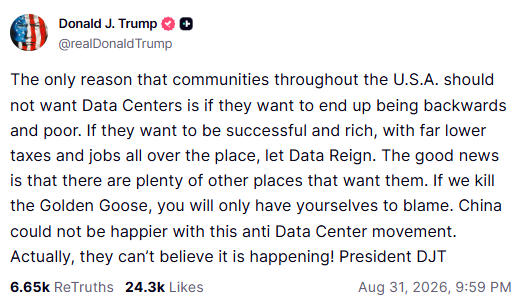
Post screenshot
The British 'Financial Times' stated that Trump's remarks marked his most explicit support for the wave of artificial intelligence infrastructure construction across the United States to date. Previously, this had sparked strong opposition from voters, including many Republicans.
Due to local opposition, dozens of data center projects across the United States, with a total investment of about $15 billion, have been delayed or canceled. Local governments from both parties in the United States have announced measures to suspend, review, or ban further development.
Texas Governor Greg Abbott (Republican) suspended hundreds of projects in the state this month, stating that developers had “received the strong opposition they deserved.” Byron Downs, the Republican candidate for governor of Florida, initially welcomed data centers, but later began to criticize them as well.
Republican strategists warn that data centers are becoming a politically sensitive topic. They point out that internal polls show these projects are highly unpopular, and have become a symbol of people's general anxiety about the power of large tech companies, rising electricity costs, and the disruptive effects of artificial intelligence.
According to the American media website Axios, the survey results are shocking. According to a survey conducted by the Annenberg Foundation, 61% of Americans oppose the construction of new data centers in their communities, including 54% of Republicans.
The US Vice President Williams recently told reporters that he believes “the strong opposition to data centers is probably 99% due to the rising energy prices in the surrounding areas.” He said that if developers can solve these problems, “I think data centers will not be so controversial anymore.”
According to reports, on August 31 local time, an advocacy organization associated with technology and artificial intelligence billionaires stated that they would launch a “public engagement campaign costing millions of dollars”. The campaign aims to gain public support for data centers by emphasizing their economic benefits. Initial advertising efforts will be conducted in Kansas, Ohio, and Wisconsin.
This organization is associated with the “Leading the Future” Super Political Action Committee. This bipartisan committee has raised over $75 million from billionaires in Silicon Valley, vowing to support state and federal candidates who oppose undermining the infrastructure needed for America’s competitiveness in the global artificial intelligence field, before the midterm elections.
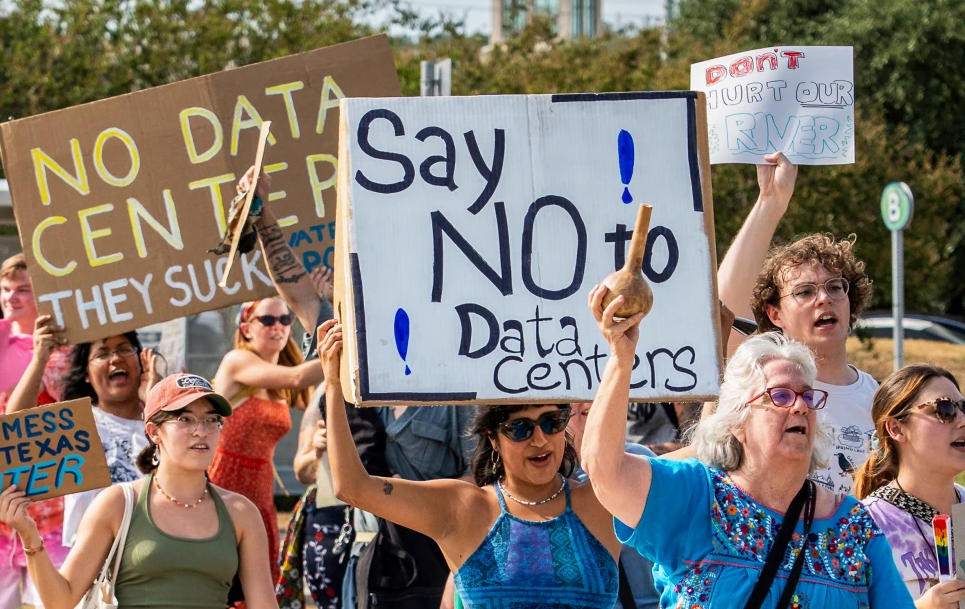
American citizens protest the construction of data centers. US media.
According to previous reports by American media, due to concerns about data centers damaging the ecological environment and affecting residents' electricity usage, people in many areas of the United States have held protests against the construction of data centers near their homes.
Afterwards, some American politicians and business leaders slandered China by claiming that China was financially supporting protesters in the US.
In early June, Republicans in the U.S. House of Representatives also cited two think tank reports, urging the Trump administration to investigate actions by China allegedly involved in inciting public opposition to AI data centers. Both reports claimed that “groups associated with foreign entities” were driving anti-data center sentiment.
OpenAI also slandered China, falsely claiming that China may have orchestrated a cyber campaign against the construction of data centers.
However, many experts in the technology industry believe that American technology giants and politicians have failed to focus on key issues. They have been preoccupied with unfounded “foreign conspiracy theories” while neglecting communication with American citizens.
American enterprise research analyst Rui'an Feidaoxiu said that American public opinion on data centers is not related to China, and that the opinions of politicians and business people in the United States are unhelpful. He stated: "We must recognize that China is not the reason why AI construction was unpopular in the US."