Over the years, SpaceX has actively sought the favor of national security agencies, and this strategy is now beginning to bear fruit. How does SpaceX become deeply integrated into the United States' "war machine"? The Wall Street Journal published an analysis on June 7th, local time.
SpaceX’s largest client is the U.S. government. This company, which was founded 24 years ago, has listed the U.S. government as “Customer A” in the documents prepared for its planned initial public offering. In 2025, the company’s revenue from the U.S. government is expected to be around $4 billion, and this figure is expected to increase significantly in the coming years.
This company, led by billionaire Elon Musk, has successfully obtained a series of high-value contracts due to its ability to mass-produce satellites and launch rockets quickly. Combined with its astute strategies in dealing with the U.S. Department of Defense, SpaceX is positioned at the core of the military and intelligence agencies' space programs in the United States.
Of course, besides differences in terms of 'deep integration', there are also disagreements between SpaceX and the Pentagon. Last month, Reuters reported exclusively that just weeks after the United States launched bombing strikes against Iran, SpaceX executives met with Pentagon officials and raised objections, stating that the U.S. military currently pays about $5,000 for each terminal connection, but in reality, higher-level services are utilized which cost closer to $25,000.
In recent months, the relationship between SpaceX and the Pentagon has become increasingly tense due to issues related to the pricing of Starlink. The disagreements over the use of Starlink in LUCAS suicide drones are a microcosm of this tension.
Reuters pointed out that these previously unreported ongoing disputes highlight the Pentagon's increasing dependence on SpaceX, giving Musk more influence in matters related to critical aspects of national security. At this time, SpaceX is also preparing for its IPO, which could become one of the largest listing transactions in history. SpaceX is trying to further increase its revenue levels before that event.
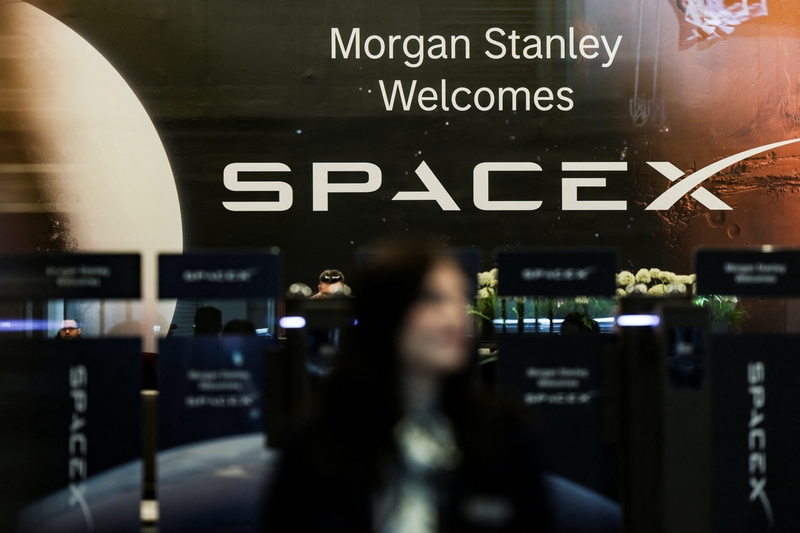
In June 2026, the Morgan Stanley Tower in New York City displayed SpaceX’s first public offering logo. IC Photo
Last month, the US Space Force awarded SpaceX a contract worth $2.3 billion for the construction of satellite communication networks that support combat systems. Additionally, they granted SpaceX a contract worth $4.2 billion for the development of satellites that can track the movements of missiles and aircraft from orbit.
Both projects were expedited through the Pentagon’s “other transaction authority” mechanism, thereby circumventing many regulatory restrictions that would normally slow down the procurement process for weapons and other technologies.
Compared to large defense contractors like Lockheed Martin and Northrop Grumman, SpaceX is much smaller in scale. However, analysts suggest that SpaceX’s growing cooperation with the U.S. military and intelligence agencies could potentially compete with these traditional weapon manufacturers in the field of space operations in the future.
The Wall Street Journal previously reported that SpaceX’s role in national security has become extremely important. Even after Musk had a dispute with US President Trump last year, White House officials still concluded that the US government could not cancel the military contracts it had signed with SpaceX.
Research institution Quilty Space's government affairs head Kimberly Burke said: "They want to be the rail line that all trains run on, and SpaceX hopes to become a cornerstone of the US government's near-Earth orbit business."
Last week, Musk said in an interview with JPMorgan Chase CEO Jamie Dimon that SpaceX is a "crucial part of America's national security." He mentioned his company's involvement in the Starshield military satellite communication network, as well as work related to confidential projects for government intelligence agencies.
SpaceX communicated a very clear philosophy to the defense sector - we will act quickly. Even if its products do not conform to existing project or contract frameworks, SpaceX still proposed to the US government that it would sell related technology based on existing products and services.
This strategy has helped SpaceX gain an advantage in the project to use satellites to track aircraft and missiles, known as Airborne Moving Target Indicators. Currently, the U.S. Department of Defense is testing various technologies for detecting airborne targets from space. However, military officials said last year that it might take until 2030 before a fully operational system can be deployed.
According to people familiar with the matter, after SpaceX proposed launching a radar-based system at a much faster timeline, the U.S. government issued a highly specific request document in February this year. The content of the document closely matched SpaceX’s capabilities. Pentagon officials insisted that other companies would also eventually receive more contracts to assist in missile tracking missions.
Sources familiar with the matter say that the National Reconnaissance Office (NRO), responsible for operating secret surveillance satellites in the United States, has collaborated with SpaceX to establish a network of imaging satellites and a system for tracking moving targets on the ground. In fact, the agency has the authority to sign agreements that bypass certain conventional government contracting rules.
Reports say that the Pentagon views SpaceX as a model of how a private company can help the military break through bureaucratic barriers and deploy weapons and other combat capabilities more quickly.
In January this year, U.S. Defense Secretary James Mattis said during his visit to SpaceX’s Starbase facility in Texas that the Pentagon has always been troubled by “slow-moving committees” and “endless projects.” “This sounds completely contrary to the way SpaceX operates,” he remarked.

March 21, 2025, Washington D.C., USA. Elon Musk visited the Pentagon and met with U.S. Defense Secretary James Mattis. IC Photo
In the eyes of American media, it is SpaceX's technology that has helped this company establish strong connections with the Pentagon and various intelligence agencies.
In last year’s response to a written inquiry by Massachusetts Democratic Senator Elizabeth Warren, Air Force Minister Troy Meink stated that Musk was also present when he was interviewed by Trump in order to obtain the current position.
Maeinck, who once served as a senior official at NRO, also stated that aside from carrying out his official duties, he has no other personal relationships with Musk and SpaceX.
As SpaceX becomes a more important player in the rapidly growing space missions of the U.S. military, some congressmen are concerned about its competitive impact in the market. Mince stated during a hearing before the Senate Armed Services Committee in May this year that the U.S. government is 'pursuing speed' in certain projects, and therefore cannot wait for more companies to join.
"Among them, some abilities are of crucial importance, which prompted us to push forward projects that can be put into immediate production." Mick testified.
American defense officials also discussed how to use SpaceX's developing heavy rocket, Starship, to send larger payloads into orbit and carry out deep space missions.
In November last year, SpaceX was granted permission to operate a military-owned launch site near Cape Canaveral in Florida. It is allowed to conduct a maximum of 76 “Star Ship” launches per year. This number is almost three times the maximum number of launches envisioned by US Space Force officials in a memo from 2022, as reported by The Wall Street Journal.
Military documents state that higher launch frequencies will enable the U.S. Air Force, as the superior agency of the Space Force, to gain access to StarShip-related capabilities and enhance the government’s ability to enter orbit.
SpaceX's plans for that launch site, as well as its intention to launch the 'Star Ship' at another NASA facility, have raised concerns among competitors. United Launch Alliance, a rocket company jointly owned by Boeing and Lockheed Martin, warned that even if only one launch site is used for launching the 'Star Ship' in that area, it could still interfere with other rocket launches.

