On August 24th, local time, U.S. Treasury Secretary Steven T. Besson issued a warning to the world, urging countries to cut off any financial ties with Iran. Otherwise, they would face the risk of being excluded from the dollar system. Previously, Besson imposed what he called ‘the most severe financial sanctions in history’ on Iran.
According to Reuters and The Guardian, Besson announced at a press conference that other countries need to cut off their business ties with Iran, otherwise they may face the risk of being excluded from the dollar-dominated financial system.
But he refused to specify which countries would be targeted, and did not reveal when these penalties would take effect. He only said that these countries would be given time to comply with the new regulations.
We are giving everyone an opportunity to correct their bad behavior. Why am I going to bring down the global financial system? Bassett replied when being questioned on a lack of specific measures or why not take action immediately.
He revealed that U.S. President Trump is in contact with leaders from around the world. Officials from the Department of Defense, the Department of Treasury, and the State Department have also contacted relevant departments, requesting action to cut off relations with Tehran.
According to reports, the US Treasury announced a list of sanctions against 60 individuals, entities, and ships on that day. The list includes several entities, individuals, and ships from mainland China and Hong Kong, but no Chinese financial institutions are included.
When asked whether he would “leave room for the Americans” regarding China's actions, Beson emphasized "no one can surpass American sanctions."
He also said that the Treasury Department has mapped out Iran's networks, intermediaries, and financial channels used for smuggling oil and evading sanctions, involving digital assets, technology, gold, aviation, and shipping. He stated that Washington will work with its partners to target any sources of 'illegal income' in Iran.
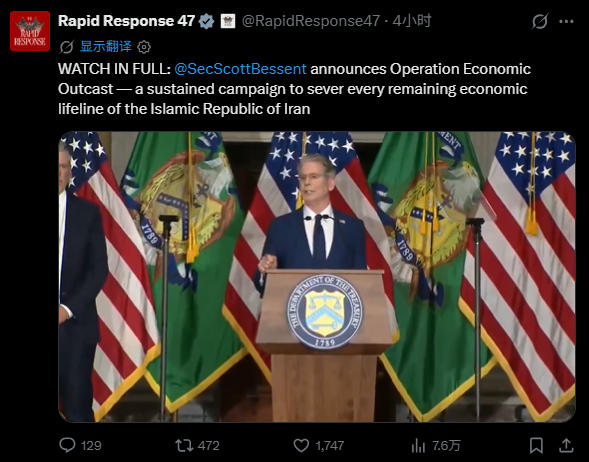
Bessen attended a press conference on the 24th. Screenshot of the tweet
On the same day, Iran's Parliament Speaker Kalibaf issued a statement on social media platform X, countering the economic pressure exerted by the United States.
"American people know nobody will believe their boasting," Caliph wrote, "The economic situation in the United States does not allow further restrictions on relations with other countries." He also stated: "Iran's trading partners have clearly expressed, through media or information sent to us, that they will never consider these statements."
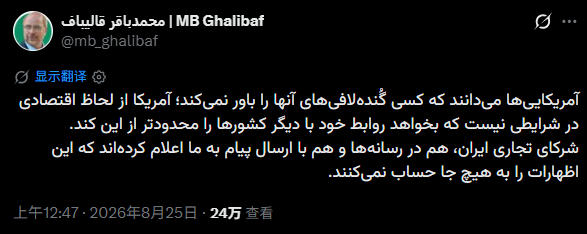
Tweet screenshot
Since the attacks on Iran by the United States and Israel, nearly six months have passed. This conflict has disrupted regional shipping, reduced oil flows, and had an impact on the economies of both the United States and the global economy.
According to Reuters, although this war has weakened Iran’s conventional military capabilities and caused economic suffering, Iran still retains sufficient missile and drone capabilities, which have nearly halted shipping in the Strait of Hormuz. After the negotiations collapsed, Washington seems to be looking for further economic pressure. However, Iran has been under a series of heavy sanctions from the United States and international organizations for decades.
On August 20th, Besent announced that the United States would impose 'the most severe financial sanctions in history' against Iran, with the goal of overthrowing Iran's leadership.
On the 21st, Iran stated that if the United States makes another threat, Iran would respond in a "devastating" manner.
Iran's Supreme National Security Council Secretary Mohsen Rezai warned on the 22nd that if regional countries join the United States in imposing sanctions against Iran, Iran will not only be prepared to target oil tankers passing through the Strait of Hormuz, but will also attack other oil transportation routes in the Persian Gulf region.
Iranian Economic Minister Ali Madanizadeh recently stated that Iran is fully prepared for the sanctions against the United States. He noted, “We also have our own tools, and we know how to deal with them. Our defenses are no longer passive; the enemy should wait for an attack.”
Iran's Islamic Revolutionary Guard spokesman Housein Mohebi vowed that if Iran's infrastructure is threatened, serious blows will be dealt to the United States' key interests and energy chokepoints.
As relations between the United States and Iran deteriorate sharply, American politicians and media frequently twist China into the topic of sanctions.
Recently, Besent publicly called on China to "follow the plan" in order to further isolate Iran's economy and "disintegrate that regime".
In the interview, when asked whether the new sanctions involved China, Besent declined to provide a specific response, saying that “many discussions are better carried out privately.” However, he explicitly requested China to provide what he called “cooperation.” He cited data showing that about 50% of China’s energy comes from the Gulf region. He said that “following the plan will be beneficial for them,” and noted that all parties hope for the reopening of the Strait of Hormuz in order to reduce energy prices.
On August 24, Lin Jian, a spokesman for the Ministry of Foreign Affairs, responded to related questions by stating that sanctions and pressure are not helpful in solving problems. Instead, they only exacerbate tensions and escalate the situation, and do not serve the interests of either side.
Lin Jian said that China calls on all parties to maintain rationality and restraint, to avoid taking measures that could further intensify conflicts and undermine global economic development and financial stability. It is important to return to the correct path of dialogue, negotiation, and political resolution as soon as possible. China will closely monitor the relevant developments and take necessary measures to safeguard its legitimate rights and interests.
