The Trump administration refuses to abandon the use of “tariff sticks”. According to Bloomberg report on August 25th, sources familiar with the matter revealed that the U.S. government is planning to impose a 7.5% tariff on Chinese goods, citing so-called “overcapacity” as the reason.
Reports indicate that this move will restore tariffs on China to approximately 20% during Trump’s second term in office.
This will be the latest step taken by U.S. President Donald Trump to reinstate his protectionist trade agenda after the U.S. Supreme Court overturned the government’s policy on import taxes from China and dozens of other economies. However, Trump also hopes to avoid escalating trade conflicts with China.
Sources familiar with the matter said that the exact tax rate has not been finalized yet. It is well known that Trump often requests modifications or additions to trade-related statements at the last moment.
Another person familiar with the discussion revealed that one of the options being considered by the US government is to announce higher taxes on China, but to temporarily suspend some tax rates, so that the increase in taxes can be controlled at 7.5%.
Sources close to the matter added that details regarding which tax rates will be suspended and for how long remain under negotiation.
In March of this year, the Trump administration initiated investigations into issues related to “overcapacity” against more than a dozen major trading partners, in accordance with Section 301 of the Trade Act of 1974. In July of this year, the US imposed 10% to 12.5% tariffs on 60 economies, including China, on the grounds of so-called “forced labor”. The tariff rate applied to China was 12.5%.
Bloomberg reports that US officials hope to announce the results of their investigation into “overcapacity” by September 24th. However, people familiar with the matter say this may face legal challenges.
When asked about the tariff plan, a White House official said that any announcement would come directly from the government, and any reports or discussions should be considered baseless speculation. The U.S. Trade Representative Office did not immediately respond to requests for comment.
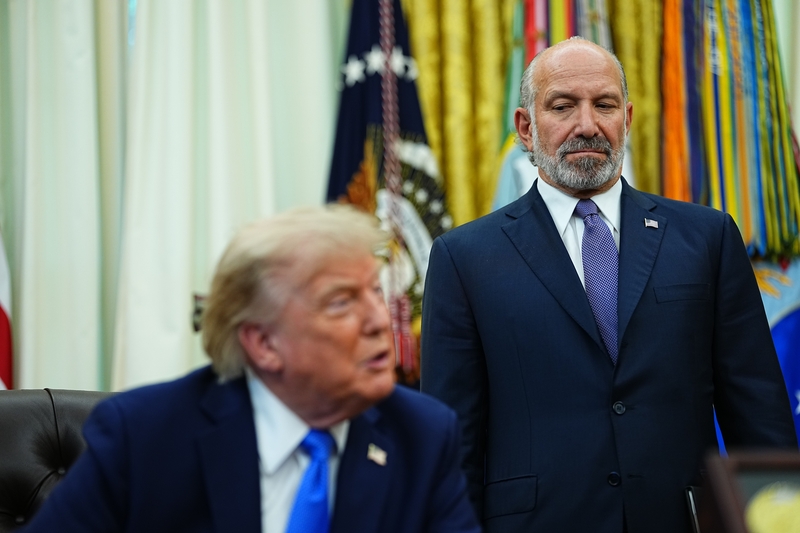
August 6th, Trump and Rutnik held a press conference at the White House. Oriental IC
In July this year, Foreign Ministry spokesperson Lin Jian stated that China's stance on Sino-US economic and trade issues is consistent and clear. China opposes all forms of unilateral tariff measures. A tariff war or trade war does not serve the interests of either party.
The Ministry of Commerce previously released a report that further clarified China's stance on the issue of so-called 'overcapacity'. The report indicates that relevant countries and economies are growing concerned about the competitiveness and market position of their own industries. They politicize economic and trade issues, exaggerate the issue of China having 'overcapacity', accuse China of posing a threat to the world market with its production capacity, and use this as an excuse to intensify restrictions on China. Protectionism is becoming increasingly intense.
In recent years, the United States has introduced a series of trade protectionist measures, which have seriously affected Sino-US economic and trade relations and also accelerated the restructuring of the global industrial chain.
China's responses have evolved from early tariff countermeasures to multi-level measures such as export controls, entity lists, unreliable entity lists, and recourse to the WTO. At the same time, China is promoting domestic production in key areas.
On August 5th, the Chinese side introduced five measures in response to the US restrictive measures against China.
"Chinese side took a restrained approach to countermeasures," the same day, the Ministry of Commerce spokesperson's remarks encouraged American side "to cherish the stability of China-US trade relations that was hard-won", at the same time warning that if the American side stubbornly goes their own way, the Chinese side will further counter.
Foreign media have noted the differences in China’s approach this time: restraint, but with diversity and countermeasures. Among China’s series of measures are strengthening export controls on drones and related technologies, imposing sanctions on several American companies, and launching the first national security investigation related to foreign trade.