"I slept for a while, and the world changed."
This is the sentiment of a 28-year-old robot teacher during the BBC's visit to China's robotics industry. From vocational classrooms to intelligent factories, the BBC sought answers to how China uses robots to reshape the "world's factory."
According to a report by the BBC on August 25th, robot teacher Chen Tianyu spent his spare time visiting factories that are undergoing automation transformation. He observed how the latest robot equipment worked, and then brought those experiences back to the classroom, deciding what should be taught in artificial intelligence and robotics courses.
In the training classroom of Hangzhou Technician College, more than 30 students are writing programs for industrial robots. One student is typing on the keyboard while staring at the robotic arm: "Make it grab that cylindrical part and place it in the designated position."
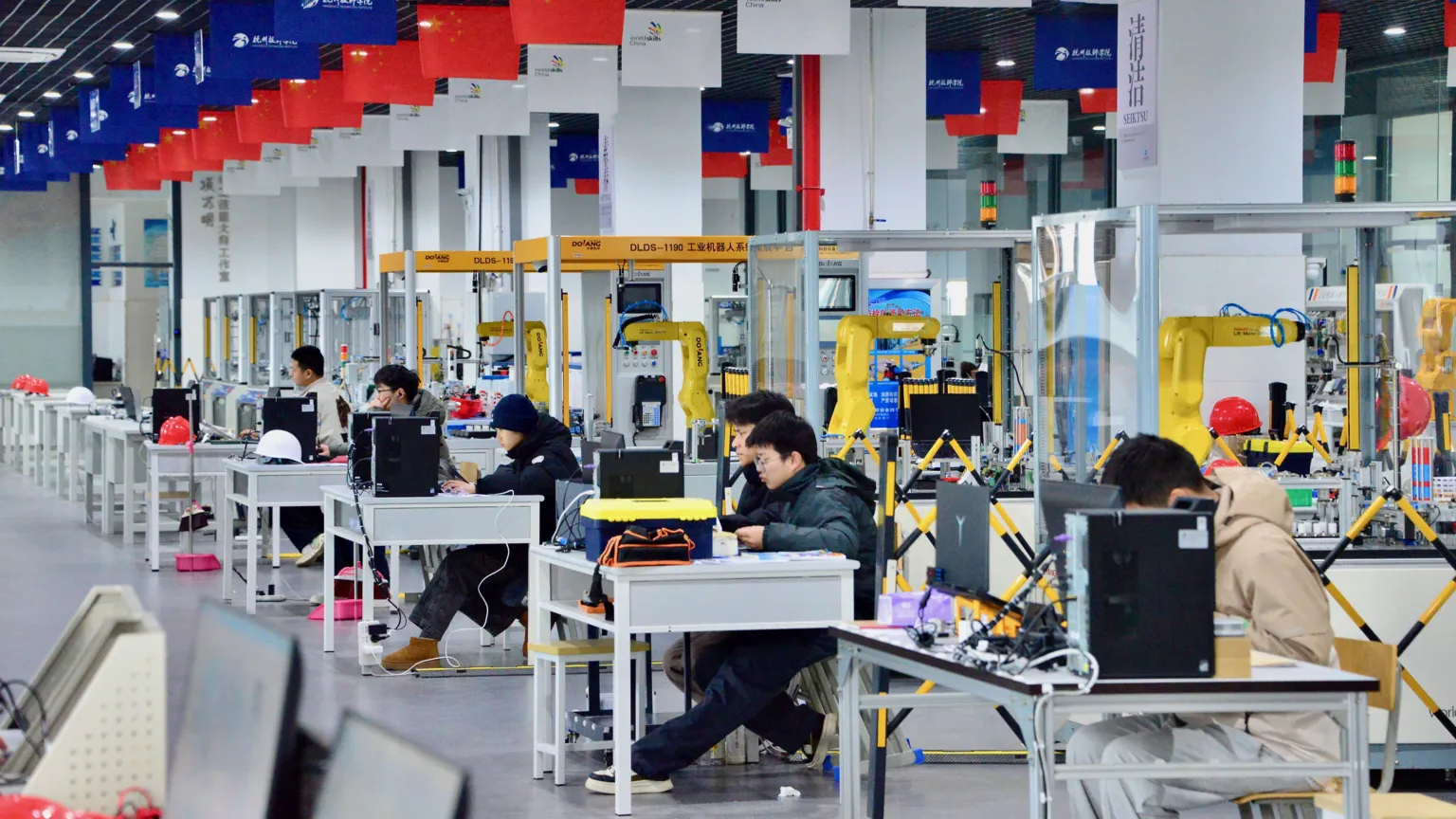
Students learning robotics technology from the BBC
On the other side, a row of industrial robots is waiting for debugging, and the research and development project of medical robots is also being carried out simultaneously. Chen Tianyu told his students, "If artificial intelligence and robots no longer need you, then you will definitely be eliminated."
The BBC believes that what these students are facing is not just a profession, but the future that China is building.
Hangzhou Technician College is just one of many newly established vocational colleges across the country. The campus specializes in programs such as robotics, aviation engines, intelligent manufacturing, and rare earth processing. Students can start their training system at the age of 15.
More importantly, after graduation, they will be directly involved in a manufacturing industry where robots are becoming increasingly popular.
Data shows that currently, more than 2 million industrial robots are in production in Chinese factories, making China the country with the largest number of such robots in the world. The number is still growing at an alarming rate. Over half of the industrial robots worldwide are actually made in China.
International Federation of Robotics (IFR) data shows that China's industrial robot density has exceeded 500 robots per 10,000 people, surpassing Germany and Japan, making China one of the largest manufacturing economies with the highest level of automation in the world.
According to data from the National Bureau of Statistics, the total output of industrial robots in China will reach 773,000 units in 2025. In the first half of 2026, the national output of industrial robots reached 538,000 units, a year-on-year increase of 28.0%. The output in May alone exceeded 100,000 units for the first time, setting a new record. In 2025, China will add 328,000 new industrial robots to its fleet, and the total number of new installations expected for the entire year of 2026 will reach 400,000 units, accounting for 69% of the global new installations. China has maintained its position as the world’s largest industrial robot market for 13 consecutive years. This means that robots have evolved from “incremental equipment” to a fundamental part of manufacturing infrastructure.
The BBC also visited some industrial sites, where they saw robots. These robots aren’t like humans; they don’t dance or jump on stages. Instead, they perform tasks such as welding, painting, handling, and assembling. They can work day and night without rest or benefits. Some of these robots are designed to create more robots. The BBC believes this is a preview of China’s “new productive forces” and how they will reshape the country.
In the workshop of CRP Technology, a robotics company in Chengdu, two types of manufacturing processes are occurring simultaneously. On one side, more than 30 workers are assembling and polishing robotic arms. On the other side, four young engineers are working around a prototype robot, hoping that it will be able to manufacture more robots in the future.
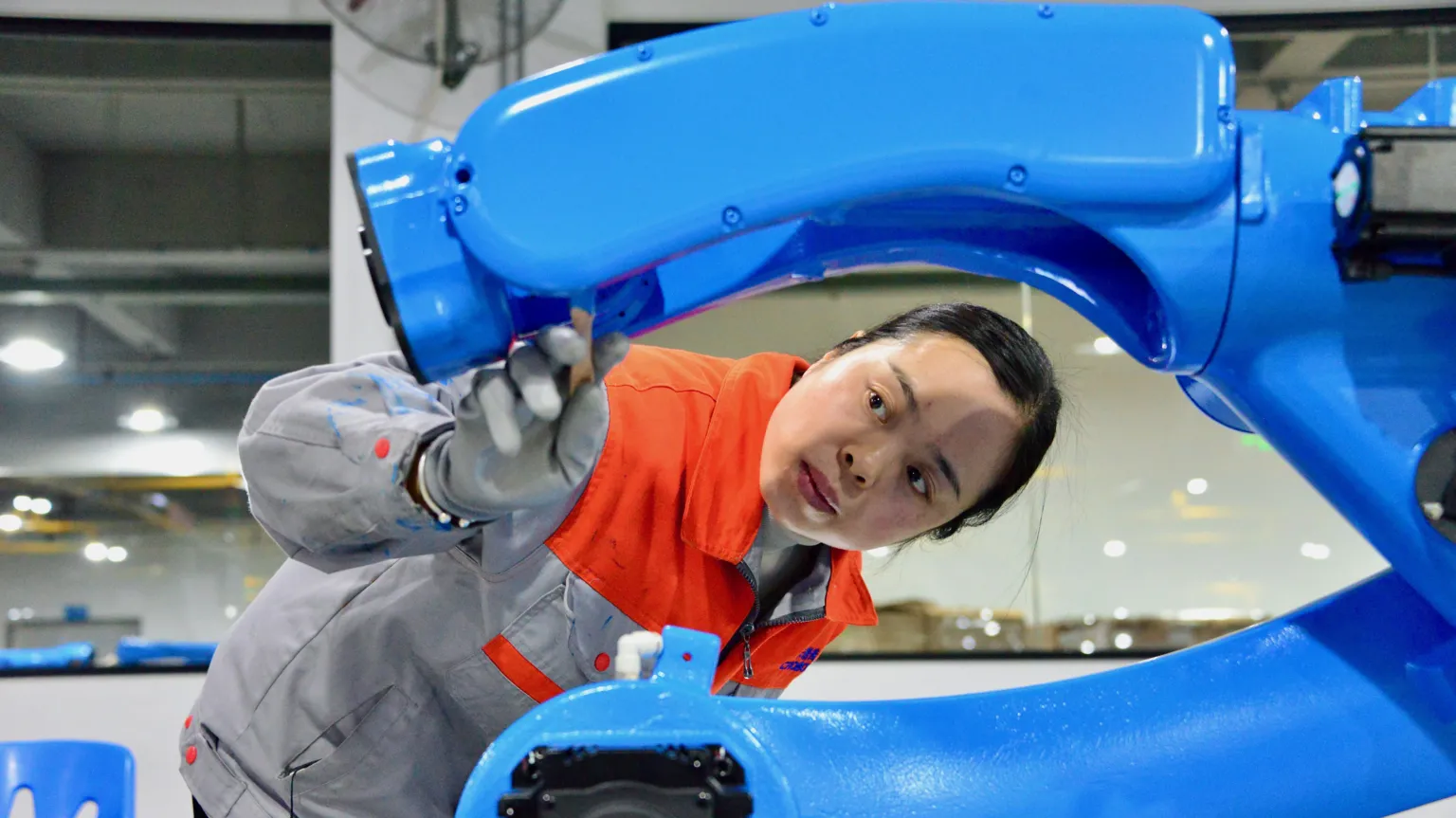
Engineers are working hard to create a robot that can build other robots. BBC
A 31-year-old R&D engineer, Pang Kai, is pushing a humanoid robot skeleton forward slowly. Currently, it can only perform simple tasks such as scanning codes. “Maybe in another six months, it will be able to learn another task.”
The CRP production robotic arm has been in use for 9 years, and its products are widely used in industries such as automotive, electronics, and wind power. The company states that a single robotic arm can handle over 90% of repetitive processes.
But Pang Kai is thinking about a much more distant future. "We hope it will think like humans. In ten years, China may not have enough workers."
In fact, the robotics industry in China has already formed a complete echelon. In addition to industrial robotic arms, Chinese companies are accelerating their development of humanoid robots. The applications of these robots range from logistics handling and inspection to rehabilitation medicine and service industries. Since 2025, several companies have begun commercial delivery of small quantities of these robots, making it considered the beginning year of industrialization for humanoid robots.
At Hangzhou Leapcar Automobile Factory, robots are present almost throughout the entire production line.
The stamping, welding, and painting workshops have basically achieved 100% automation. Mechanical arms are responsible for handling, welding, and spraying paint, while final quality inspection is still carried out by hundreds of employees.
Zero Run Automotive Vice President Cao Li said: "It's completely possible, and it might come very soon."
However, she also emphasized that robots do not have no costs; they also require daily maintenance and regular inspections.
In recent years, the new energy vehicle industry in China has become one of the most important application scenarios for robots. Automobile companies such as BYD, Geely, Leeopar, and Xiasi have continuously increased their automation rates. A modern automobile factory often deploys thousands of robots, achieving high levels of coordination in processes such as stamping, welding, logistics, and inspection. This also promotes the use of domestic robots instead of imported equipment.
International Robot Union Secretary-General Susanna Biller believes China's biggest advantage comes from its manufacturing industry ecosystem.
She gave an example: in Shenzhen, it usually takes less than an hour to purchase all the necessary parts for a robot, while in Europe, it may take a week.
However, she also believes that the United States still leads in terms of robot 'brains'—artificial intelligence models. Nevertheless, from DeepSeek to Moonshot, Chinese companies have been launching new artificial intelligence models, claiming they can compete with top American companies.
Driven by the “open-source” approach of artificial intelligence startups that share code, China’s innovation capability has surpassed expectations even despite the United States imposing export controls on key advanced chips. On July 28, 2026, the U.S. government announced a ban on importing new humanoid robots from China, citing national security concerns. This ban itself confirms that China’s leading position in this field is putting pressure on the United States. Analysts generally believe that the key to winning the next stage of the AI race lies not in large language models themselves, but in who can first deploy intelligent capabilities on a massive scale across millions of machines.
Returning to Hangzhou Technician College, the BBC found that this institution not only teaches programming, but also emphasizes engineering practice.
The entire aviation building, rare earth laboratories, and robotics competition platforms together form the student training system. Chen Tianyu said that many students have already been booked by companies before they even graduate.
It is best to find one's own place in the wave of technological advancement. Structural changes will definitely bring new employment opportunities.
As of now, China has established the world's largest vocational education system. There are over 10,000 vocational colleges nationwide, which train tens of millions of skilled talents every year. Fields such as robotics, intelligent manufacturing, and industrial internet have become popular directions for many years, providing continuous talent supply for the high-end manufacturing industry.
"My students asked me what will happen in the future," Mr. Chen said. "I said I don't know. Technology changes too quickly. But we cannot stay still, here and sleep. We must move forward and see what we can do."