A US-based artificial intelligence (AI) startup has abandoned its US-based models and switched to using China's Kimi K3.
On August 20 local time, Harvey, a company based in San Francisco, issued a statement indicating that it has built its first internal model, Harvey Tenet, based on the Kimi K3 model.
According to a report by the Hong Kong-based South China Morning Post on the 21st, this move highlights the trend among Western tech companies to turn to open-source systems developed in China, given the soaring development costs. Previously, these companies relied on closed proprietary models from American companies such as Anthropic, OpenAI, and Google.
Harvey Company stated in its announcement that its latest internal model has achieved "state-of-the-art" performance in complex legal work.
Artificial intelligence policy research fellow Simon Heddlin said that Harvey's shift was "an excellent example of open-source models."
He posted on social media stating that open-source models allow developers to retrain the system on specific industry or enterprise data, thereby improving accuracy and reducing inference costs. Post-training refers to additional training on specific tasks or datasets, based on pre-trained models.
"We remain in the earliest stage of exploration for the possibility of open-source, high-capability model weight models," said Hederlin. "Regrettably, the United States lags behind in developing cutting-edge open-source weight models."
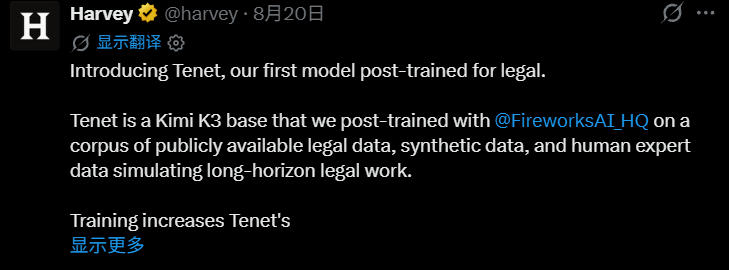
Screenshot of the post
According to reports, Harvey was founded in 2022 and has received support from American companies such as OpenAI and Sequoia Capital. In a round of financing in March this year, its valuation reached $11 billion, and it primarily serves large international law firms and corporate clients.
The company stated in its announcement that Harvey Tenet, trained on a comprehensive legal dataset, performed better than its base models and leading American systems—including Fable 5 and GPT-5.6 Sol—in a series of complex, long-duration legal representation tasks.
According to Harvey, this has improved cost efficiency. The company stated that Harvey Tenet’s training involved the use of approximately 150 NVIDIA B300 graphics processing units, taking two months.
According to reports, the high cost-effectiveness of China's open-source models has attracted more and more Western companies.
American telecom giant AT&T's vice president, Mark Austin, recently stated that the company has not yet used any Chinese open-source weight models. However, the company is analyzing options from Chinese companies such as DeepSeek and Moon’s Dark Side.
