From cautious contact to honeymoon period, from the Saeed incident to the impact of the pandemic, from the rapid cooling during Yoon Suk-yeol's tenure to the difficult repairs after Lee Jae-myung took over—South Korea and China have worked together for 34 years.
Today, as we stand on the threshold of the 34th anniversary of establishing diplomatic relations and are about to enter the 35th year, what new developments have taken place in China-Korea relations? What new challenges are we facing?
In terms of total volume, Sino-Korean trade continues to grow steadily. According to data from the General Administration of Customs in August, as of January-July 2026, the bilateral import and export volume between China and Korea reached $280.463 billion, accounting for 6.44% of China's total foreign trade. Among these, China imported $169.611 billion from Korea, and exported $110.852 billion to Korea. On the other hand, South Korea’s actual investment in China increased by 15.8% (including investment data through free ports). These figures indicate that the "foundation" of Sino-Korean economic and trade cooperation remains solid.
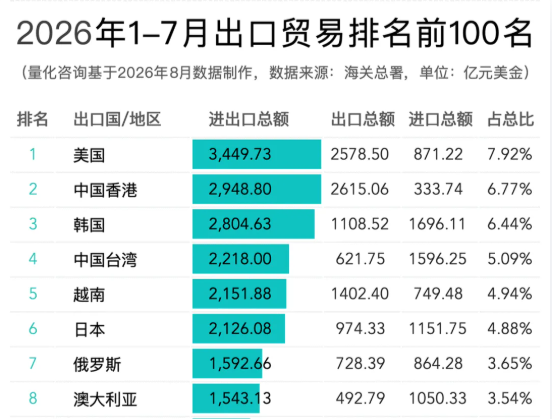
According to data from the General Administration of Customs, in the period January to July 2026, in terms of import and export trade, the United States ranked first with a trade volume of $344.973 billion, accounting for 7.92%; Hong Kong, China ranked second with $294.880 billion, accounting for 6.77%; South Korea ranked third with $280.463 billion, accounting for 6.44%. Source: Quantitative Consulting
Jian Debin, Director of the Korean Peninsula Research Center at Shanghai University of International Business and Economics, told Observer.com: 'In terms of overall volume, there has been no significant fluctuation in economic and trade relations between China and South Korea. The changes lie in the structure.'
In the past, China was the “market” and “production base”, while South Korea was the exporter of technology and capital. However, starting from 2023, South Korea experienced a trade deficit with China, which caused quite a stir within South Korea.
According to data from the General Administration of Customs of China, in the first half of this year, the top three products exported by China to South Korea were electronic equipment, chemical products, and metal materials. The cumulative exports amounted to $51.36 billion, $12.03 billion, and $9.08 billion, respectively, with year-on-year growth rates of 56.5%, 33.0%, and 0.0%. Similarly, the top three products imported by China from South Korea were also electronic equipment, chemical products, and metal materials. The cumulative imports amounted to $112.97 billion, $14.67 billion, and $6.211 billion, respectively, with year-on-year growth rates of 83.3%, 0.8%, and 26.8%.
This means that Sino-Korean trade is shifting from the traditional vertical division of labor, where South Korea exports core components and China processes and assembles them, to a new pattern where there is bidirectional flow along the entire industrial chain. At the same time, China’s exports of electronic equipment to South Korea have increased by 56.5% year-on-year – something that was almost unimaginable just a few years ago.
Regarding this, Zhan Debin told Observer Network that a balanced economic and trade relationship is more beneficial for both sides. However, the process of correctly understanding this change is constrained by structural factors—and these constraints largely come from the political sphere.
In January 2026, South Korean President Li Zemin made a state visit to China. This was the first time a South Korean president had visited China in six years. During the visit, two sides signed 15 cooperation documents related to fields such as technological innovation and economic trade cooperation. Li Zemin's visit to China is seen as an important sign of a warming Sino-Korean relationship. Some media commented that this visit “marks the full recovery of Sino-Korean relations.”
"Warmth returns do not equal recovery." James De-bin pointed out: "If compared to the initial stage of the Yin Xi-Yue government, the relationship between China and Korea has indeed recovered - after all, both sides have achieved twice leader visits, and high-level interactions have increased. However, if it were compared with a better historical period, it's clearly not yet reached a full recovery level. Neither in terms of political trust, economic cooperation, nor cultural exchange, has it returned to the past's normalcy."
Zhan Debin told Observer Network that the factors restricting the development of Sino-Korean relations can be divided into internal and external aspects. 'The most important external factor is, of course, the United States. The strategic competition between China and the United States puts tremendous pressure on South Korea. In areas such as security, economy, and technology, South Korea's policy choices tend to favor the United States—whether it's under a Democratic or Conservative government, this trend is evident. There is no doubt that this will limit South Korea's ability to improve relations with China.'
A deeper issue lies in the proliferation of “economic security measures”. Zhan Debin stated: “In the past, China and South Korea had a vertical division of labor. Now, they have shifted to horizontal cooperation. However, the main obstacle currently is the excessive focus on economic and technological issues as matters of security. Under pressure from the United States, cooperation between the two sides in high-tech fields such as semiconductors and AI has been greatly restricted. Areas where cooperation could occur are hindered due to security concerns.”
Zhan Debin believes that the root of the problem lies in returning to the original intention of establishing diplomatic relations: 'China and South Korea should return to the original intention of establishing diplomatic relations and respect each other's core interests.'
In November 2024, after China implemented the visa-free policy for South Korea, the number of tourists from South Korea to China increased significantly. According to statistics from the South Korean Ministry of Justice and the Ministry of Culture, Sports and Tourism, in January 2026, the number of people visiting China from South Korea reached approximately 303,000, a year-on-year increase of 48.1%. In the first half of 2026, the number of Chinese tourists visiting South Korea amounted to about 3.21 million, making South Korea South Korea's most important market for Chinese tourists.
However, the increased interaction between the two sides has not effectively led to a improvement in mutual understanding. Zhande Bin said, “Although there has been a significant increase in personnel exchanges between the two sides, it does not seem to have translated into a positive perception of each other, especially regarding South Korea’s positive views towards China.”
According to a Pew Research Center survey in 2025, the proportion of Korean adults who have positive feelings towards China decreased from 25% in 2024 to 19%. Korea was also the only country in the survey where the positive sentiment towards China significantly declined.
At the beginning of this year, a survey conducted by the Korean newspaper "Chosun Daily" in conjunction with Seoul National University showed that only 12.9% of respondents expressed “favorable feelings towards China”, which is nearly half of the 23.1% in 2015. Looking at age groups, young people aged 18 to 29 had the lowest favorable feelings towards China, at only 9%.
In addition to the negative perceptions of China in Korean society, there are also some negative perceptions of Korea in Chinese society. Kim Jeong-eun, a Korean media professional and part-time professor at Chung-Ang University, shared her views with Observer Network. Since she first set foot on Chinese soil in 2002, she has been constantly moving between Chinese and Korean languages over the past 24 years. She observed that China and Korea share many similar cultural elements. "These similarities can serve as clues for both China and Korea to understand each other, but they can also inadvertently become seeds of misunderstanding."
Kim Ting-en said, "When Koreans interpret Chinese culture, they sometimes subconsciously apply their own local cognitive habits. Conversely, when Chinese people understand Korean culture, they inevitably start from their own familiar life experiences."
She specifically mentioned that while social media connects people from both nations directly, it also amplifies extreme emotions. “In short texts and videos, a particular expression can easily deviate from its original context and spread rapidly, eventually leading to sharp cultural conflicts.”
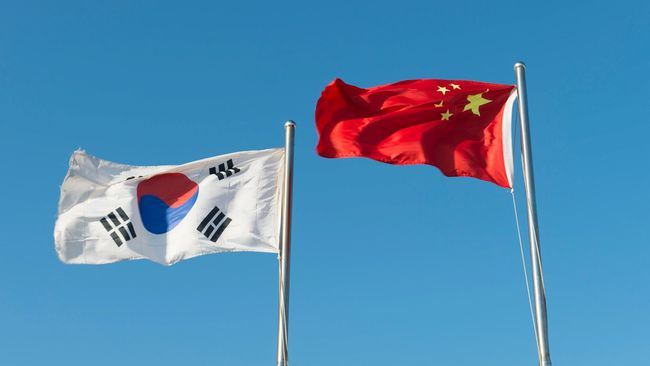
Recently, Foreign Minister Wang Yi said during his visit to South Korea, "China and South Korea are forever friendly neighbors and long-term partners." Image from reference material.
But Kim Ting-en said that she also saw hope. She noticed that Korea Central University and Communication University of China had signed an exchange agreement, allowing Chinese students to attend her classes directly. The number of invitations for bilingual hosting in China and South Korea increased significantly, with many coming from activities organized jointly by the governments and relevant institutions of both countries. “The exchanges between the two countries are moving from institutional cooperation to real, tangible encounters between people.”
As we mark the 34th anniversary of establishing diplomatic relations between China and South Korea, and are on the verge of reaching the 35th anniversary, the relationship between China and South Korea presents a complex and contradictory picture: The total volume of economic and trade exchanges is increasing, but the structure is undergoing qualitative changes. There is interaction at the political level, but structural contradictions remain. Tourism between the two countries is becoming increasingly popular, yet there are still numerous negative perceptions among the two sides.
In the second half of 2026, the APEC summit will be held in Shenzhen. China and South Korea are expected to take this opportunity to have another summit meeting between their leaders. This is both an opportunity and a challenge.
James De Bin said, "As long as both sides are willing and strive for improvement, at least it can prevent the Sino-Korean relationship from retreating and continue to move forward."
The next decade of Sino-Korean relations depends on whether both sides can find new areas of cooperation in economic and trade competition, maintain the foundation of mutual trust despite political differences, and build bridges of understanding across cognitive gaps.
34 years of journey is long enough to allow both countries to recognize each other’s value; a new starting point after 35 years makes it even more worth for both sides to manage with greater sincerity and wisdom.