On the morning of August 24th, the 16th National Assembly of Vietnam passed a resolution on “Adjusting the Investment Proposals for the Construction Project of the Lao Cai-Hanoi-Haiphong Railway”, approving a significant increase in the scale and standards of construction for this Sino-Vietnamese border railway project.
According to the new plan, the total project investment will increase from 203.231 trillion Vietnamese dongs approved in 2025 to 289.339 trillion Vietnamese dongs, an increase of 86.108 trillion Vietnamese dongs, which is approximately 22.1 billion RMB.
From the adjustments made this time, it is clear that the additional investment does not simply come from an increase in project costs. The Vietnamese side has actually made significant changes to the project construction approach: in the important Hanoi-Haiphong section, the plan has been changed to build two parallel lines in one go; new connecting lines have been added to the Hanoi railway hub. At the same time, investments have been made in locomotives, power systems, and safety facilities. The engineering design has also been re-optimized for soft soil foundations, flood prevention, and climate change considerations.
In other words, the Japanese side is shifting from the approach of "building railways first" to one where they try to address the capacity requirements, connection issues with key points, and operational safety needs over a significant period of time during the construction phase.
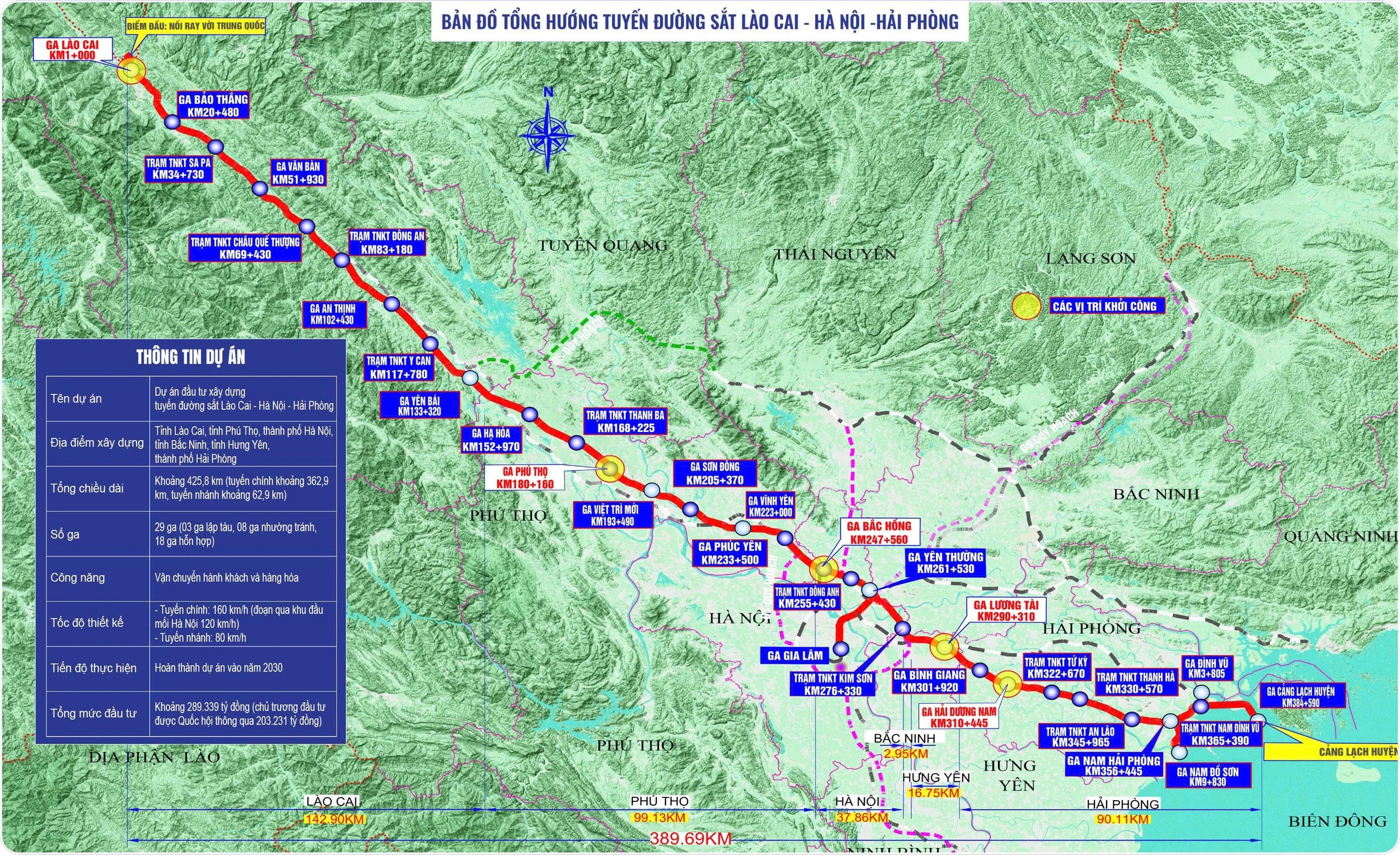
In this additional investment, the total costs for construction and equipment increased by approximately 51.2 trillion Vietnamese dongs. The largest increase came in the section from Bắc Hồng Station to Nam Hải Phòng Station, where the original single-track construction plan was changed to a double-track construction, resulting in an additional investment of approximately 22.8 trillion Vietnamese dongs.
This is one of the changes that best reflects the Vietnamese side's attitude in this adjustment of the plan.
According to the original financing plan, a single-track line would be built for the Hanoi-Haiphong section first. It is expected that a second line will be constructed around 2045, with the track system upgraded to double-track. However, the Vietnamese side believes that there may be a need to build a second line about 10 years after the railway begins operation, based on latest traffic forecasts. Rather than carrying out construction work close to the existing line after the first line has already been in operation, it is better to complete the construction all at once now.
The Vietnam Railway Project Management Department believes that while this approach increases current investment, it can reduce the total cost over the entire lifecycle. Compared to construction in phases, building a double-track line at once is expected to save approximately 12.5 trillion Vietnamese dongs. It also reduces the required land area by about 115 hectares. Additionally, there is no need to add two technical operation stations, some meter-gauge railways, or single-track bridges in the future.
A more direct effect is an increase in transportation efficiency. The operating speed on the Hanoi-Haiphong section is expected to increase from about 95 kilometers per hour to 120 kilometers per hour, reducing travel time by approximately 14 minutes. The Vietnamese estimate that this could generate economic benefits of about 50 billion VND per year.
In addition, this choice also takes engineering safety into consideration. Surveys have shown that there is a lot of soft soil beneath the section between Hanoi and Haiphong. If the first railway line is put into operation before the construction of the second railway line, the settlement caused by construction activities could directly affect the operation of the existing lines. Therefore, “building a double-track line at once” not only increases capacity but also eliminates future construction and operational risks in advance.
The second major investment is the reconstruction of a 8.4-kilometer-long An Yuan-Ji Lin railway, as well as the renovation of Ji Lin Station. The related construction costs will increase by approximately 7.75 trillion Vietnamese dong. If land acquisition and demolition are also considered, the additional investment resulting from this adjustment will be even higher.
According to the latest master plan for Hanoi, Jia Lin will become the main passenger railway hub in the northern part of the capital, while An Yuan will serve as a freight hub.
Therefore, the purpose of constructing the new An Garden-Ji Lin line is not just to add 8 kilometers of railway tracks. It is also to re-organize the road network after the old Street-Hanoi-Haiphong railway enters Hanoi, so that it can connect more smoothly with Vietnam’s existing national railways and Hanoi’s urban rail transit systems. This will also create conditions for implementing TOD development around Ji Lin Station.
The Vietnamese government states that this adjustment can reduce the travel time for railway trips starting from the center of Hanoi by about 8 minutes, resulting in an economic benefit of approximately 10.5 billion VND per year.
In addition, in order to connect the existing railway with the La Chai–Hanoi–Haiphong railway, additional investment of approximately 400 billion Vietnamese dongs will be allocated for two connecting branches.

Another major part of this capital increase isn’t related to rails, bridges, or trains, but rather land.
Compensation, support, and resettlement costs have increased by approximately 34 trillion Vietnamese dongs. Among these, based on the latest land acquisition scale and the current land prices and compensation standards in 2026, the costs have increased by approximately 18 trillion Vietnamese dongs. The additional land acquisition and demolition costs due to the new An Yuan—Jia Lin route amount to approximately 13.8 trillion Vietnamese dongs. In addition, the reservation of land for approximately 1000 hectares of building materials excavation areas and waste sites has further increased the costs by approximately 2.9 trillion Vietnamese dongs.
It is worth noting that the total area occupied by the project has actually decreased compared to the previous plan. This means that the increase in land acquisition costs cannot be simply attributed to ‘more land being occupied’. Rather, changes have occurred in land prices, compensation and resettlement standards, as well as the scope of land acquisition after detailed surveys.
Apart from the basic route, Yuefang has also significantly increased vehicle and railway system configurations this time around.
Investments in locomotives and vehicles increased by approximately 2.7 trillion Vietnamese dongs; investments in other equipment increased by approximately 12.5 trillion Vietnamese dongs due to an increase in the number of items purchased and changes in exchange rates.
Along the line, there will also be additional 22 kV power supply lines and safety facilities for train operation, with an additional cost of approximately 1 trillion VND.
Meanwhile, some engineering designs have been re-optimized, resulting in an increase of approximately 3.8 trillion Vietnamese dong. The main improvements include enhancing the durability and stability of the structures, increasing their flood resistance capabilities, adapting to climate changes, and reducing the impact of railways on existing residential areas.
Some sections that were originally planned to use deep excavation for road cuts will be converted into tunnels. For high fills and lines crossing urban areas, bridges will be used more frequently.
In other words, the Japanese side did not allocate all of the additional investment to 'increasing the length of lines'. Instead, a significant portion of the investment was used to improve the quality of the lines and reduce long-term maintenance and operational risks.
Additionally, the costs for project management and construction investment consulting increased by approximately 160 billion Vietnamese dong, while the contingency funds decreased by approximately 110 billion Vietnamese dong.
Overall, the most noteworthy aspect of this increase of 86.108 trillion Vietnamese dongs in investment is not the total amount itself, but rather the change in the Vietnamese side’s approach to development.
The previous plan reflected a strategy of controlling initial investment and gradually expanding according to future needs. This adjustment clearly favors early investment – those projects that can be completed in one go for the construction of multiple tracks will not be postponed until twenty years later. For those where railway hubs can be established in advance, connecting lines will be built immediately. Supporting facilities such as vehicles, electricity, operational safety, flood control, and climate adaptation will also be implemented simultaneously during the construction phase.
This choice means that the Japanese side is willing to bear higher upfront financial and financing burdens in exchange for reduced future expansion costs, improved transportation capacity, and a more complete connection of road networks.
Especially the Lao Street–Hanoi–Haiphong Railway connects the Vietnam-China border on one end and the largest port cluster in northern Vietnam on the other. It passes through Hanoi and several industrial concentration areas. For Vietnam, this railway not only serves as a regular intercity passenger and freight transportation line but also forms an east-west railway backbone that runs through the northern economic belt, connecting the border railway with the port transportation system.
After adjustments, the maximum design speed for the section from Laojie to Nanhaifang is 160 kilometers per hour, and for the part of the Hanoi railway hub, it is 120 kilometers per hour. The sections from Beihong to Nanhaifang and from Anyuan to Jialin will be built as double-track lines. The main line and the branch line from Anyuan to Jialin will use electric traction. The branch lines leading to the ports will initially use diesel locomotives, and in the future, they will gradually transition to clean energy-powered vehicles.
According to the current plan of the Vietnamese government, the project aims to be basically completed by 2030.
Therefore, the additional investment of approximately $3 billion is not just a simple increase in prices. Instead, the Vietnamese side has decided to complete the capacity that was originally planned for future expansion earlier, while the construction is still in its initial stage. The goal is clear: to reduce the cost of secondary construction in the future operations, so that this railway line connecting the Vietnam-China border, the capital Hanoi, and Haiphong port district will have higher transportation capabilities and a more complete network function from the moment it is put into operation.