Last year on this day, the Japan-US tariff agreement was officially announced by then Prime Minister Ishihara Masayoshi. However, after a year has passed, Mr. Ishihara has stepped down from office, and what remains of this agreement is a mess.
The tariffs imposed by the Trump administration on goods such as cars continue to hinder Japan's export performance. According to this agreement, Japan promised to invest and raise capital in the US totaling $550 billion, but so far only $109 billion has been actually committed, with a completion rate of only 20%, indicating a significant stagnation in progress.
Meanwhile, the U.S. Supreme Court ruled that the “countervailing tariffs” imposed by the Trump administration under the International Emergency Economic Powers Act were illegal. This presents a rare legal reversal in the entire situation.
This agreement was officially announced on July 23 last year by then Japanese Prime Minister Shigeru Ishihara. The core content is that the US will reduce the previously imposed 25% “counter-tax” on imported goods and 27.5% car tariffs to 15%. In exchange, Japan, which had always held a strong opposition stance, softened its position and promised to provide substantial investment and financing to the US.
However, after the agreement came into effect, Japan's exports to the United States decreased rather than increasing. Monthly figures showed negative growth for several months until signs of recovery began to appear in March of this year. In the automotive industry, which was most affected, Toyota and six other major automakers faced a total loss of business profits of 2.4 trillion yen (approximately 99.6 billion RMB) due to tariffs during the fiscal year 2025 (from April 2025 to March 2026).
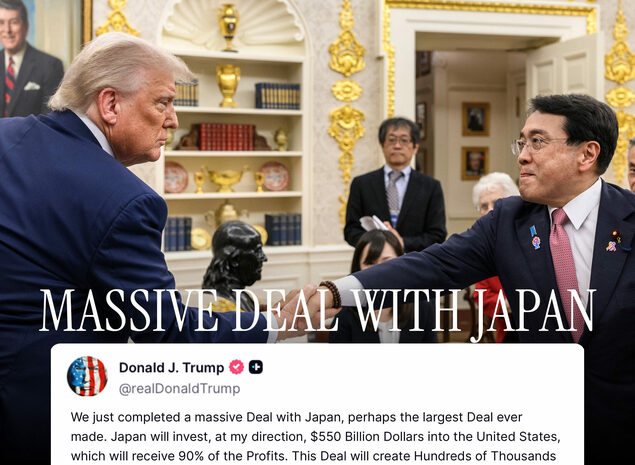
The White House released a photo related to Japan-US tariff negotiations on X (formerly Twitter) on July 22, 2025, in the US time. President Trump (left) shook hands with Japanese Minister for Economic Recovery, Ryutaro Akazawa. Kyodo News
In terms of investment and financing with the United States, although six energy-related projects, including gas and thermal power generation and next-generation nuclear power plants, were finalized in February and March this year, the actual amount invested to date is only about 109 billion US dollars, which is just over 20% of the target set by the two governments. Japanese private businesses lack confidence in future profits, and they are also very concerned about rising investment costs. Therefore, large amounts of capital are still on hold.
More dramatically, there are legal uncertainties involved. In February this year, the U.S. Supreme Court ruled that the Trump administration’s use of the International Emergency Economic Powers Act to impose countervailing tariffs was unlawful, forcing the U.S. to stop such taxation. Instead, new tariffs were imposed under Article 122 of the Trade Act, and the authority granted by this provision is due to expire tomorrow—on July 24th. Although the U.S. has indicated that it will continue to seek other legal grounds to maintain the taxation, this agreement’s dilemma in terms of both law and practice is now completely exposed.