Two years after Germany partially liberalized marijuana regulations, it has become the largest legally regulated marijuana market in Europe. With a sharp increase in imports of medical marijuana, German conservative politicians have begun warning of the risks to crime and health that this poses. The Merz government has also proposed tightening regulations on medical marijuana, but there are still disagreements within the ruling coalition.
According to a report by the British 'Financial Times' on August 22, data from the German Federal Institute for Health shows that the legal import of cannabis in Germany has increased by approximately six times since 2024. In 2024, the government led by Chancellor Scholz allowed adults to possess and grow cannabis privately, and expanded the legal channels for purchasing medicinal cannabis with a doctor's prescription.
Currently, there is increasing criticism from the Christian Democratic Party (CDU) led by Chancellor Merz and its sister party, the Christian Social Union (CSU).
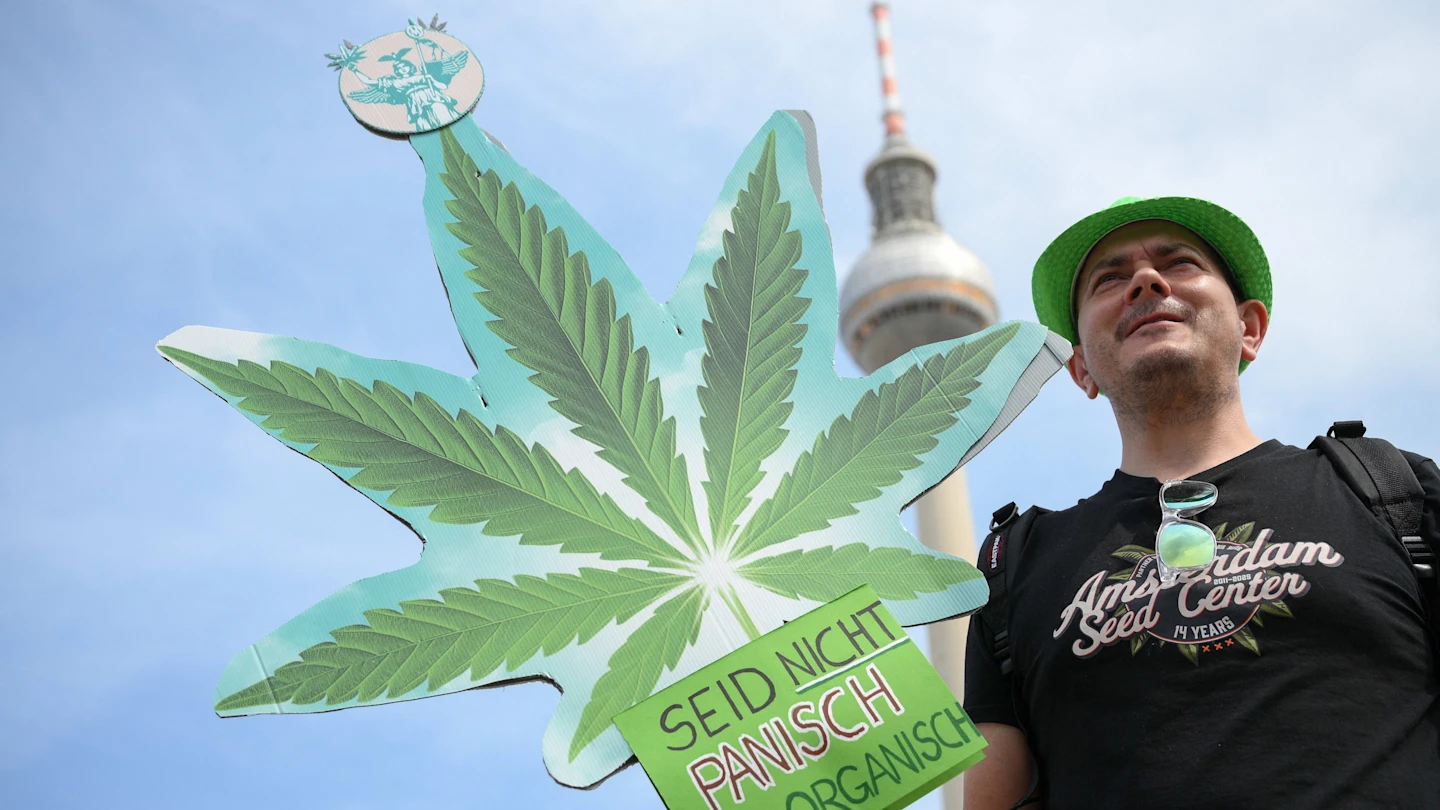
Berlin Marijuana Parade, Financial Times
German Interior Minister and CDU politician Alexander Dobrindt described the Marijuana Law as “a completely useless law,” stating that it weakens efforts to prevent drug use and enforce laws. German Family Minister Carin Prien also called for strengthened measures to prevent addiction among children and adolescents, emphasizing that given marijuana’s potential to become an “entry drug,” early intervention is still very important.
The German Ministry of Health has submitted a draft law aimed at tightening restrictions on the use of medical marijuana to prevent recreational abuse. However, the Social Democratic Party, one of the ruling alliances, opposes this change. The draft law is expected to be discussed in parliament this fall.
Data shows that Germany's imports of medical marijuana increased from 8,143 kilograms in the first quarter of 2024 to 50,539 kilograms in the first quarter of 2026.
A recent study by the University of Hamburg shows that in 2025, the total amount of marijuana available for consumption in Germany will exceed 200 tons. Of this amount, only 2.6 tons will come from domestic production, with the rest mainly relying on imports. The industry research firm Prohibition Partners estimates that the total value of the marijuana market in Germany will reach $997 million that year.
"Jacob Mante, a scientist responsible for the two-year assessment research on this topic, said that "the illegal market is shrinking, but overall consumption has practically remained unchanged."
Research also found an increase in hospital cases related to cannabis, due to the increasing availability of cannabis products containing high levels of THC (tetrahydromethylcannabinol). Manta believes that cannabis products should clearly indicate the THC content and be used according to different medical and mental health conditions. However, some manufacturers are exploiting regulatory loopholes to sell products that lack any scientific basis.
In Kerner Park in Berlin's Neuköllen district, it is quite common to see people openly using marijuana.
22-year-old Swiss youth Dominic told *Financial Times* that he has ADHD, so he prefers to purchase cannabis from German pharmacies on prescription, because he can confirm the THC concentration. "The dark web cannot guarantee this, they say what they want, but it may not be true."
However, even though the medical use of cannabis has been legalized, more than half of cannabis consumers in Germany do not obtain cannabis through prescriptions.
A survey conducted in the second half of 2025 showed that 35.2% of consumers obtained marijuana through “social sources” such as friends and acquaintances, while 21% chose to grow marijuana themselves. Selling marijuana without a medical prescription is still illegal.
A 23-year-old resident of Berlin, Lisa, stated that her dealer even provides door-to-door delivery service. “The quality is excellent, and there are many different varieties to choose from.” She also said that she had friends growing marijuana, "Because I know them, so the quality is guaranteed."
Forty-five year old hobby farmer Hendrik Liete believes that the cost of his own farming is lower if he can continue to do so legally. He considers repealing legal regulations a "stupid" decision, because these laws have positive effects on society as a whole.
It is noteworthy that research has found that cannabis-related criminal activities have decreased by about two-thirds compared to before the reform, while overall cannabis consumption has remained stable. At the same time, German wastewater monitoring data shows that the residual concentrations of cocaine and 'khat' have nearly doubled over the past two years.
