This summer has been an exceptionally busy season for Turkish diplomacy. In just a few weeks, Ankara has made progress in three areas that do not seem directly related to each other: NATO, ASEAN, and a new security cooperation mechanism involving Turkey, Saudi Arabia, and Pakistan.
They seem to belong to completely different diplomatic agendas. But when put together, we can see that Turkey is trying to adapt to an increasingly regional and networked international system, and by participating in institutional arrangements in different regions and with different characteristics, it is expanding its strategic flexibility.
Ankara seems to be forming a new diplomatic logic: it is not prepared to simply choose between the “West” and the “East,” but rather attempts to enter multiple networks at the same time. This could be referred to as a form of “multidirectional connectivity.”
The international media's attention first turned to the NATO summit in July. As the second-largest military force in NATO, Turkey reaffirmed its position within the transatlantic security framework through this summit. However, remarkably, one of the most discussed topics by international media after the summit was not the summit communiqué itself, but rather the guns that Turkish President Erdogan presented to some foreign leaders. This seemingly minor diplomatic incident unexpectedly revealed a contradiction in European security politics: some European leaders found it difficult to bring this gift back home due to legal restrictions in their countries.
While Europe is discussing rearmament, increasing defense budgets, and establishing more autonomous defense capabilities, there are still significant differences in political cultures, legal systems, and perception of threats among different countries. Although NATO has unified collective defense provisions, this does not mean that member states have developed completely consistent security perspectives.
If NATO represents Turkey's long-term integration into the Western security system, then another event that occurred in July revealed another aspect of Ankara's involvement in Asia.
On July 21, 2026, during the 59th ASEAN Foreign Ministers' Meeting held in Manila, the capital of the Philippines, Turkey was officially granted the status of an ASEAN dialogue partner. As early as 2019, Turkey formally introduced the “New Asia Initiative” (Yeniden Asya), aiming to re-establish long-standing, relatively decentralized political, economic, and social relations with Asian countries.
Therefore, what truly matters about being a dialogue partner is not just a diplomatic title, but rather the fact that it allows Turkey to further integrate into the regional cooperation networks that are emerging in Asia. ASEAN has a population of nearly 700 million people, and its surrounding countries include major economies such as China, Japan, South Korea, India, and Australia. For Turkey, which has long been oriented towards the European market while hoping to expand its economic influence in Asia, being part of this network is of long-term strategic importance.
Meanwhile, on another axis, Turkey has taken more notable actions—signing trilateral defense agreements with Saudi Arabia and Pakistan.
Since the crisis erupted on October 7, 2023, the military, geopolitical, and political dynamics in the Middle East have undergone profound changes, leading to a fundamental period of strategic transformation. The regional security framework, the relationships between various forces, and the geopolitical arrangements of global powers in this region have all been reconfigured as a result. Suicide drones, proxy forces, non-state actors, and continuously updated security strategies of regional nations—these factors, combined with the risk of the crisis spreading throughout the Middle East, are contributing to an increasingly asymmetric security environment in the region.
Facing a rapidly changing and increasingly complex security environment, stretching from the Eastern Mediterranean to the Persian Gulf and even South Asia, all parties are faced with the need to redefine the balance of regional powers. Against this backdrop, Turkey, Pakistan, and Saudi Arabia have found a common strategic support. On August 7, 2026, the three countries held a meeting in Mecca, taking a historic step by officially signing the "Mecca Joint Defense Agreement."
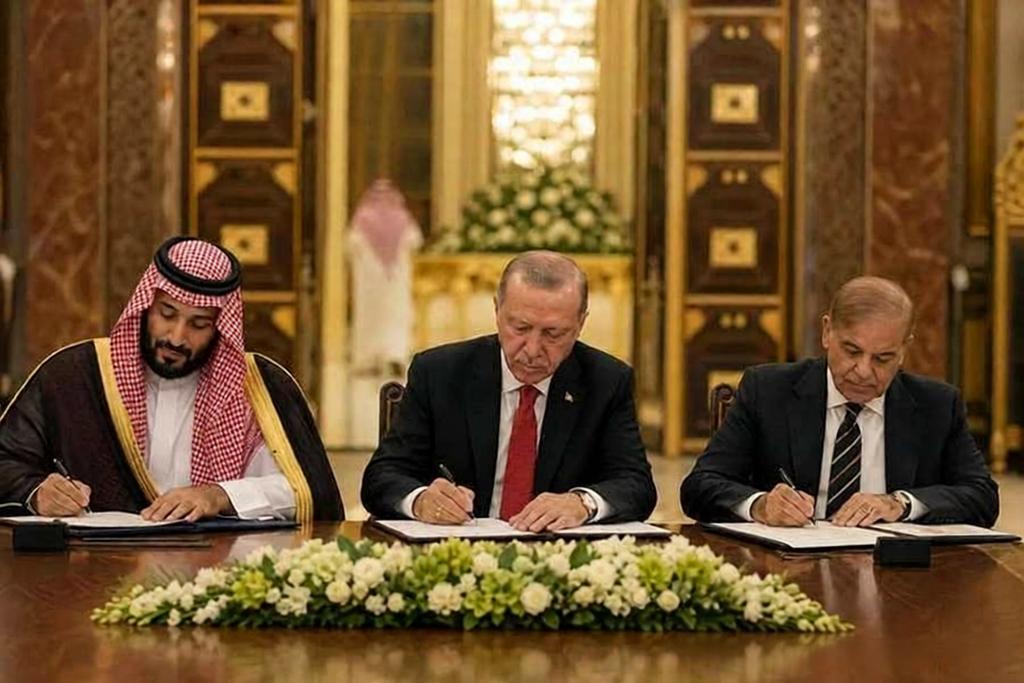
The Three Kingdoms signed the "Mecca Joint Defense Agreement"
After the agreement was announced, one of the terms that quickly emerged was “Islamic NATO”. However, this term is somewhat misleading. The three countries came together not solely due to what is called “Islamic unity”; what truly drove the cooperation was the shared geopolitical reality and security needs. At the same time, the Mecca Agreement may have a stronger economic dimension than traditional military alliances. In the future, with the development of trade corridors, defense industry cooperation, and investment projects, this security mechanism is likely to gain a clearer economic and trade context.
If we only consider the resources possessed by these three countries, there is indeed a clear complementarity among them. Saudi Arabia has strong capital and energy capabilities; Pakistan possesses nuclear deterrence capabilities as well as long-term military experience; Turkey has the second-largest military force in NATO and has developed a increasingly sophisticated defense industry system in areas such as drones, missiles, armored vehicles, warships, ammunition, and electronic warfare. This complementarity is particularly evident in the defense industry. If Saudi capital is combined with Turkey's sophisticated military industry, it could not only provide new financing and joint investment opportunities for some high-investment, long-term projects, but also reduce research and development costs as well as initial investment expenses by expanding orders and production scale.
But rather than simply referring to it as “Islamic NATO,” it might be more important to note that the Mecca Agreement may be sending a new signal: Turkey, Saudi Arabia, and Pakistan are attempting to enter a new stage of “collective strategic autonomy,” working together to shape regional security arrangements. The key is not to eliminate all external forces, but to retain strategic options, reduce security risks, and mobilize complementary resources among the three countries, without completely handing over regional order to any one external power.
In this sense, the Mecca Agreement could become a significant turning point in the regional security architecture. The agreement states that an armed attack against any member state will be considered a joint attack against the three nations. This expands the triangular relationship beyond mere defense cooperation and establishes a institutional foundation for collective deterrence.
It is particularly noteworthy that this mechanism does not necessarily remain confined to just three countries. Currently, the possibility of regions such as Egypt, Syria, and Qatar gradually joining this security framework has also been discussed. If this mechanism continues to expand, its nature may evolve from a trilateral defense cooperation to a more comprehensive regional security mechanism. If this vision ultimately becomes reality, its geopolitical significance will undoubtedly increase further. The question then arises: Who is this alliance aimed at? Iran, Israel, or the United States? Different observers have given completely different answers.
One view is that the formation of this mechanism will further isolate Iran. Especially after a direct military conflict between the United States, Israel, and Iran, and Iran expanding its retaliation to the Gulf region, Middle Eastern countries’ concerns about the regional security order have increased significantly. Another completely different explanation is that in the long term, the real threat to this security framework may not be Iran, but rather Israel’s increasingly expanded regional military capabilities.
The recent events in northern Syria seem to reinforce this judgment. On August 18th, Israel launched an air strike on the Abuzuhur Air Base in Idlib province. Unlike Israel’s previous military actions, which were mainly focused on southern Syria, this attack targeted the northern region where Turkey’s influence is growing. Israel explicitly stated that it does not tolerate any Turkish troops being stationed at the base, and viewed it as a security threat. This indicates that as Turkey’s security role in Syria and broader regions increases, Israel is increasingly openly considering Ankara as a regional competitor that needs to be constrained.
This involves both political factors within Israel and strategic considerations related to maintaining its freedom of military action in Syria. Especially given Turkey's efforts to enhance its air power by upgrading its F-16 fleet, advancing the KAAN fighter jet program, and seeking to return to the F-35 program, Israel may wish to maintain its current advantage in terms of air power until further changes occur in the regional balance of air forces.
There is another perspective that takes a broader view: the Mecca Agreement indicates a declining confidence among Middle Eastern countries in the American security umbrella. All these explanations make some sense. However, if one only understands the Mecca Agreement from the perspective of 'whom this alliance targets', it may still underestimate its significance. The more important question is not to find a specific enemy, but why these three countries believe it is necessary to establish such a mechanism now.
Over the past few decades, the international order has been largely based on the systems led by major powers: the security field relies on the alliances led by the United States, the economic field relies on the market systems formed through globalization, and international rules are mainly shaped and maintained by a series of institutions and international organizations established after World War II. But today, this system is changing. China’s rise is undoubtedly one of the most important structural factors in this change. Its growing economic and diplomatic influence also provides more countries with new opportunities for cooperation and relatively stable, predictable choices. As options in the international system become more diverse, actors other than major powers also gain greater strategic space. It is against this backdrop that the role of “middle-sized powers” is beginning to receive increasing attention.
The Canadian Prime Minister emphasized the importance of medium-sized powers in the new international context during his widely discussed speech at Davos. This concept is becoming increasingly important for understanding current international politics. In a world where great power competition is intensifying, medium-sized powers do not necessarily have only two options: to join A or B. A third possibility is also emerging: to connect with each other.
Saudi Arabia, Turkey, and Pakistan are countries that have significant regional influence, but they are not strong enough to shape global order on their own. They all maintain important relations with the United States, yet they all seek to expand their strategic autonomy to varying degrees. From this perspective, perhaps what makes the Mecca Agreement most notable is not whether it will become a true "Islamic NATO," but rather the broader trend it reflects: medium-sized powers are attempting to establish their own institutional networks. This is why it is worth observing both the Mecca Agreement and Turkey's participation in the ASEAN dialogue network.
On the surface, the ASEAN-Megarex agreement has little to do with each other. ASEAN is located in Southeast Asia, with economic cooperation, diplomatic coordination, and regional governance as its core; the Megarex agreement connects the Middle East, South Asia, and Anatolia, emphasizing security and defense more. However, for Turkey, they actually represent two different directions of the same diplomatic logic. The ASEAN agreement represents economic and diplomatic connections. The Megarex agreement represents security connections. One extends eastward into the Asia-Pacific region, while the other connects to the Middle East and South Asia both southward and eastward.
In fact, if we use the framework of ‘strategic circles’ proposed by Turkish scholars Murat Yeşiltaş and Ferhat Pirinççi in their book ‘Turkey’s Grand Strategy’, these two diplomatic actions fall at different strategic levels. The two scholars divided Turkey’s geostrategic space into five circles. The third strategic circle includes regions that do not have direct land-sea borders with Turkey but can directly affect its core interests, such as the Middle East, North Africa, Europe, Balkans, and Central Asia. The fourth circle extends further to the Horn of Africa, Sub-Saharan Africa, Latin America, and Asia.
According to this framework, the Mecca Defense Agreement mainly occurs in Turkey’s third strategic circle, while the ASEAN dialogue partnership falls within the fourth strategic circle. The simultaneous progress of both indicates that Ankara’s current strategic autonomy does not involve a linear expansion in one direction. Instead, it employs different tools at different geopolitical levels: in the third circle, it relies more on security, defense, and strategic cooperation; in the fourth circle, it relies more on diplomacy, economic ties, and institutional connections. Somalia provides another example of the fourth strategic circle.
As an important country in the Horn of Africa, Somalia has become a crucial hub for Turkey's security and energy cooperation in recent years. The two countries signed defense agreements in 2024 and energy cooperation agreements in 2025. It seems that Turkey's fourth strategic sphere extends not only to Asia, but is also forming new hubs in the Horn of Africa on the other side of the Indian Ocean.
In the past, people tended to discuss “globalization”. However, the trend that has emerged in recent years can be described more accurately as “regionalized globalization”. The world is not completely decoupled, but a single global security and economic system is being supplemented by an increasing number of regional networks that overlap with each other. The ASEAN, Gulf Cooperation Council, BRICS mechanisms, Shanghai Cooperation Organization, and various forms of small multilateral security mechanisms all reflect this trend. The international order in the future may no longer be like a pyramid, but more like a network. For medium-sized powers like Turkey, this means a new opportunity. The key is to occupy as many network nodes as possible. This is what is called “multi-directional connectivity”.
Of course, if the Mecca Agreement is understood merely as a military alliance, another important dimension may be overlooked. Security architectures can ultimately have economic spillover effects. Capital does not favor wars, supply chains do not favor blockades, and logistics do not favor unpredictable maritime routes. In recent years, a series of crises that have occurred in the Strait of Hormuz, the Red Sea, and the Gulf of Aden have repeatedly shown that modern economies’ “global supply chains” are actually highly dependent on a few extremely fragile geographical nodes. Chinese leaders often emphasize the idea when discussing the relationship between security and development: security is a prerequisite for development.
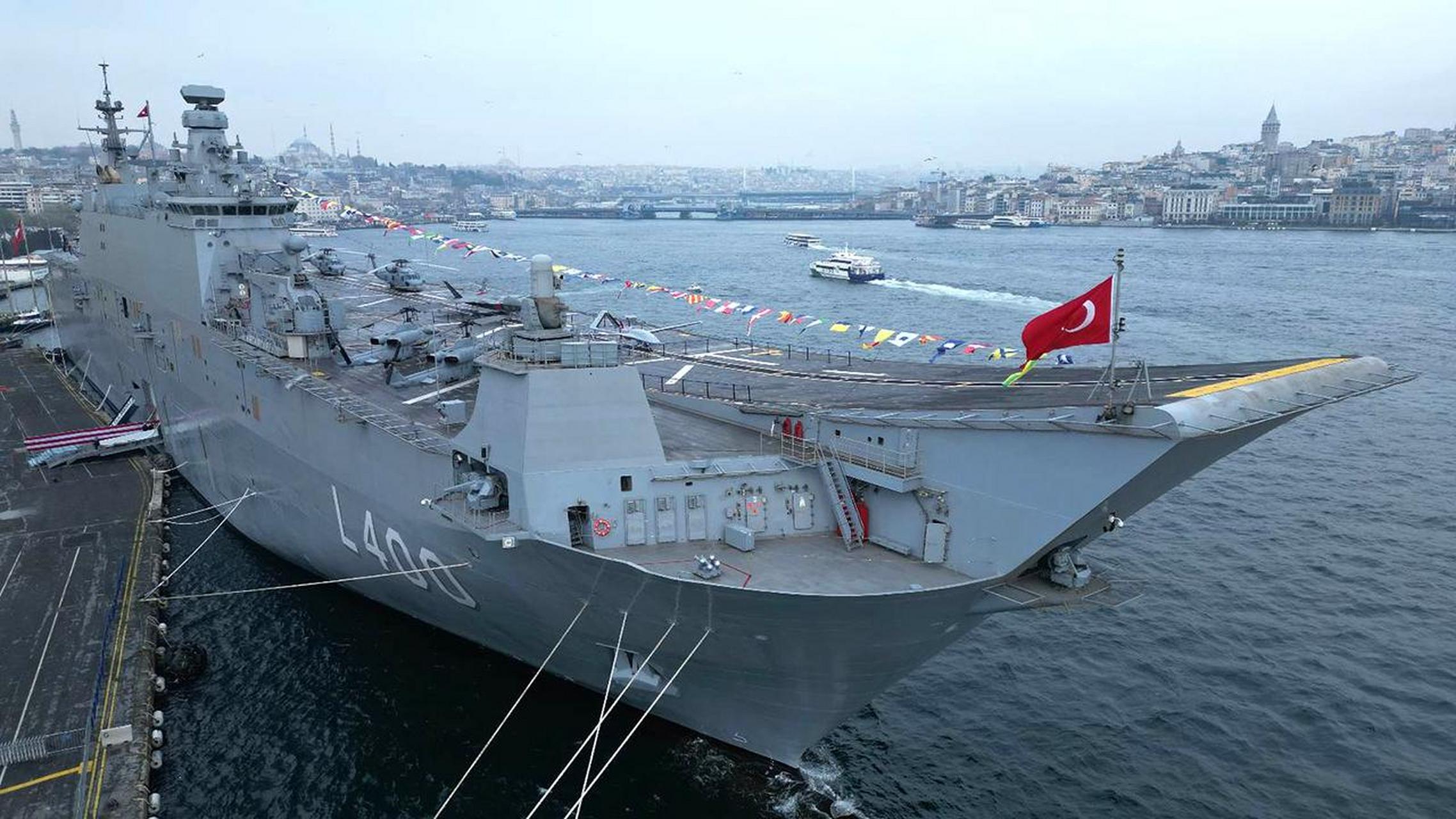
Turkish Anadolu aircraft carrier
This trend of combining security with economy has begun to emerge in the energy sector. On August 1st, Turkey and Iraq signed a one-year crude oil transportation agreement, which allows for a daily capacity of 750,000 barrels per day for the Iraqi-Turkish crude oil pipeline to transport oil from Iraq. More notably, this pipeline has a technical capacity of about 1.5 million barrels per day. Ankara hopes that in the future, not only will it transport oil from Iraq, but also crude oil from Kuwait and other Gulf countries through Turkey to the Jebel Ali port, and then into the world market. This means that the economic logic behind regional security cooperation involves more than just investment and military cooperation; it also includes the re-layout of energy and trade routes. Against the backdrop of higher geopolitical risks to traditional energy routes like the Hormuz, the strategic value of land-based energy corridors connecting the Gulf, Iraq, Turkey, and the Mediterranean is increasing.
From this perspective, what truly deserves attention in the future of the Mecca Agreement may not be just joint military exercises, arms cooperation, or military coordination. More importantly, it is whether it can gradually create a more stable regional economic cooperation environment. If Saudi Arabia's capital, Turkey's industrial base and logistics location, and Pakistan's geographical position that connects South Asia with the Indian Ocean can form economic connections through security cooperation, then the significance of the Mecca Agreement could go beyond traditional military alliances.
Changes in the safety environment will ultimately be reflected in the business world. In the past, when companies calculated whether a cross-border trade was worthwhile, they often considered price, transportation distance, and logistics costs. But today, security risks, financial settlements, and supply chain stability are increasingly being taken into account in these cost calculations.
This change is also very evident in actual commercial activities. Taking my own work experience as an example, after the conflict occurred, some bank settlements that were originally carried out in Dubai were affected. Turkish banks provided more direct and flexible solutions for some cross-border transactions. Similar changes occurred at the supply chain level. In the past, Turkish companies rarely considered Chinese suppliers when purchasing some petrochemical products from the Middle East, as transportation distances from China were longer and logistics costs were higher. However, the increased risks caused by the war, along with changes in transportation and transaction costs, have changed the original cost structure and comparative advantages. As a result, Chinese suppliers have begun to be included in the choice options of more Turkish companies.
This is also a fascinating reality: Geopolitics does not change the distances on the map, but it can alter the distances in a commercial sense. When security, financial, and logistics risks are taken into account, suppliers that were once far away may become closer, and markets that had geographical advantages may lose some of those advantages as well.
If you zoom out a bit, an even more interesting picture appears. One of the most important maritime routes for global trade starts from East Asia, passes through the South China Sea to the Strait of Malacca, then across the Indian Ocean, via the Arabian Sea, the Strait of Mandeb, and the Red Sea, eventually reaching the Mediterranean and Europe. Turkey’s recent diplomatic actions occur at different points along this vast maritime corridor.
The significance of the Mecca Agreement is no longer limited to military cooperation between three countries. In an era where global order is accelerating towards regionalization and major powers are reshaping trade and security networks, it serves as a microcosm of how middle-sized powers seek new forms of cooperation.
As great-power competition reemerges as the main thread of international politics, the world has not simply returned to the era of two camps confronting each other. Instead, more and more middle-sized powers are seeking strategic autonomy, using regional cooperation, small multilateral mechanisms, and cross-regional networks to diversify risks and expand options. Consequently, the global order is evolving from a "pyramid" dominated by a few major powers to a "network" where different regional forces, economic corridors, and security mechanisms interweave. If globalization's key term over the past few decades has been "interdependence," then the key term for the future international order may increasingly be—maintaining autonomy within interdependence, and establishing connections within multipolarity.
