On August 20th, Switzerland and China officially announced the completion of negotiations for an upgraded free trade agreement. As a result, almost all of Switzerland's exported goods will enjoy tariff reductions with China. This news brought relief to the Swiss government and export-oriented companies.
According to a statement released by the Swiss government on that day, the new agreement will grant zero tariffs for 99.8% of Swiss exports to China. Swiss iconic exports such as watches, pharmaceuticals, and precision instruments will be able to enter the Chinese market completely duty-free. At the same time, Swiss investors will also have more convenient access to the Chinese market.
China is Switzerland's third-largest trading partner, after Germany and the United States. According to Reuters, bilateral trade volume reached 46 billion Swiss francs in 2026, equivalent to about 57.6 billion US dollars or 388.6 billion yuan. According to Swiss customs data, bilateral trade volume increased from 31.7 billion francs in 2015 to 51.2 billion francs last year. China is an important market for Swiss chemicals, pharmaceuticals, precision instruments, and watches.
After meeting in Bern, Chinese Minister of Commerce Wang Wentao and Swiss Federal President and Minister of Economics and Education Pamlan jointly announced the completion of the negotiations.
In the free trade agreement that took effect in 2014, China granted duty-free treatment to almost all goods exported to Switzerland. However, only about half of Swiss exports to China enjoyed the same preferential treatment. The new agreement also covers areas such as origin rules and trade facilitation, service trade, digital trade, competition, and economic and technical cooperation.
For Switzerland, which relies heavily on exports, this agreement undoubtedly brings relief in the complex international economic and trade context. The stock prices of Swiss companies such as Swatch Group and Ferrari Group rose in response.
The Swiss government reached a preliminary agreement with Washington in November last year, setting the customs duties at 15%. However, due to the US's reluctance to sign a legally binding agreement, there are still doubts about this. Last summer, the Trump administration initially imposed a 39% tariff on Switzerland, which was the highest rate among developed countries at that time.
Bloomberg says that, in the current uncertain global trade environment, especially with continued pressure from US trade policies, this new agreement with China is seen by Switzerland as an important "pressure relief valve". It not only strengthens Switzerland's export competitiveness but also reflects China's strategy of actively deepening economic ties with European countries while competing with the United States for global influence.
According to reports, after completing legal reviews, China and Switzerland plan to officially sign the agreement later this year, and then initiate the approval processes in their respective countries.
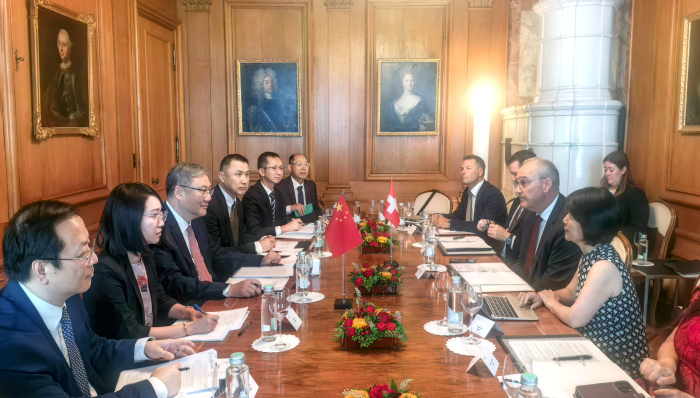
China-Russia consultations with the Ministry of Commerce of China
The China-Russia Free Trade Agreement was signed in July 2013 and came into effect in July 2014. It is the first free trade agreement signed between China and European countries. After this upgrading negotiations are completed, both sides will accelerate the implementation of their respective domestic procedures to formally sign the upgrading protocol at an early date.
Chinese Commerce Minister Wang Wentao stated that in September 2024, China and Switzerland initiated negotiations to upgrade their free trade agreement. Through five rounds of consultations, the negotiations to upgrade the agreement were successfully completed. Both sides have pledged to achieve higher levels of bilateral openness in various areas such as goods, services, investments, and rules. This will create new opportunities for economic and trade cooperation between the two countries. Switzerland is an important partner for China, and its cooperation with China has always been at the forefront. In today's uncertain international environment, this also demonstrates the clear determination of both sides to support free trade.
He emphasized that this year is the beginning year of China's 15th Five-Year Plan, and it also marks the 10th anniversary of the establishment of an innovative strategic partnership between China and Switzerland. The Chinese Ministry of Commerce is willing to work together with the Swiss Federal Department of Economic Affairs and Research to implement the important consensus reached by the two leaders. We aim to complete the formal signing and implementation of the upgraded agreement as soon as possible, in order to enhance the quality and level of bilateral economic and trade relations, and to benefit both Chinese and Swiss businesses and people more effectively.
