According to a joint observation study conducted by scientists from the Institute of Oceanology, Chinese Academy of Sciences, released on August 20, 2026, the trend of long-term decline in the mass of the Antarctic ice sheet has shown a phased slowdown. Between July 2021 and April 2023, the mass of the Antarctic ice sheet increased by approximately 695 billion tons. This is the largest mass increase recorded in nearly 20 years by gravity satellite observations.
Research indicates that this change is due to atmospheric processes driven by tropical oceans, which alter the path of water vapor transport and increase snowfall in the Antarctic region. The related findings were published online in the international academic journal Nature on August 19, 2026.
The Antarctic ice sheet is one of the important uncertainties contributing to global sea-level rise. Between 2003 and 2024, the Antarctic ice sheet lost an average of about 140.5 billion tons of ice each year. However, during the period from 2021 to 2023, continuous heavy snowfall occurred in the eastern part of Antarctica, which partially offset the ongoing loss of ice in South Antarctica.
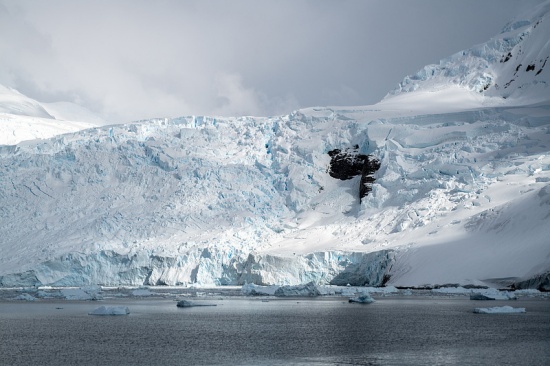
Antarctic glaciers. Image provided by CCTV News.
The first author of the paper, Wang Yunneng, an associate researcher at the Institute of Oceanology, Chinese Academy of Sciences, explained that from 2021 to 2023, the sea temperatures in the warm pool area of the tropical Western Pacific were consistently high. This region is one of the areas with the highest sea temperatures worldwide and is also one of the regions that release the most heat into the atmosphere. The abnormal warming in this area has reshaped the atmospheric circulation patterns.
The consistently warm sea water has stimulated large-scale atmospheric waves. These waves, propagating to the high latitudes of the Southern Hemisphere, have formed a north-south dipole circulation pattern near southeastern Antarctica, thereby altering the wind field and the route of moisture transport. Moisture tracking simulations show that moisture from the mid-latitudes of the Indian Ocean is transported to southeastern Antarctica, resulting in the aforementioned heavy snowfall and contributing to an increase in the mass of the ice sheet.
As early as 2025, a team from Tongji University pointed out an "abnormal increase" in the Antarctic ice sheet during 2021-2023 in the journal Science: Earth Sciences. The study also emphasized that the rate of ice sheet mass loss had almost doubled over the previous decade (2011-2020). If all four key glacier basins in Antarctica were to melt completely, it could lead to a global sea level rise of more than 7 meters.
Observations and simulations indicate that such warming events occur approximately every ten years. However, short-term increases in ice mass cannot change the overall trend of long-term ice loss in the Antarctic ice sheet. Specifically, the ice sheet in southwestern Antarctica continues to lose ice; at the same time, some of the outlet glaciers in southeastern Antarctica are also threatened by melting at the base of the ice shelves and accelerated ice flows caused by warm ocean water.