On August 19, the Zhuque-3 Remote Satellite Launch Vehicle developed by Lanzhou Aerospace was launched and successfully completed land-based recovery. This mission is the first time in China that a reusable launch vehicle’s sub-stage has been successfully recovered using a land-based method, following the successful recovery of the first stage of the Long March 10 B launch vehicle from the maritime network on July 10. This marks a significant breakthrough in China’s reusable rocket technology.
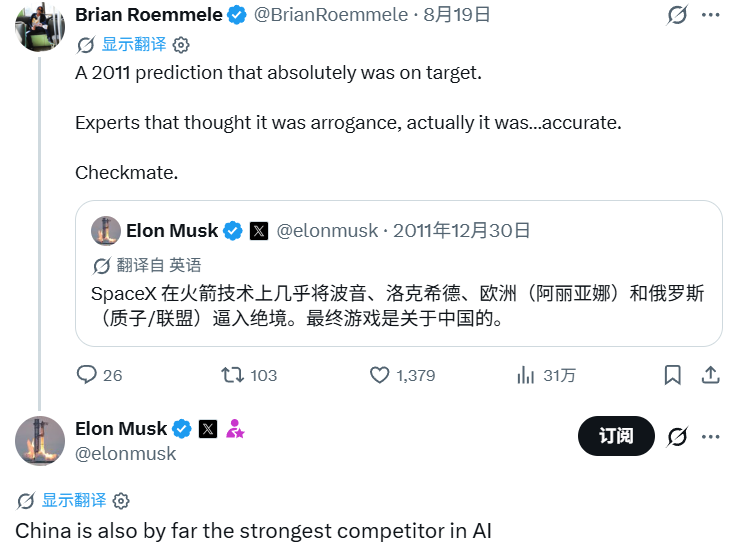
On that day, on the American social media platform X, a netizen discussed this matter and mentioned a “prediction” made by SpaceX CEO Elon Musk in 2011 regarding the development of rocket technology in various countries. In that post, Musk wrote, “SpaceX has almost forced Boeing, Lockheed, European (Ariane rockets), and Russia’s Proton/Alouette rockets into a corner in terms of rocket technology. The final battle of this competition will only be decided by China.”
This netizen was amazed by Musk’s prediction, which turned out to be “completely accurate”. Musk also reposted this post and replied, “China is also the strongest competitor in the field of artificial intelligence right now.”
Many foreign media reports on China's successful recovery of the rocket on land have mentioned the rapid development of China's commercial space industry. Reuters reported that rocket recovery is crucial for reducing costs, and could make space exploration a commercially viable industry similar to civil aviation. Thus, LanChang Aerospace has become the third private company in the world to successfully recover a orbital stage booster, following SpaceX and Blue Origin, further narrowing the technological gap between China and the United States in this field.
The American space news website space.com reported on July this year, where China achieved the world’s first recovery of a rocket launch vehicle network. It stated that the Long March 10B rocket gently landed into a mesh device fixed to a ship at sea during the recovery process. In this case, the Zhuque-3 rocket landed directly on land and maintained an upright position using its landing legs.
The website also noted that, in addition to Blue Arrow Aerospace, several Chinese private commercial space companies are currently developing technologies for the recycling of sub-vehicles of reusable launch vehicles. Given the development trend of China's commercial space industry, “rocket landing and recovery may no longer be something new in China in the future.”