"The Iran war revealed the value of diversified supply chains and strategic reserves—China has learned these lessons over the past twenty years, while other Asian countries are now paying a heavy price for it."
The British 'Financial Times' wrote in an article on August 17 that years of energy security strategies have allowed China to show greater resilience during the energy market turmoil caused by the war in Iran. Compared to some Asian countries, which have faced soaring energy prices and even supply shortages, China has suffered relatively less impact, and its energy strategy has begun to be adopted by other nations.
The report suggests that this crisis has actually served as a “stress test” for China’s energy strategy over the past 20 years. China has long attached great importance to reducing its dependence on imported oil and gas. To this end, China has increased domestic energy production, vigorously developed renewable energy sources such as hydropower, wind power, and solar energy. At the same time, coal is utilized to ensure energy security, serving as a “ballast stone” in ensuring energy stability. On the other hand, China is accelerating the electrification of industries such as automobiles, thereby reducing oil consumption.
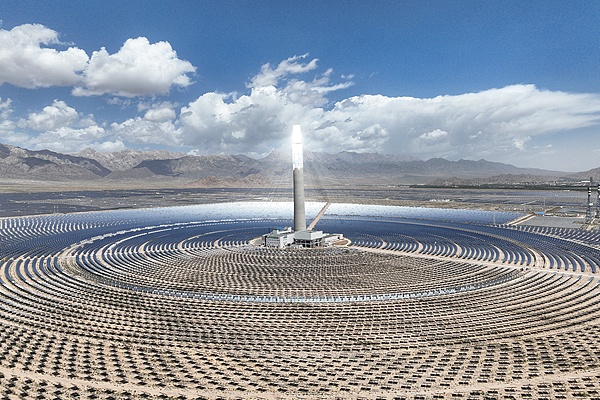
Qinghai Haixi Prefecture, aerial view of Delingha molten salt tower solar power station, shining brightly under the sunlight. Visual China
This transformation has already shown significant results. Data from the International Energy Agency shows that Chinese new energy vehicles can currently replace about 1 million barrels of gasoline and diesel per day. By 2035, this figure is expected to exceed 4 million barrels. The Chinese side estimates that domestic oil consumption will reach its peak before the end of the 2020s, and demand for gasoline and diesel may have peaked.
At the import side, China is also continuously diversifying its risks. Before the outbreak of the conflict in Iran, about 60% of China's crude oil imports came from the Middle East. Although this proportion is not low, it is still significantly lower than Japan's level of over 90%. In terms of natural gas, only about 17% of China's imported natural gas comes from the Middle East. Land-based pipelines from Russia and Central Asia account for nearly half of China's imports, ensuring that some supplies are not affected by maritime routes.
Strategic reserves serve as another “insurance” measure. According to estimates, China had over 1 billion barrels of crude oil stockpiles before the war. Even if imports were completely cut off, these stocks would be sufficient to meet imports for more than 100 days. In the first half of this year, China’s crude oil imports decreased by more than 1.3 million barrels per day. However, domestic fuel supplies remained stable overall, and stockpiles played an important role as a buffer.
The Financial Times believes that the Iran war has highlighted the importance of diversified supply sources and strategic reserves. China began to develop this strategy over 20 years ago. Now, other Asian countries are also considering expanding their energy reserves. China's approach of reducing import risks, promoting electrification, diversifying supply sources, and establishing large reserves may be adopted by more countries in the future, thereby further changing the global energy market.