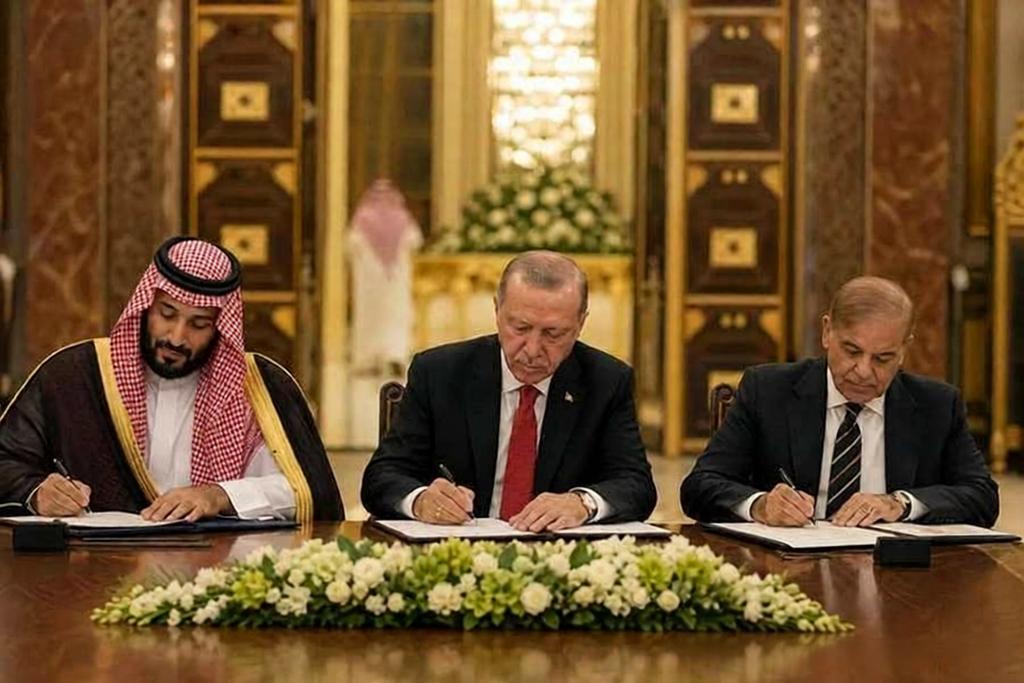
Recently, Saudi Crown Prince and Prime Minister Mohammed, Turkish President Erdogan, and Pakistani Prime Minister Sharif signed a joint defense agreement in Mecca. The most notable clause is that any armed attack against one of the three countries will be considered an attack on all three countries.
On August 12 local time, Erdogan stated that he hopes more countries will join in the future.
As soon as the "Mega Defense Agreement" was finalized, attention was not just focused on who would form alliances with whom. The United States, India, and China were all brought into the discussion.
Several analysts said that this agreement appears to be a form of 'grouping together' by the Islamic world, but in reality, it is a vote of distrust towards the American security umbrella. Against the backdrop of changes in U.S. security policy, this ‘creates opportunities for China to expand its presence in the region.’
Similarly, for India, which is considered Pakistan's "rival," this is certainly not good news.
It is worth noting that while Indian media and scholars are anxious, they do not forget to mention China. They also describe China as the ‘low-key winner’ of this latest trilateral agreement. In many analyses, there is a recurring question: will China be invited into this new circle?

On July 7th, Turkey, Saudi Arabia, and Pakistan signed the "Mecca Security Agreement." Oriental IC
India is pulling China's hair out of anxiety.
Shanghai Institute of International Studies researcher Liu Zongyi told Observer Network that India is anxious because it often chooses the wrong side and makes serious strategic misjudgments. India also stands in opposition to the Islamic world and has always regarded China as its greatest threat and opponent, 'not knowing its own true strength.'
I believe that the Three Kingdoms will not invite China to join the Mecca Defense Agreement. Even if they do, China will not agree to it.
Liu Zongyi stated that China's position is clear; it will not participate in military agreements or military alliances. Pakistan is fully aware of China's stance, and therefore will also not promote China's participation in such defense agreements.
Saudi Arabia, Turkey, and Pakistan came together not out of whim, each having their own agendas.
For Turkey, Ankara hopes to add a economic giant and a nuclear power to its ranks, thereby significantly enhancing its deterrence against Israel. The country's defense industry will benefit from broader commercial opportunities. Erdogan uses this as an opportunity to expand his influence in the Muslim world.
Saudi Arabia's calculations are more realistic: it doesn't want to rely entirely on the United States for its security.
Liu Zongyi analyzed that for Pakistan, signing the Mecca agreement involves considerations at both international and domestic levels.
At the international level, firstly, it aims to strengthen its role as a regional security hub. As the only nuclear state in the Islamic world, this country can further consolidate the position of its core military forces. Secondly, it seeks to increase its voice and diplomatic influence. Thirdly, it can serve as a bridge between China and the Middle East, the Islamic world – while also receiving support from China for industrialization in Pakistan, financial assistance from Saudi Arabia, and military aid from Turkey.
He pointed out, “The previous security framework in the Middle East was led by the United States, but countries have realized that the U.S. commitment to security is not reliable.”
At the domestic level, it is possible to alleviate the pressures of domestic development. This includes financial debt relief: Saudi Arabia and other Gulf countries can provide financial support, thereby reducing the pressure of debt defaults caused by the Fed's interest rate hikes and external shocks. It also includes easing counter-terrorism pressures: Saudi Arabia can offer political support, while Turkey can provide counter-terrorism equipment to combat militant groups like the Baluch Liberation Army and "Baitullah" among other domestic separatist and terrorist forces.
In addition, if conflicts between India and Pakistan occur again, Gulf countries like Saudi Arabia will clearly take a side, changing the previously isolated position of Pakistan in its relations with India.
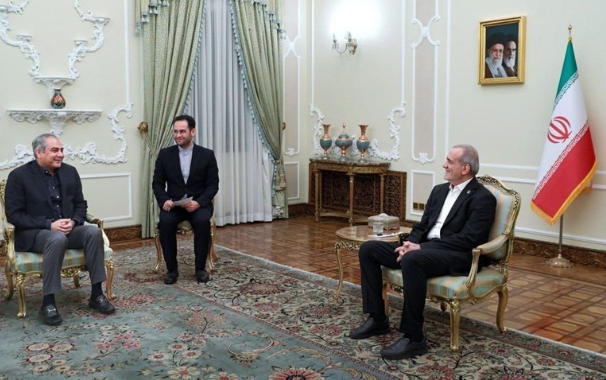
On the 12th, Pakistan’s Interior Minister (left) met with the Iranian President. IRNA
It is noteworthy that Pakistan is actively expanding its diplomatic reach. According to Iran's official news agency IRNA, after the agreement was signed, Pakistani Interior Minister Nawaz Khan visited Iran immediately, emphasizing that bilateral relations are “irreversible”. This action clearly aims to maintain balance.
In summary, the interests of the three parties overlap, but they are not exactly the same. This precisely gives the agreement more flexibility.
The Australian think tank Loy International Policy Institute calls this a "strategic ambiguity," as the public statements still fail to clarify command arrangements, troop commitments, consultation procedures, and how member states will respond to attacks by non-state actors. Analysts say this ambiguity can still serve as a deterrent, and it has different benefits for all three signatory countries.
Turkey is a NATO member country. Saudi Arabia is a traditional partner of the United States. Pakistan has nuclear weapons and maintains close relations with the United States.
These three signatory countries have maintained long-term ties with Washington, but they are all sending signals indicating that they no longer wish to rely entirely on a single external guarantor for their security. They are beginning to try to build their own security networks.
Therefore, the signals emitted by this action warrant Washington's vigilance: the United States provides security guarantees, and it is no longer the only option for regional countries.
The South China Morning Post reported that the United States provides security, weapons, and military support to Gulf countries, with Saudi Arabia being an important partner of the US in energy, finance, and regional affairs. However, now Saudi Arabia is looking for a ‘backup plan’.
Loy International Policy Institute pointed out that this is both an opportunity and a warning for the United States. While it can share the burden of defense, it does not guarantee that the United States will have greater control. "The three countries may coordinate to formulate policies that conflict with Washington's preferences regarding issues such as Iran, Israel, China, or the use of force."
"Gulf states are sending a signal that they are detaching from the US safety umbrella," said *Nan Hu Zao Bao* newspaper on October 10th, adding that "the outside world widely believes that major security agreements between the US and Gulf states are crumbling, creating an opportunity for China."
Analyses suggest that China-Pakistan relations, and the broader Middle East strategy, may provide China with an indirect way to access the Gulf defense system.
However, Michael Kugelman, a researcher at the Atlantic Council, holds a different view. In a recent post on social media, he believes that this agreement would be welcomed by the United States, as it could focus more attention on its main long-term competitor—China.
"Yes, the Trump administration is implementing a global strategic shrinkage strategy, which is intended to concentrate resources on dealing with China," said Liu Zongyi.
He stated that the United States hopes to 'outsource' regional security responsibilities. Firstly, the strategic retreat of the United States also means a concentration of power, with more efforts directed towards the Asia-Pacific region. Secondly, the withdrawal by the United States objectively aims to encourage countries like India and Japan to take the initiative to contribute funds and efforts to contain China's rise as a regional leading force. The United States is aware that both Japan and India will never want China to become a dominant power in the region.
After the agreement is implemented, India will definitely be one of the observers with the most complex feelings.
India's anxiety stems from its frequent errors in queue formation and strategic miscalculations, said Liu Zongyi to Observer Network. Over recent years, India has made entirely incorrect judgments on the unfolding of events regarding issues like the US-China rivalry, the Russia-Ukraine conflict, the US-Iraq war, and the Indo-Pakistani conflict, overestimating itself while underestimating its opponents.
He pointed out that the key issue is that India “doesn’t know its own strength”. For example, India has always regarded China as its biggest threat and rival. “But China has never considered India as a rival. Instead, India feels that China looks down on it and disrespects it.”
He stated that after the three countries sign a defense agreement, India will be concerned that the agreement may change the existing security situation in South Asia. It is also worried that neighboring countries will join the agreement, further squeezing its own strategic space.
Currently, India has reiterated its partnership with Israel. Liu Zongyi mentioned that before the United States and Israel launched military attacks on Iran, India sided with the United States and Israel, mainly in an attempt to obtain American advanced weapons through Israeli channels, in order to compensate for the shortcomings of Russian and French weapons.
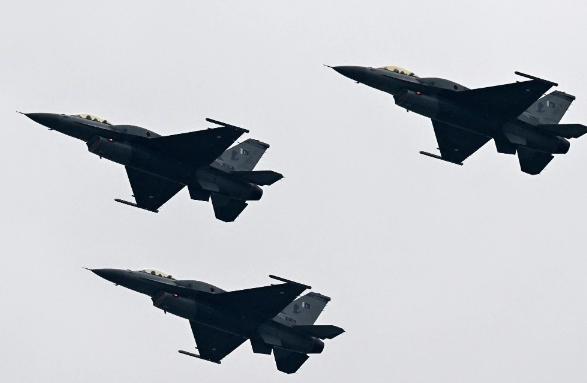
Pakistani JF-17 fighter jets (referred to as "Xiaolong" by China) - Image from materials
"After the '5/7 air-to-ground' operation, India believes that the only weapons in the world that can counter Chinese weapons are American weapons," Liu Zongyi said, "But the Americans set very high terms and a very high price, so India could only get American weapons through Israel. India also believes that some Israeli weapons even surpass American ones, like air defense systems."
Indian scholars believe that in the future, it is necessary to closely monitor the developments of neighboring South Asian countries.
"Bangladesh is undoubtedly worth close attention," said Uday Chandran, Professor of Political Science at the Indian Ayodya University. "Bangladesh's accession to this treaty is not impossible, and this would be a momentous step towards an uncertain future."
Liu Zongyi believes that it is unlikely for South Asian countries such as Bangladesh to join the agreement in the near future. The possibilities are more likely to be Egypt and Iran.
But he also pointed out that this agreement will inevitably impact the security situation in South Asia. There are significant differences in development directions among countries in South Asia. Apart from Nepal, Bhutan, and Sri Lanka, most other countries are moving away from India.
Among them, India wants to be the ‘leader’ of South Asia and the Indian Ocean, playing a dominant role in the futures of other countries; Pakistan is aiming to connect with the Middle East to the west, serving as a bridge; Bangladesh, on the other hand, looks towards the east, connecting with ASEAN and China. In addition, there are differences between Bangladesh and India regarding issues such as the extradition of Haseena, border management, and water resource allocation. Bangladesh is gradually strengthening its cooperation with China and Pakistan.
The issue circled around, but ultimately it landed back on China.
The reason is not difficult to understand.
China has a close relationship with Pakistan and is also an important economic partner of Saudi Arabia. China has also played a role in restoring diplomatic relations between Saudi Arabia and Iran, and has been increasingly involved in Middle Eastern security affairs.
So, once the Mecca agreement continues to expand, people outside will naturally ask: Will China join?
I believe that the Three Kingdoms will not be invited to join, and if they are invited, China will not agree to it, " Liu Zongyi expressed. Pakistan fully understands China's stance on "not participating in military alliances," so it would not promote China to join such security agreements.
When asked about China’s role in this agreement, Liu Zongyi pointed out that China certainly hopes for peaceful and stable development in neighboring regions such as the Middle East and South Asia. It also aims to promote economic and trade exchanges with relevant countries and support the implementation of the “Belt and Road” initiative.
He said: "However, we don't hope to establish so-called geopolitical influence in various regions like the United States."
He also mentioned that China supports the territorial sovereignty of regional countries and their development of self-defense capabilities.
Therefore, if relevant countries require it, China can conduct normal arms cooperation with them,” said Liu Zongyi. He emphasized that the prerequisite must be “for self-defense needs and not to harm third-party interests.”
He also said that Pakistan can play an important role in China's arms system exports. Pakistan currently has a production line for F-16 fighter jets, and is actively promoting this model worldwide. Saudi Arabia has previously purchased many Chinese-made equipment.