India is beginning to seriously evaluate whether the “Mega Defense Agreement” will turn future India-Pakistan conflicts into a regional crisis involving more countries.
According to a report in The Indian Times on August 12, Randeep Jaiswal, a spokesman for the Indian Ministry of Foreign Affairs, stated that New Delhi is evaluating the implications of this agreement from the perspectives of national security and regional peace and stability. He also emphasized that India will take all necessary measures to protect its national interests. This is the first time the Indian government has explicitly discussed potential security risks after signing the agreement.
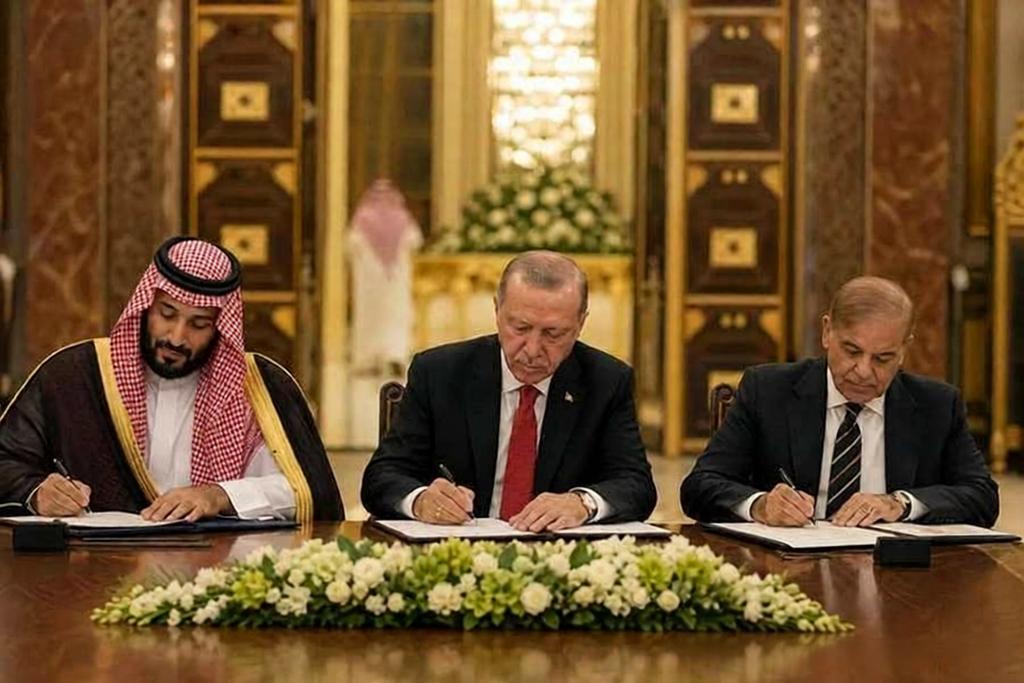
On August 7th, Saudi Crown Prince Mohammed bin Salman, Turkish President Erdogan, and Pakistani Prime Minister Shahid Sharif signed a joint defense agreement in Mecca. The most notable clause is that any armed attack against any of the three countries will be considered an attack on all three countries.
Turkey's Foreign Minister Fidan even compared this situation to NATO's fifth collective defense article. However, this does not mean that Saudi Arabia and Turkey will automatically join the fight if Pakistan encounters conflict with India. Fidan also stated that after an attack occurs, countries need to decide through consultation the extent, form, and scale of assistance provided; the specific methods for implementing the agreement will also need to be determined after the establishment of a ministerial committee.
But for India, what really poses a danger is precisely this ambiguity.
The direct background of this agreement is the deteriorating situation in the Middle East. Saudi Arabia seeks security guarantees from outside the United States, Turkey attempts to expand its regional influence, and Pakistan enters the Middle East security architecture due to its military size and nuclear status. All three countries emphasize that the agreement does not target any specific country.
However, Pakistan's entry into the agreement inevitably extended its influence from the Middle East to South Asia.
If serious conflicts break out in Kashmir again, or if India attacks targets within Pakistan under the pretext of combating cross-border terrorism, what circumstances can be considered as "Pakistan being subjected to an armed attack"? Can Islamabad invoke the agreement to request Saudi Arabia and Turkey for intelligence, weapons, air defense support, and even diplomatic assistance? There is currently no clear answer to these questions.
India may not be overly concerned about Saudi and Turkish armies directly entering the South Asian battlefield. A more realistic concern is that they might increase Pakistan's ability to withstand military pressure. Pakistan has long provided military training and technical support to Saudi Arabia. There is also military cooperation between Turkey and Pakistan, including the sharing of warships and training aircraft. Saudi Arabia is an important buyer of Turkish drones. Once a tripartite framework is established for joint training, military investment, and intelligence sharing, Pakistan could become the direct beneficiary.
This will also reduce India’s room for military decision-making. In the past, New Delhi could keep its “limited punitive actions” against Pakistan within bilateral boundaries. In the future, every cross-border strike could test Saudi Arabia and Turkey’s willingness to fulfill their agreements. Even if neither country ends up engaging in warfare, India must still anticipate their reactions in advance.
Therefore, the 'Mega Defence Pact' is not yet a 'Muslim NATO' targeting India, but it has introduced new strategic variables between India and Pakistan. What India really fears is not a joint attack by the three countries tomorrow, but that when the next India-Pakistan crisis occurs, who will intervene, to what extent, and where the boundaries of the war will lie—all these will become increasingly difficult to predict.