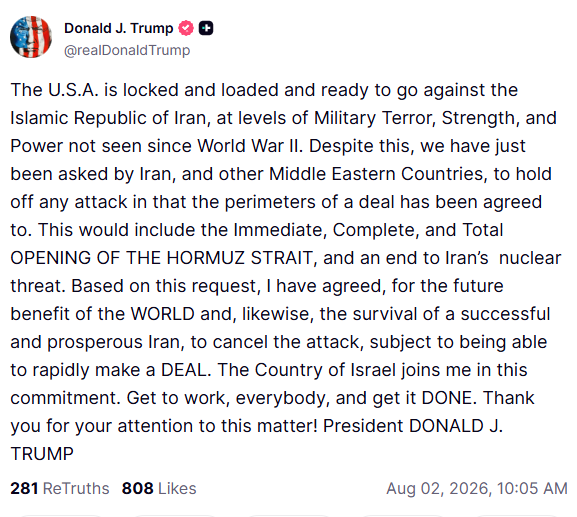
On August 10, 2026, local time, U.S. President Trump posted on Truth Social, responding to Iran's demands for compensation for losses incurred in military conflicts over the past five months.
Trump said that Iranian negotiators are demanding compensation for losses suffered during the military conflicts over the past five months, and “this issue has never been mentioned in any previous negotiations or meetings.” He called this demand “an interesting idea,” and also demanded that Iran pay compensation.
Trump wrote that he demanded compensation from Iran for “all those who lost their lives or were seriously injured due to their roadside bombs and multiple conflicts,” including the families of the victims killed in the attack on the destroyer “Cole,” as well as thousands of people who died in the fighting.
He also mentioned that Iran should pay compensation to the families of hundreds of thousands of innocent protesters who were killed over the past 50 years, as well as to the families of the 52,000 people who were killed in the past five months. Trump said he has instructed U.S. negotiators to include this demand in all future negotiations with Iran.
Trump continued in subsequent posts, "Furthermore, regarding negotiations with Iran, Iran should bear responsibility for the losses and deaths suffered by the people of Lebanon, Syria, Yemen, and Gaza!"
When speaking to reporters at the White House, he reiterated his demand for compensation and stated that if the United States is willing and capable, it can escalate the conflict.
"If we want to do this, of course we have the ability to do it," Trump said. "Yes, you will all soon find out."
He claimed that the U.S. military controls the Strait of Hormuz and that its blockade is "foolproof".
Trump added, “We have cleared the entire strait of mines. We have full control over the strait. Now, can they cause trouble? Yes, they can cause trouble, but they don’t have the money to do so.”
On October 12, 2000, the US Navy destroyer ‘Kol’ was attacked by a suicide bomber in Aden, Yemen, resulting in the death of 17 US military personnel. The US has always attributed this incident to al-Qaeda. In January 2019, the US announced that it had killed the mastermind of the attack, Jamal Abu Aden. In this statement, Trump blamed Iran for the casualties.
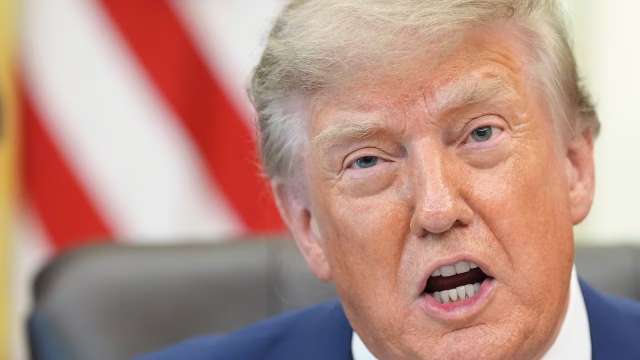
Trump delivered a speech in the Oval Office on Monday, demanding that Iran compensate for the deaths caused. US media
According to AFP, Trump used a common strategy last week: first threatened to impose a 'severe blow' on Iran (which could include attacks on civilian infrastructure), and then retracted the threat, suggesting that a peace agreement was nearing being reached.
On the day before he made these statements, he said that he was taking a “low-key” approach to dealing with this conflict. This indicates that he intends to respond to the situation by increasing economic pressure rather than launching further military strikes.
The American Axios reported an interview with Trump on Sunday, stating that although Iran delayed reaching an agreement regarding the opening of the Strait of Hormuz, Trump showed no dissatisfaction over this.
According to reports by the Iranian news television station on the 8th, Zoregard, secretary of the Supreme National Security Council of Iran, stated that if the United States does not change its behavior, the Strait of Hormuz will remain closed. The prerequisite for reopening the Strait of Hormuz is that the United States fulfills five conditions, including a permanent cessation of military operations against Iran, and this includes returning Iranian frozen assets and compensating Iran for the losses caused by the military actions.
Due to the deadlock in negotiations, Iran's blockade of the Strait of Hormuz has caused fuel prices to soar and disrupted the global economy. This has put pressure on Trump, who is facing mid-term elections in November.