“Even Mercedes-Benz cannot stop the decline of German cars in the Chinese market,” wrote Bloomberg on August 11. The long-established German car brand is losing ground in China, the world’s largest automotive market.
After winning the favor of Chinese buyers for decades thanks to its German engineering technology, Mercedes-Benz took a move that Bloomberg considered a "decentering" action last year—partnering with the fast-food chain McDonald's to promote its latest model.
In this marketing campaign called "Just Macchi", Mercedes allowed a cheeseburger doll to replace its traditional trident emblem on its new all-electric CLA model.
Mercedes originally hoped that this model would attract enough young people and stop the decline in sales in the Chinese market. However, things did not go as planned. In the first half of this year, the model was sold only 1,153 units in China, while Xiaomi delivered more than 80,000 SU7 models with similar prices during the same period.
German automakers such as BMW, Volkswagen, and Porsche also have a poor performance in the Chinese market. Their sales volumes decreased by at least 30% in the second quarter, which is a larger decline compared to the overall market. At the same time, domestic Chinese brands like Xiaomi and BYD are stealing customers from them.
These German car companies are losing key growth and profit drivers. So far, none of the companies has found a way to stop this downward trend.
The report indicates that this does not mean that German car companies are not making efforts. Most of them have already collaborated with Chinese companies to gain access to the latest electric vehicle technologies and to better understand the needs of local drivers. For example, Mercedes-Benz has developed a long-wheelbase version of the CLA for the Chinese market, taking into account Chinese consumers’ preference for more spacious rear seats. This model also comes equipped with software including artificial intelligence voice control. Its starting price is 290,000 yuan, which is about 40% cheaper than the European version.
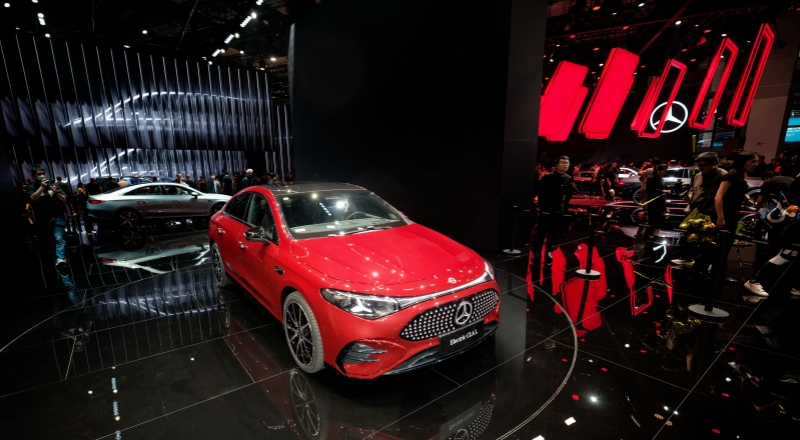
On April 23, 2025, Shanghai, the new Mercedes-Benz electric long-wheelbase CLA was unveiled at the 2025 Shanghai Auto Show. IC Photo
However, according to people familiar with the matter, Mercedes not only failed to win customers, but also had to admit that competition in the Chinese market requires further price cuts. This means that almost every sold pure-electric CLA model is operating at a loss. These people said that Mercedes is restricting the promotion of this model until economic conditions improve. As these are internal business decisions, they requested to remain anonymous.
Mercedes-Benz responded by stating that the model is not aimed at increasing sales, but rather at showcasing the company's latest technology in the competitive entry-level market. In an email statement, the company said they are "focusing on sustainable growth, rather than short-term market share gains." Mercedes-Benz also noted that the all-electric GLC compact SUV, launched last month in China, has performed well in terms of market feedback and reservations.
JPMorgan analysts Jose Asumendi pointed out that, at present, many German automakers' products have lost competitiveness in the Chinese market due to pricing issues. German brand cars usually have higher prices and are mainly fuel-powered vehicles, while China's fuel-powered vehicle market is shrinking.
BMW has lowered its profit expectations due to the declining performance in the Chinese market, making it one of the least profitable major automobile manufacturers in Europe this year. German car company executives, including Ola Källenius, the CEO of Mercedes-Benz Group, believe that competition in the market will remain very fierce for the next few years.
Bloomberg believes that the problems of German automakers lie not only in their prices. In many cases, they still operate according to the timeline of the fuel-powered car era, updating their products every four years or longer. They also disclose information about new products long before consumers can actually purchase them. In China, however, the cycle for launching new electric vehicle models has been reduced to 18 months, and new models are available for public purchase as soon as they are released.
"While you're selling, you've already been developing the next generation of," said Zhou Xing (pronounced), an automotive business advisor for Ai Rui Platinum, who worked in Germany and China. "This industry is absolutely impossible to return to the old path."
Chinese consumers' brand perception is undergoing a fundamental change. In China, Mercedes-Benz, Audi, and BMW are losing their luxury prestige, as consumers believe that these brands lag behind local manufacturers in software and electric vehicle technology.
According to Li Yanwei, an expert from the China Automobile Circulation Association, one of the reasons why the pure electric CLA has struggled is that its competitors have dominated the same price range with more advanced autonomous driving functions, entertainment systems, and more fashionable brand images. The pure electric CLA attempts to appeal to young consumers, but it has overlooked Mercedes-Benz's traditional target audience of middle-aged and elderly customers, who typically have families and prefer larger interior spaces.
Li Yanwei said that the all-electric CLA is 'in an awkward position – it's neither the most economical nor the most luxurious'.