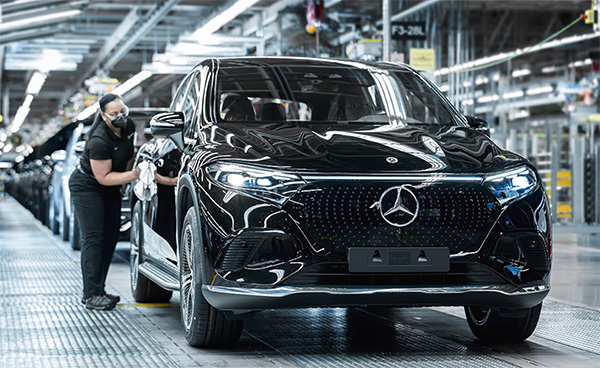
According to Reuters, Mercedes said on September 22 that its production in Germany is not competitive according to international standards, especially due to high labor costs. Mercedes stated that the company hopes to retain its factories and jobs in Germany, but must improve the framework conditions to increase productivity in Germany.
Previously on September 21, Michael Schiebe, CEO of Mercedes-AMG, warned workers at the factory in Sindelfingen, Germany that if costs could not be reduced, a final assembly plant and a powertrain plant would have to be closed in Germany. However, no specific details were provided.
Siebel stated that retaining the German factory is Mercedes-Benz's clear goal, but this requires a joint commitment from both the company and the workers regarding cost measures.
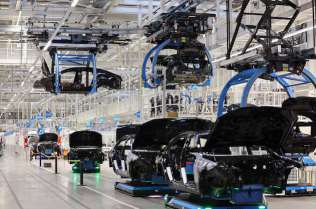
Mercedes-Benz Sindelfingen Plant, Reuters
Regarding Xi Bei's remarks, a spokesperson for the Mercedes-Benz General Management Committee said that anyone who resorts to such threats will face resolute resistance from the union. Threatening to close factories is not a way to shape the future: "If the Mercedes-Benz Board of Management believes that ultimatums such as 'compromise or factory closure' can be used to pressure employees, our answer is 'never agree.'"
Previously, due to the Volkswagen Group announcing a reorganization and the layoff of up to 100,000 jobs, as well as the possibility of closing four German domestic factories, the German Metal Industry Union (IG Metall) is organizing large-scale national protests. Tens of thousands of car workers have demonstrated against the mass layoffs in the automotive industry.
However, the German automotive industry is struggling to compete with Chinese competitors while also facing high tariffs from the United States.
Data released by the German Federal Statistics Office on September 2 showed that from January to July this year, Germany's automobile exports decreased to approximately 2 million units, a decrease of 4.0%. The export value fell by 8.9% to 73.5 billion euros (approximately 563.245 billion yuan). During the same period, Germany imported approximately 1.3 million new vehicles, a year-on-year increase of 16%. The import value increased by 12.6% to 34.9 billion euros (approximately 267.464 billion yuan).
It is worth mentioning that China became Germany's largest source of imported vehicles for the first time. From January to July this year, Germany imported approximately 175,000 passenger cars from China, a year-on-year increase of 120.9%, accounting for 13.8% of all new vehicles imported by Germany. Among these imports, the import volume of pure electric vehicles increased by 66.3%, that of hybrid vehicles increased by 36%, while the import volume of fuel-powered vehicles decreased by 9.0%. In the overall structure of German automobile imports, the combined share of pure electric and hybrid vehicles has exceeded 56%.
On the other hand, exports of all types of vehicles from Germany have declined. Exports of fuel-powered vehicles decreased by 2.9% to approximately 1 million units, exports of pure electric vehicles decreased by 2.9% to 560,000 units, and exports of hybrid vehicles decreased by 8.2% to 380,000 units. Due to US tariffs, German car exports to the United States decreased by 2.6%, and the export value dropped significantly by 17.1% to 9.6 billion euros (approximately 73.566 billion yuan).