“Are you an American student, post-doctoral researcher, or a university scholar who feels that you were denied research positions, laboratory opportunities, or post-doctoral positions because you were given priority over Chinese applicants?”
On August 10 local time, the infamous United States House of Representatives 'Ad Hoc Committee on Strategic U.S-China Competition' (hereinafter referred to as the 'China Ad Hoc Committee') once again caused trouble.
This post posted on social platform X urges individuals with “first-hand” information or relevant documents to contact the “China Special Committee” via their reporting email.
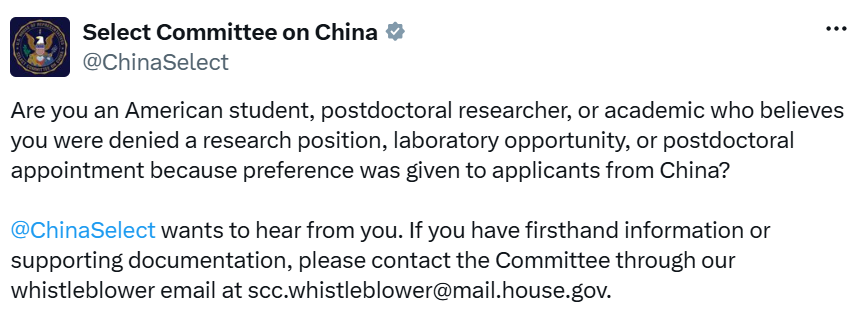
This targeted personal attack immediately sparked strong backlash against Chinese applicants.
Someone commented "Whites can't even do math... this is all China's fault."
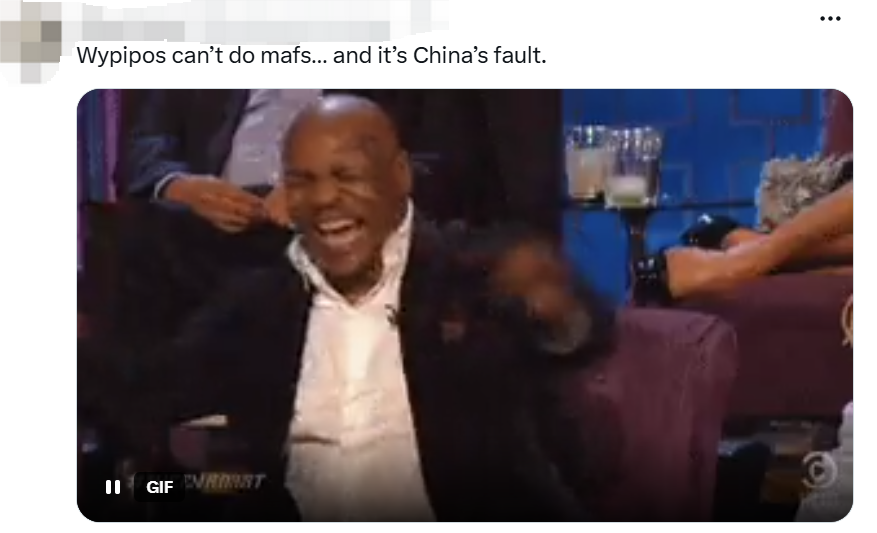
"There are still those who claim, "Rather than doubting and being paranoid, let us think more about how to cultivate some truly talented and learned individuals."

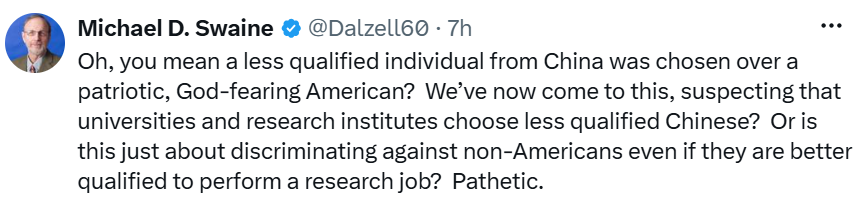
American think tank QI’s senior researcher Michael Swaine also spoke out bluntly, questioning whether the committee is implying that universities have chosen Chinese applicants who are not as qualified as those from the United States.
Swin posted on X asking, "We have come to this point—doubting that universities and research institutions will choose Chinese people with even worse qualifications?"
He also questioned whether this measure was ultimately ‘discriminatory against applicants for research positions who, even if they have better qualifications, are not American’. He called this practice ‘sorrowful’.
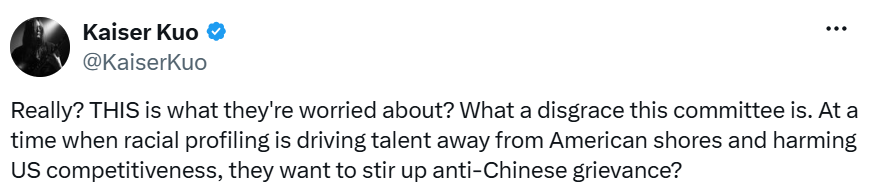
"Sinica Podcast" host Kaiser Kuo (of Chinese descent) called this move "unbecoming." He wrote on X, "Is this really it? Is this what they're so concerned about? ... At a time when the very notion of racial categorization is pushing talented individuals out of America and harming American competitiveness, why are they fanning anti-Chinese sentiments?"
Denis Simon, who has long studied the technological relations between the United States and China and was the executive vice president of Duke University in Kunshan, Jiangsu, China, said in the Hong Kong-based South China Morning Post that while the fairness of the academic position recruitment is indeed a legitimate concern, the committee's wording is "almost openly racist."
Simon is also a researcher at the “Quincy National Affairs Institute”. He said: “Starting the investigation by explicitly naming ‘Chinese applicants’ suggests there are preset reasons and related individuals involved.”
He pointed out that the competition for research positions and postdoctoral positions is extremely fierce, and the decision-making process is highly decentralized. Typically, each research team makes decisions based on various factors, including professional expertise, publication history, recommendation letters, funding, and project compatibility.
"Chinese applicants were selected while American applicants were rejected. This fact alone cannot prove the existence of bias, discrimination or a threat to national security," Simon said.
Unless there are special considerations regarding safety, American citizenship should not automatically give someone priority for a certain position, and another candidate might be more suitable for the role.
Simon also reminded that applicants who fail to be selected generally do not have a complete understanding of the candidates, nor can they fully understand the reasons behind the hiring decisions. Mere disappointment cannot be considered evidence of discrimination.
The measures taken by the 'China Special Committee' come at a time when public opinion is increasingly worried about the notorious 'China Action Plan' making a comeback.
The “China Action Plan” was launched in November 2018. At that time, the Trump administration required 94 regional judicial departments to file at least one or two lawsuits against China each year, in order to prevent China from “stealing information from the United States”. American intelligence agencies also used this plan as a pretext to fabricate the idea of “Chinese academic spies”, leading to many unjust cases.
On February 23, 2022, the Biden administration announced the termination of the “China Action Plan” initiated during the Trump administration. However, the negative impact caused by this action still lingers.
The South China Morning Post pointed out that the ‘China Action Plan’ did not expose the so-called ‘spies’, but many researchers who were surveyed lost their jobs and had their lives completely disrupted as a result.
A study published in the Proceedings of the National Academy of Sciences by Princeton University sociologist Xie Yu and her colleagues in 2023 shows that nearly 20,000 Chinese-American scientists left the United States between 2010 and 2021.
The number of scientists leaving the United States increased from 900 in 2010 to 2621 in 2021. Research indicates that while the growing attractiveness of China to researchers is part of this trend, the sharp increase in the number of scientists leaving the US was due to the introduction of the "China Action Plan".
This worry extends beyond just those researchers working in the US. The number of Chinese tech talent attracted to work in the US is also declining.
A recent analysis by the American Immigration Research Center shows that the number of F-1 student visas issued to Chinese citizens from May to August 2025 decreased by 46% compared to previous averages. The number of F-1 visas issued to Indian students also dropped by 60% during the same period.
This think tank views a reduction in Chinese student visas as a potential benefit to U.S. national security, claiming that it can reduce the risks of espionage and technology transfer.
This line of argument that involves planting false accusations and framing charges, forms a dangerous echo at the congressional level.
In April, the ‘China Special Committee’ set up a so-called ‘whistleblower’ email address on its official website, stirring up American scholars, researchers, and faculty members to report research collaborations with entities related to China’s defense and industrial infrastructure.
In response to this, Foreign Ministry spokesperson Mao Ning stated that it is evident that the so-called 'Special Committee' has gone to extreme lengths in its efforts to suppress and contain China. In recent years, the US has generalized the concept of national security, deliberately undermining normal scientific and technological exchanges between China and the US, and actively persecuting Chinese students and scholars. Such actions will only weaken America's innovation capabilities, acting like throwing stones at one's own feet.
