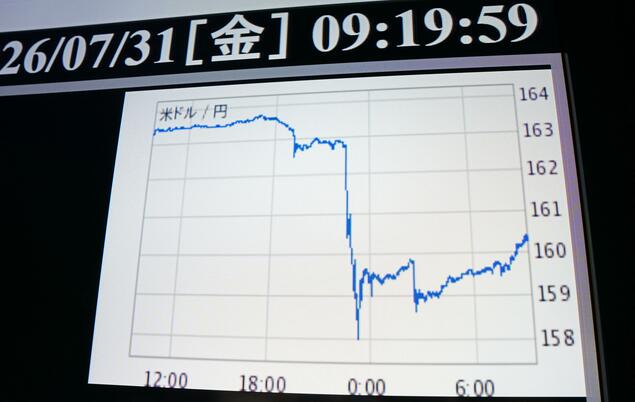
According to Bloomberg's report on August 7th, as this week comes to a close, the Japanese yen has lost nearly half of the gains it achieved due to US-Japanese intervention. This has led traders to speculate that authorities may intervene again.
That morning, the exchange rate of the Japanese yen against the US dollar was around 158.45, far below the high of 155.23 reached on August 3rd. Before the United States and Japan jointly took action to buy yen last week, which was the first such move since 1998, the yen exchange rate had once approached a 40-year low of 164 yen per US dollar.
This decline highlights the limitations of intervention measures in reversing the long-term decline of the Japanese yen. The significant interest rate differential between the United States and Japan, Japan’s heavy debt burden, and geopolitical uncertainties continue to put pressure on the Japanese yen exchange rate.
Meanwhile, driven by rising oil prices, the dollar experienced its largest single-day increase in two weeks on August 6th. This reflects a decline in market optimism regarding the easing of tensions in the Middle East.
Previously, officials from the United States and Japan have warned investors that they are determined to defend the yen exchange rate if necessary.
Huaqiao Bank strategist Moh Siong Sim said, “The possibility of intervening again is quite high, especially when the US dollar-yen exchange rate approaches 160 yen.” However, he added: “For effective intervention measures, it’s crucial to pair them with a faster pace of interest rate hikes from the Bank of Japan or a favorable macroeconomic environment that supports a relaxing monetary policy by the Federal Reserve."
Although the Bank of Japan kept the benchmark interest rate unchanged last week, the overnight index swaps market indicates that there is a probability of raising rates before September of about 60%. Japanese Finance Minister Tadakatsu Murakami, the country’s top foreign exchange official, stated that authorities will coordinate with monetary policy to address fluctuations in the foreign exchange market.
Previously, Reuters quoted former Bank of Japan official Atsushi Takeuchi as saying that U.S. involvement has significantly enhanced the symbolic significance of intervention, and also increased the risk for speculators to continue shorting the Japanese yen. However, if Japan’s fiscal policy and central bank interest rate policies remain unchanged, it will be difficult for the Japanese yen to find sustained support.
Guang Tao, Chief Global Economist at BOC Securities, told Observer.com that the weakening of the Japanese yen is mainly driven by economic fundamentals, and not entirely due to market sentiment or herd effects. Even if the Bank of Japan raises interest rates, it will be difficult to reverse the decline in the yen’s value without any improvement in economic fundamentals.