China is becoming a factory of factories. Today's China no longer simply produces low-value consumer goods, but is beginning to export chips, precision machinery, and robot arms, among other high-value products that support global manufacturing industries.
In an article published on August 6th, The Wall Street Journal described China’s industrial situation as follows. The article mentioned that Dongguan, located near Hong Kong, helped China become the “World Factory” decades ago. It produced large quantities of cheap toys, shoes, clothing, and electronic products, which contributed to the rapid development of the Chinese economy. Today, Dongguan is at the core of a new round of industrial transformation.
Tōsōdā is one of the largest manufacturers of industrial robots and mechanical equipment in China. Its international business vice president, Jiang Xiǎocheng, stated: “Historically, high-end manufacturing was led by Germany and Japan. However, now our technology has caught up, and we have achieved a lead in many products.”
China has an advantage in many links of the global supply chain, which further enhances its export capabilities. At the same time, it is better able to withstand tariff barriers on finished products. Data from the McKinsey Global Institute shows that in the first five months of 2026, exports of intermediate goods and capital goods increased by 25% and 12%, respectively, while consumer goods exports grew by 4%.
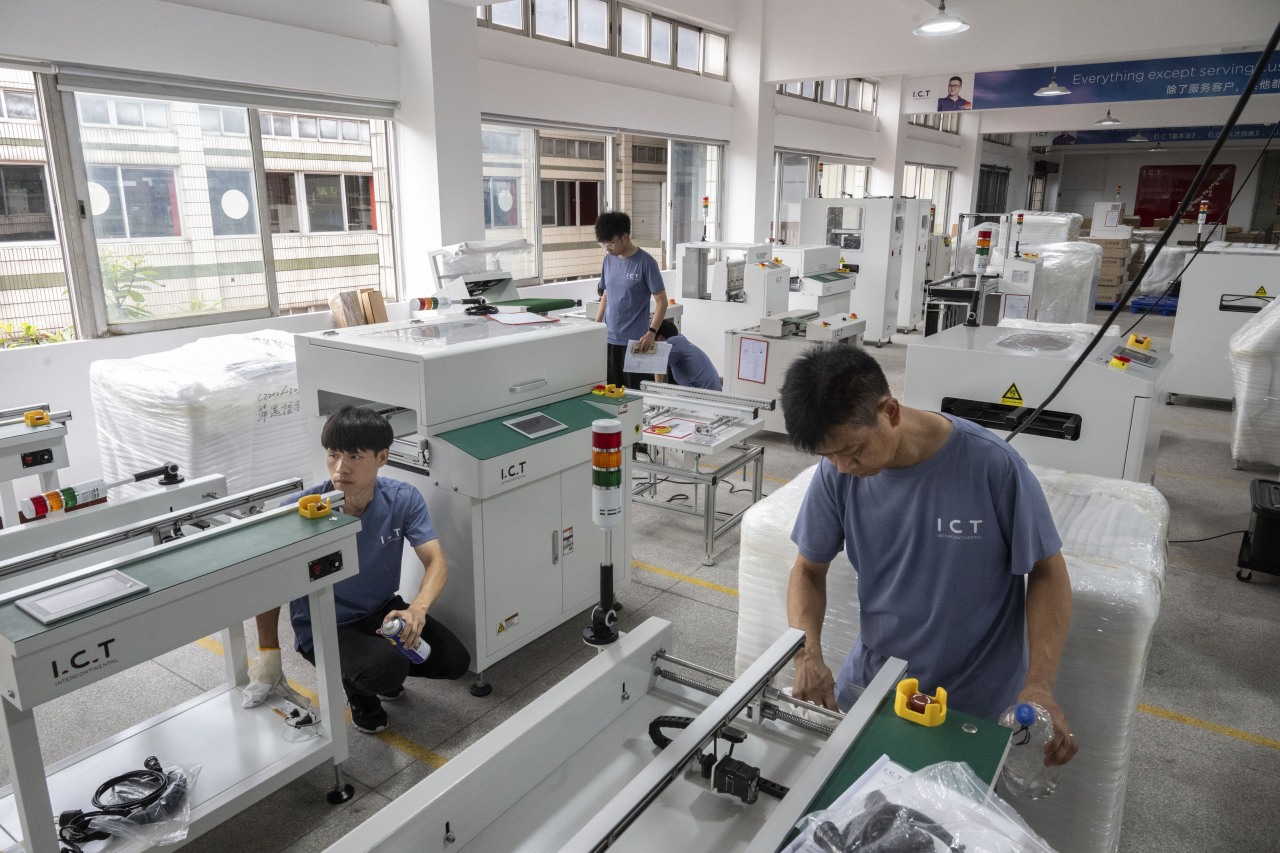
Dongguan Intertech Technology Co., Ltd. is a company that produces automated systems for assembling circuit boards. Wall Street Journal
This transformation is impacting the economic moats of high-end manufacturing economies such as the EU, Japan, and South Korea. These countries’ manufacturers of chemical products, machinery, and batteries used to treat Chinese factories as customers, but now China has become a strong competitor in overseas and domestic markets. For the first time in decades, Germany’s imports of high-end capital goods from China exceed its exports to China.
Reports say that many people view this as a “version 2.0 of China’s impact”. Although South Korea and Japan have seen a surge in exports related to artificial intelligence this year, many industries are also losing their global market share.
At TOSIDA's headquarters in Dongguan, a screen displays the logos of its global client base: American manufacturer Jabil, South Korean Samsung, Chinese mainland companies Huawei and CATL, as well as Taiwan-based Foxconn. The company claims to have over 15,000 clients across more than 50 countries.
Reports indicate that China's transformation from a global consumer goods assembly workshop into a high-end manufacturing powerhouse is the result of years of accumulation.
Relevant policies encourage the increase of local supporting facilities and promote the expansion of domestic component production capacity. Relying on the support plan for specialized and innovative "little giants" enterprises, China provides subsidies, tax incentives, and low-interest loans to thousands of small and medium-sized enterprises in high-end manufacturing sectors.
The huge domestic market and fierce competition in the market have accelerated the upgrading of industries within the country. A complete network of suppliers and infrastructure has also significantly improved production efficiency.
In Dongguan, Wang Hongfei's experience is a microcosm of China's industrial rise. When China joined the World Trade Organization in 2001, 18-year-old Wang Hongfei came to Dongguan alone, living in a tiny dormitory of just 12 rooms, working on the assembly line at Buweiga Electronic.
By 2012, Wang Hongfei established Dongguan Intercontinental Technology Co., Ltd. This company, with a staff of 80, specializes in exporting automated assembly equipment for circuit boards. He mentioned that the company’s equipment is sold around the world, with clients including American companies such as IBM, Honeywell, and L3 Harris. The company’s supply chain relies almost entirely on domestic sources.

Wang Hongfei, General Manager of Dongguan Intercontinental Technology Co., Ltd. The Wall Street Journal
One recent Saturday, workers were inspecting a production line that was about to be shipped to a customer in Mexico. The corporate slogan hanging above their heads reflected the relentless service-oriented spirit of Chinese factories: "Everything is talk unless it serves customers."
Wang Hongfei expects that Dongguan Intercontinental Technology’s revenue will increase by at least 50% this year. The company is about to relocate its new headquarters, which will be twice the size. “The era in which China merely serves as a world factory has come to an end. Now, China is helping the world build factories. It is impossible for China to always export finished consumer goods.”
He stated that tariffs have had no impact on his company at all. As long as there is demand for electronic products worldwide, the factory will operate at full capacity.
A analysis by the McKinsey Global Institute of Chinese customs data shows that after the United States imposes new tariffs in 2025, China’s consumer goods exports will experience a decline for the first time since 2019. However, exports of intermediate inputs and capital goods increased by more than $175 billion, helping to push China’s trade surplus to a record high of $1.2 trillion.
McKinsey Global Institute partner Cheng Zhengmin said that for high-end manufacturing economies, "China is increasingly transitioning from customer to competitor."
Lito Electronics is a parts manufacturer based in Dongguan. Its products are used in Nestlé coffee machines and other electronic devices. Cherry Lee, the company's sales representative, said that many customers, in order to reduce costs, have switched from purchasing European and American brands to buying Lito's products. Since 2020, the company's sales have been growing at an average annual rate of about 10%.
She explained that Mexico and Vietnam have become important export markets for Lito Electronics. Many companies have moved their production capacity out of China in order to avoid U.S. tariffs, which has driven the industrialization process in Southeast Asia and Latin America. This presents a significant opportunity for Chinese factories that export intermediate goods and capital goods.

The production workshop of Litto Electronics, headquartered in Dongguan. Wall Street Journal
In São Paulo, Brazil, German manufacturer Harting, which produces heavy industrial connectors, is facing fierce competition from Chinese manufacturers. Poliana Ranari, managing director for Latin America at Harting, said that Chinese competitors offer products with significant price reductions of up to 30%, and their product quality continues to improve, which has impacted the growth of Harting's business.
Returning to Germany, the forklift manufacturer Jungheinrich is also facing challenges from Chinese companies in the European market. The company's CEO, Lars Burkska, estimates that the share of Chinese manufacturers in the European industrial forklift market has increased from 11% in 2019 to 30% today.
According to Bruska, Chinese manufacturers initially targeted markets where 'enough is enough', i.e., products for everyday moderate use, with prices only half of those in the Western market. Now, Chinese companies have established local R&D centers and production bases, further expanding into high-value-added product areas. In response, Eothen last year established a strategic partnership with China's forklift manufacturer Sinergy.
"We face a daunting situation, one that can even be described as serious." Bruno said. "Eternal Power recently lowered its annual profit expectation, partially due to the competitive pressure brought by China."
Dongguan Gaotuo Electronics mainly engages in circuit board manufacturing and electronic contract manufacturing services. Approximately 60% of its exports go to Europe. The company's general manager, Shi Shaoying, expects sales to increase by about 30% this year. The factory is being renovated to handle more orders.
When traveling to Europe for business, he often hears complaints about China's strong exports. He believes that the success of Chinese companies lies not only in the high cost-effectiveness of their products, but also in their ability to provide customers with comprehensive customized services, including engineering technology.
"China didn't force anyone to buy our products." He said.
At the regular press conference of the Ministry of Foreign Affairs on May 8, in response to the claims by some Western media and think tanks regarding "China's Impact 2.0," Lin Jian, the spokesperson for the Ministry of Foreign Affairs, emphasized that China's development is driven by innovation, moving from being known as the "World Factory" to a "World Market" and a "Highland of Innovation." China brings real cooperation opportunities and space to the world through its innovative efforts.
Lin Jian pointed out that openness leads to progress, and cooperation is essential for mutual benefit. China's development has never been a 'threat' to anyone; rather, it contributes to the common development of all countries. China will continue to expand its opening up at a high level, defend the multilateral trading system, and provide more certainty and new momentum for the world economy with its own stable development.