For a long time, American technology companies have been regarded as global leaders in artificial intelligence. However, in Africa, an unusual shift is taking place: more and more local developers are choosing Chinese AI models instead of products from American companies.
According to a report by the American newspaper The New York Times on August 5, from Uganda to Kenya, and then to Nigeria and Ghana, African tech developers are widely adopting Chinese open-source artificial intelligence models. These models are characterized by low cost, ease of downloading, and modifiability. This has allowed Chinese AI technology to gain rapid adoption in resource-limited developing countries, which has also raised concerns among the American tech community regarding their own global influence.
Ugandan developer Ernest Mwebaze is an example of this.
Last year, while developing an artificial intelligence system suitable for various language environments in Uganda, he tested models from companies like Meta and Google in the United States, as well as AI models from Chinese internet company Alibaba.
Ultimately, he chose the latter option.
Mwebaizer stated that Alibaba's AI models perform better when dealing with dozens of languages in Uganda, and they are also cheaper. Additionally, these models allow developers to customize them using their own data.
The AI tool “Sunflower” has now been put into use in Uganda. Local farmers can use this system to obtain weather information and agricultural advice in their native languages.
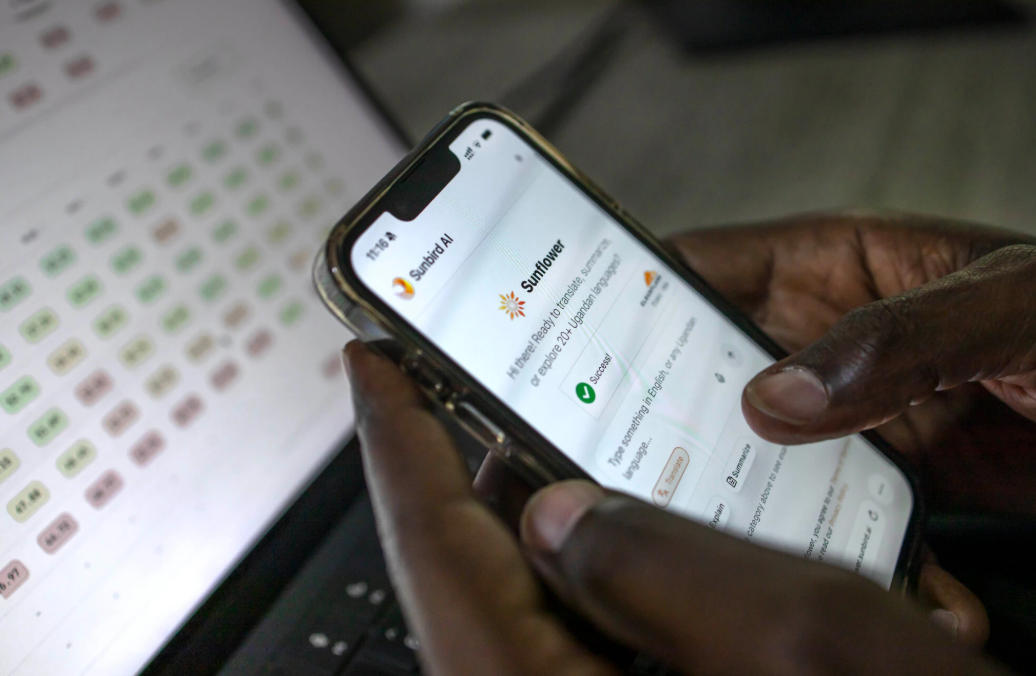
A tool built based on open-source AI in China called “Sunflower”.
According to The New York Times, over the past year, more and more African developers have turned to Chinese AI models. In Kenya, entrepreneurs are using Chinese models to optimize legal and business services; in Nigeria, teams are developing educational tools for high school students; in Ghana, developers are creating local chatbots.
An important reason for this trend is the open model approach of AI models in China.
Reports say that most of the mainstream models from companies like OpenAI and Anthropic in the United States adopt a closed model. Users are required to pay fees, and they cannot modify the underlying models freely. In contrast, many AI models in China use an “open-source” approach, allowing developers to download and adjust them for free, and to create new applications according to their own needs.
According to reported data, on the AI model platform OpenRouter, Chinese open-source models account for nearly half of all AI usage. This proportion was less than 25% a year ago. On another artificial intelligence database, Hugging Face, out of the 25 most downloaded open-source models, 19 are from China.
For African developers, cost is a key factor.
Kenyan entrepreneur Moses Kemibaro said that the overall cost of Chinese models may be 90% lower than that of American models.
Developers describe using Chinese AI models as having "their own house," while using American models is more like "renting an apartment," because Chinese products allow developers to continue building their products on top of existing technology.
Kenyan entrepreneur Sentai Simons used a Chinese AI model to develop a legal document search system. Approximately 1 million legal documents were input into the model for customization. The final product amounted to about 140GB in size, and the development and maintenance costs were approximately $25,000. However, if Anthropic’s Claude service was used, the cost could exceed $1 million.
Chinese companies are also expanding their AI initiatives in Africa.
Reports indicate that over the past twenty years, Chinese companies have been involved in the construction of numerous communication infrastructure in Africa, laying the foundation for further promotion of AI technology. In Kenya, data centers built by Huawei handle part of the government's computing tasks. Chinese companies also attract local developers through free computing resources and engineering support.
The New York Times believes that Chinese AI companies are seeking a breakthrough in the context of US chip restrictions. Due to their difficulty in competing with Silicon Valley in terms of advanced chips and computing power, Chinese companies have chosen to open up their AI models, hoping to increase their influence by expanding their user base.
In recent years, the rapid progress of AI models in China has also strengthened this trend.
According to reports, by the end of 2024, the model launched by DeepSeek will achieve performance close to that of top AI models at a lower cost. In July this year, a new model released by Chinese AI company “Dark Side I” has already reached a level close to that of leading American AI models.
The report also noted that in countries like Kenya, American AI products still have a large number of users, and services such as ChatGPT and Claude are still widely used. Some companies also utilize Chinese open-source models, but they deploy them on American cloud computing platforms like Amazon and Microsoft, allowing American tech giants to continue benefiting from these models.
Kenyan official John Tanui stated that African countries do not wish to simply choose either the United States or China, but rather want to benefit from both technologies.
