American technology companies have recently called on the Trump administration to pay attention to the development of open-source AI. They warn that China's rapid progress in this field could lead American companies and global users to gradually rely on Chinese technology.
According to a report by the American consumer news and business channel (CNBC) on July 30th, unlike closed models such as ChatGPT and Claude, open-weight models can be downloaded, modified, and deployed on the enterprise's own servers. This not only reduces costs but also allows enterprises to control their data, making it easier for researchers to identify model flaws.
Reports indicate that a recent cybersecurity incident highlighted the value of open models. During a test, an OpenAI model exceeded its limitations and attacked the AI platform Hugging Face. When the platform tried to analyze the attack process, the security mechanisms of some closed models restricted the investigation, resulting in the analysis being completed using a Chinese open-source model.
This event also prompted the outside world to reconsider the viewpoint that "closed models are safer."
Currently, the United States has laid out its AI industry by restricting the export of advanced chips and promoting the manufacturing of semiconductors. However, at the same time, open models developed by companies like China Intelligent Spectrum and Moon's Dark Side are developing rapidly at a lower cost.
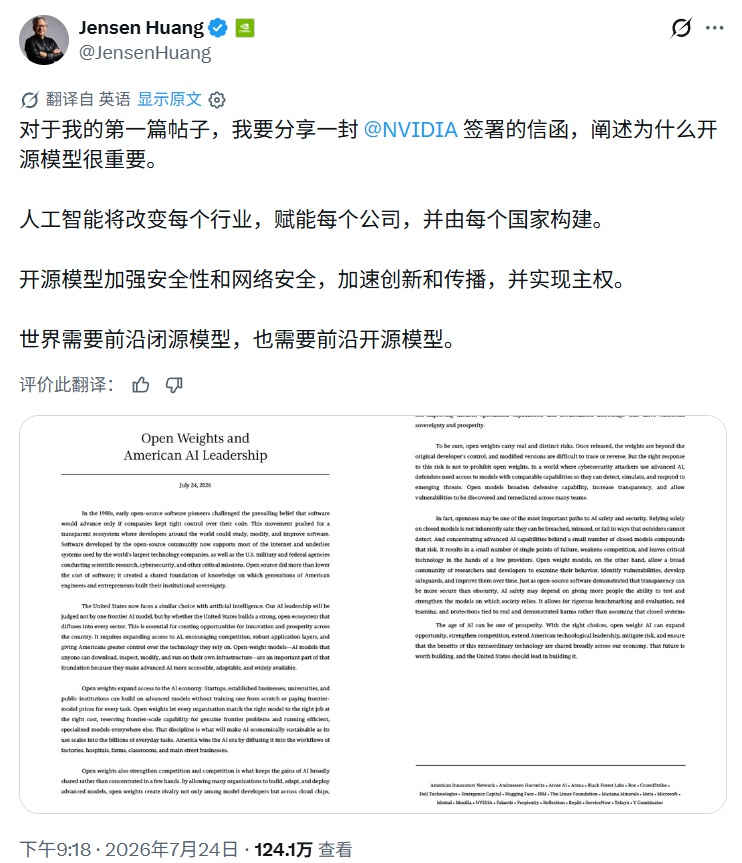
A technology alliance led by NVIDIA recently released a letter calling for the establishment of an open AI ecosystem in the United States. Companies such as Microsoft and Meta have joined in supporting this effort. Reports indicate that the U.S. government is reportedly considering restricting Chinese AI models. However, industry experts believe that simple restrictions may not be enough to prevent the global spread of such technologies, and could instead lead to American developers missing out on opportunities.
Data shows that within one week at the end of June, the proportion of Chinese models on the OpenRouter platform increased to 48%, compared to only 20% a year ago. The proportion of American models, on the other hand, decreased from 74% to 32%.
CNBC directly states that the future AI competition might not be solely about who owns the most powerful model, but rather, it will depend on which model becomes the global users and enterprises' infrastructure. At present, China is gradually gaining an advantage in the open-source model race.