Our world is undergoing a profound structural transformation—from an interdependent global village to an era of fragmentation characterized by multiple centers, multiple rules, and multiple alliances.
Trump is that elephant that has broken into rooms. From betraying his allies, to coveting other countries' territories, from suddenly wanting to create a "Peace Commission," to criticizing the United Nations system, he shows that the world is facing the collapse of international order.
But endings often begin in the beginning, and are the final manifestations of beginnings at another time. Accurate interpretation of post-war order becomes crucial. Retracing the “scene” of how post-war order was constructed, by whom, and how it was constructed, is directly related to our understanding of the current Trump administration and the world situation.
The underlying foundation of the international order is power. Michael Mann believes that the expansion of four types of power—economic, political, military, and ideological—has driven globalization and forms the intrinsic basis of the international order. Giovanni Arrighi points out that a key characteristic of the modern international system has always been the constant opposition between the logic of capitalism and territorial sovereignty, as well as the periodic attempts by the most important capitalist countries to resolve their contradictions by reorganizing the world's political-economic space.
Barry Buzan and George Lawson propose that under the influence of three key elements—industrialization, rational nation-building, and a “progressive ideology”—the world in the 19th century experienced a “Global Transformation”. The previously discrete “polycentric world” transformed into a highly interconnected and hierarchical global system of “core-periphery”, with the West at the center of this order.
Research by Mank, Ariigi, and Buzan et al has revealed the historical structures that have existed since modern times, especially the power structures within these structures. The world after World War II remains an extension of these historical and power structures.
The architects of the post-war order were the "winning nations," but not every "winning nation" had equal say in the establishment of the post-war order. At the Tehran Conference and the Potsdam Conference that determined the post-war order, U.S. President Roosevelt, Soviet People's Committee Chair Stalin, and British Prime Minister Churchill formed the "Big Three." Together, they negotiated many post-war political matters, including the founding of the United Nations.
The timeline shifts back to July 17, 1945, to August 2, 1945, to recreate the more decisive scene of the Potsdam Conference. At that time, the "three giants" discussed most was actually the distribution of their respective shares of "loot," which involved paying the price in terms of the damage and obedience of other countries.
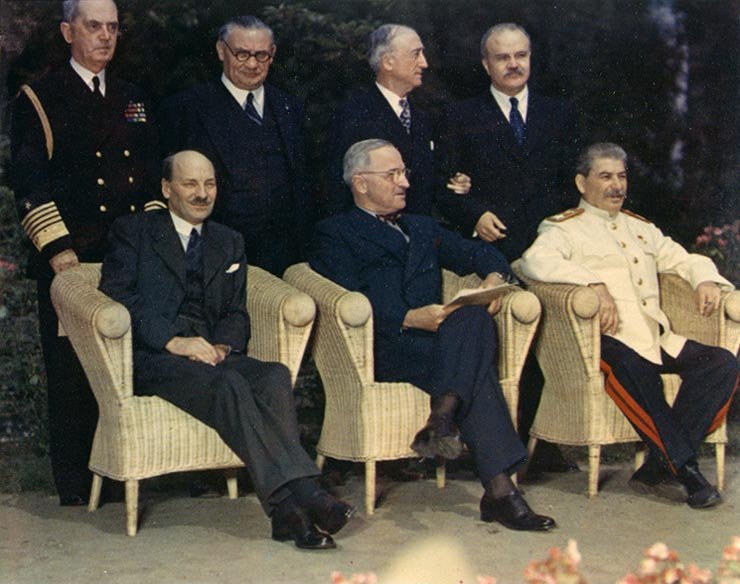
The Three Bigs (i.e., Edlemann, Truman, and Stalin) at the Potsdam Conference
For example, although the leaders of the Chinese government were invited to participate in the Cairo Conference between the heads of China, the United States, and the United Kingdom from November 23 to 26, 1943, at the subsequent Tehran Conference, the United States and the Soviet Union reached an agreement that harmed China’s sovereignty, which was further confirmed at the Yalta Conference. This illustrates the hierarchical power dynamics and the prioritization of interests in the post-war order arrangements.
Post-war international economic and financial rules were primarily agreed upon between the United States and the United Kingdom. In the negotiations between the American "White Plan" and the British "Keynesian Plan," the former won in the end, which reflected what Arizio referred to as the "most important capitalist country" undergoing a transition from Britain to the United States. Based on the US-British agreement, the Bretton Woods system was established.
Of course, in the process of establishing post-war order, the opinions of other countries were also taken into consideration to some extent. For example, at the Dumbarton Oaks Conference from the end of September to the beginning of October in 1944, the Chinese delegation suggested that international organizations should appropriately consider justice and international law, and should not only focus on political convenience. This proposal was agreed upon by the United States, the Soviet Union, and the United Kingdom, and was incorporated into the United Nations Charter.
From the perspective of the subjects, processes, and content involved in establishing post-war order, there are both commonalities and differences. The commonality is that within the framework of the United Nations, all countries and their sovereignty are equal in name only. Together, they enjoy peace while also having the potential for certain forms of common development. This is precisely what China emphasizes repeatedly: maintaining an international system centered on the United Nations, an international order based on international law, and basic norms of international relations grounded in the purposes and principles of the United Nations Charter.
The difference is that the post-war order remained a power-based order. European hegemony was reduced to a general international power, with the new hegemons being the United States and the Soviet Union. Western countries led by the United States were the main designers of the post-war rules of the game. They still enjoyed a prominent power advantage in the international order and occupied a prominent central position within the international system.
Taking the two important post-war international organizations, the World Bank and the International Monetary Fund, as examples, it can be seen that their directors and presidents have long been monopolized by Americans and Europeans. The president of the World Bank can even be considered to be “appointed” by the President of the United States. This is not based on written rules recognized by all countries, but rather on unwritten conventions.
Post-war order is therefore 'common but differentiated', encompassing explicit rules and unwritten rules, visible order and invisible order coexisting. While explicit rules and visible order advocate equality, justice, and shared resources, unwritten rules and invisible order still shape central-edge power relations, which are unjust and irrational. There exists a fundamental tension between them.
During the post-war period, this structural tension did not manifest as irreconcilable conflicts. The reason was that after two world wars, all countries had become exhausted and were willing to seek compromise. Those countries that were located on the margins were still weak and unable to resist the power arrangements of the hidden order. Additionally, some of these marginal countries had just emerged from colonial orders, while others were still in the process of doing so. Their situation was somewhat improved compared to the absolute hierarchical relationships and oppressive status under previous colonial orders.
The pursuit of equality and justice, as well as the creation of power advantages, are all integrated into the post-war order arrangements. This means that the post-war order has inherent contradictions; it is a “unity within opposition.” The central nations will strive to consolidate and expand their power advantages, which is the driving force behind maintaining the post-war order. However, marginal nations cannot fail to promote the establishment of a more just and reasonable international order, which would weaken the power advantages of the central nations.
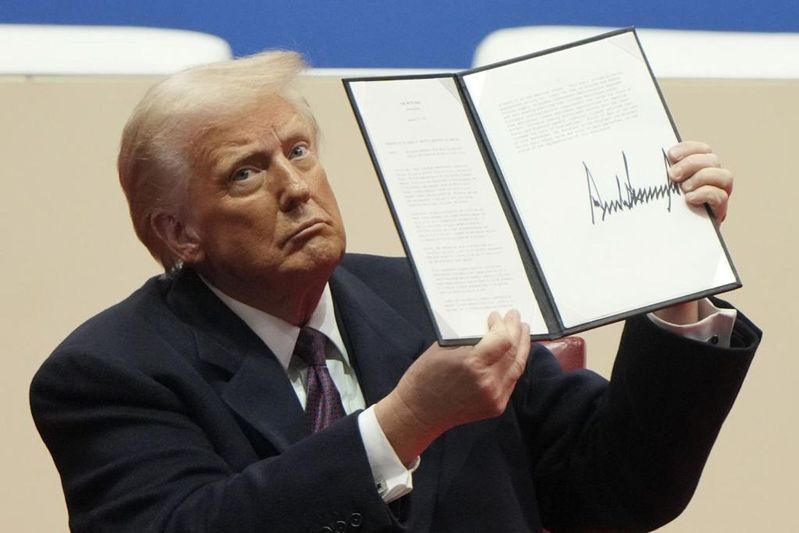
On January 7th, U.S. President Donald Trump signed a memorandum instructing the United States to withdraw from 31 UN entities and 35 non-UN organizations, totaling 66 international organizations. (Source: File photo)
In the post-war order arrangement, peace and development are both possible, but they both have their prerequisites and bottlenecks. As long as the power of marginal countries does not threaten the dominant position of central countries, those latter countries do not need to deliberately hinder the development of the former, and can even promote the common development of the former. This gives post-war order its political limitations: when the dominant position of central countries is challenged, they are more inclined to uphold the unwritten rules of the post-war order, rather than strengthening support for written rules.
This also means that there could be two ways of describing the “collapse of post-war order”: one is that the central countries no longer rely on the United Nations and international law as their core, while the other is that the marginal countries no longer accept the post-war hidden order arrangements established by the central countries. The concept of “order based on rules” that the United States has emphasized in the past is actually a hidden order based on unspoken rules.
From the end of World War II until the 1990s, the United States and the Soviet Union maintained a long-term confrontational relationship. Today, people often refer to this period as "the Cold War," "dual polarization," or "competition between two systems." However, they forget that in addition to the US and the Soviet Union, there was also the Third World in Asia, Africa, and Latin America, which also actively participated in the historical process of the second half of the 20th century.
Marked by the "Asian-African Cooperation" at the Bandung Conference in 1955, since the war, marginal countries have never stopped their efforts to demand an improved international political and economic order, with a focus on equality and fairness. Due to their cooperation across vast global spaces and the existence of certain organizational forms, mutual support among Third World nations has also developed a multilateralism experience and tradition that differs from those of central countries since the war.
In recent years, in the face of various actions by the United States to suppress China, China has repeatedly advocated for the adoption of true multilateralism. However, it must be recognized that since the post-war order inherently contained differences and contradictions from the beginning, it is inevitable that different forms of multilateralism emerged from this order. These forms of multilateralism serve different national goals and political aspirations. The multilateralism of central nations aims to strengthen the order between centers and periphery, while the multilateralism of peripheral nations aims to transform the order between centers and periphery.
The United States sought to maintain its power advantage. However, it is also important to recognize that, at the time of post-war order reconstruction, the main challenge faced by the United States was not the pressure from third-world nations seeking "liberation," but rather the former European colonial order. Both the United States and the Soviet Union were part of the central-edge order that had been established in Europe. This was what French sociologist Pierre Bourdieu referred to as "the ruled within the ruling class." Therefore, both countries were willing to break away from European hegemony.
An international order centered around the United Nations and international law was beneficial for the US and the Soviet Union in seizing power advantages from Europe. However, once the US established its power advantage in the post-war order and Europe became unable to rise again, the pursuit of equality and justice within this international order became, to a significant extent, a hindrance to US hegemony.
To this day, the weight of countries in the Global South within the United Nations system has significantly increased, and the equality of the international order has also been strengthened. However, the unwritten rules and hidden orders within the international order are becoming increasingly unsustainable. This clearly does not conform to the "original intention" of the United States in participating in the construction of the post-war order. The current Trump administration's "America First" ideology has focused more on the United States itself and its surrounding areas, while choosing to withdraw from many international affairs, including withdrawal from several international organizations. In both thought and action, the Trump administration shows a tendency to reduce the supply of international public goods. The characteristics of the Trump administration's behavior are not without precedent; they have actually been in the making since the moment the post-war order was established.