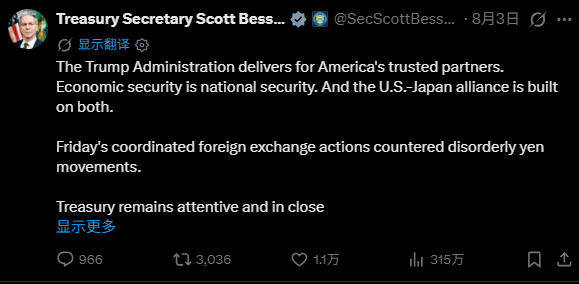
According to a report by the American Consumer News and Business Channel (CNBC) on August 4th, U.S. Treasury Secretary Steven Bisonette said on Tuesday that the Trump administration will 'do everything in its power' to support Japan's stable exchange rate regime, provided it benefits the U.S. economy.
He said when he was being interviewed by CNBC "We will do our utmost to support Japan, provided that it benefits the US economy and US taxpayers."
Baisent revealed in the program that the United States has joined Japan’s joint intervention measures to boost the Japanese yen. The reason for this is that a persistent weakening of the yen could undermine the stability of the entire Asian market and even lead to competitive devaluations of other currencies. “This situation is very unhealthy.”
He emphasized, “Given the trade flows, economic size, and Japan’s contribution to the global savings market, it is crucial to maintain the stability of the Japanese yen. The Japanese government understands this, and we are honored to cooperate with them in implementing relevant policies to contribute to regional stability.”
CNBC noted that this joint intervention was a rare move by the US in supporting another major currency, highlighting Washington's concern over the potential for the yen to remain weak in the long term. This could exacerbate Japanese inflation, depress other Asian currencies and disrupt global markets.
As part of the joint effort, the US Treasury sold euros from its foreign exchange reserves and used the proceeds to purchase Japanese yen. Bessen revealed that he has informed European officials that the sale of euros was merely a reconfiguration of reserve assets.
In my view, the euro exchange rate has become closer to a balanced level, Basen said. "I will not comment on where the euro should trade, but what is truly important is that the yen is currently being severely undervalued and what measures Japan's government is taking in response."
However, Besent also emphasized that purchasing yen can only suppress market fluctuations in the short term. Japan still needs to address the underlying factors that are driving the weakening of the yen through fundamental policy adjustments. He refused to comment on whether the Bank of Japan should raise interest rates.
Regarding Reuters’ photo last week showing “to-be-done-actions” listing “buying 5 billion to 10 billion Japanese yen,” Besent joked, “I just want those journalists who are sneaking glances from behind my back to know that the symbol for the Japanese yen is JPY.”
He also said that he originally intended to write on the list things like 'having lunch with the Supreme Leader of Iran' and 'playing tennis with Russian President Putin', but in the end, he only wrote 'buying 5 to 10 billion Japanese yen'.