According to a report by The South China Morning Post on the 27th, the Chinese think tank South China Sea Strategic Situation Awareness Program (SCSPI) recently released the Report on Military Activities in the Western Pacific by Countries Such as Britain, France, Canada, and Australia in 2025. The report states that the U.S. military reduced the frequency of its warships crossing the Taiwan Strait last year, and these operations were carried out in a low-profile manner. Meanwhile, countries like Australia, Canada, the UK, and New Zealand, which are part of the Five Eyes intelligence cooperation network, increased their military activities across the Taiwan Strait.
The report indicates that the number of foreign military ships, other than those from the United States, crossing the Taiwan Strait has increased significantly since 2024. In the past, such actions were mainly led by the United States and Canada. Now, the involvement of countries from Europe and Oceania has become more pronounced. According to statistics, last year, four countriesAustralia, Canada, the UK, and New Zealandsent a total of 6 military ships to cross the Taiwan Strait five times, and all of these crossings were reported publicly by official authorities.
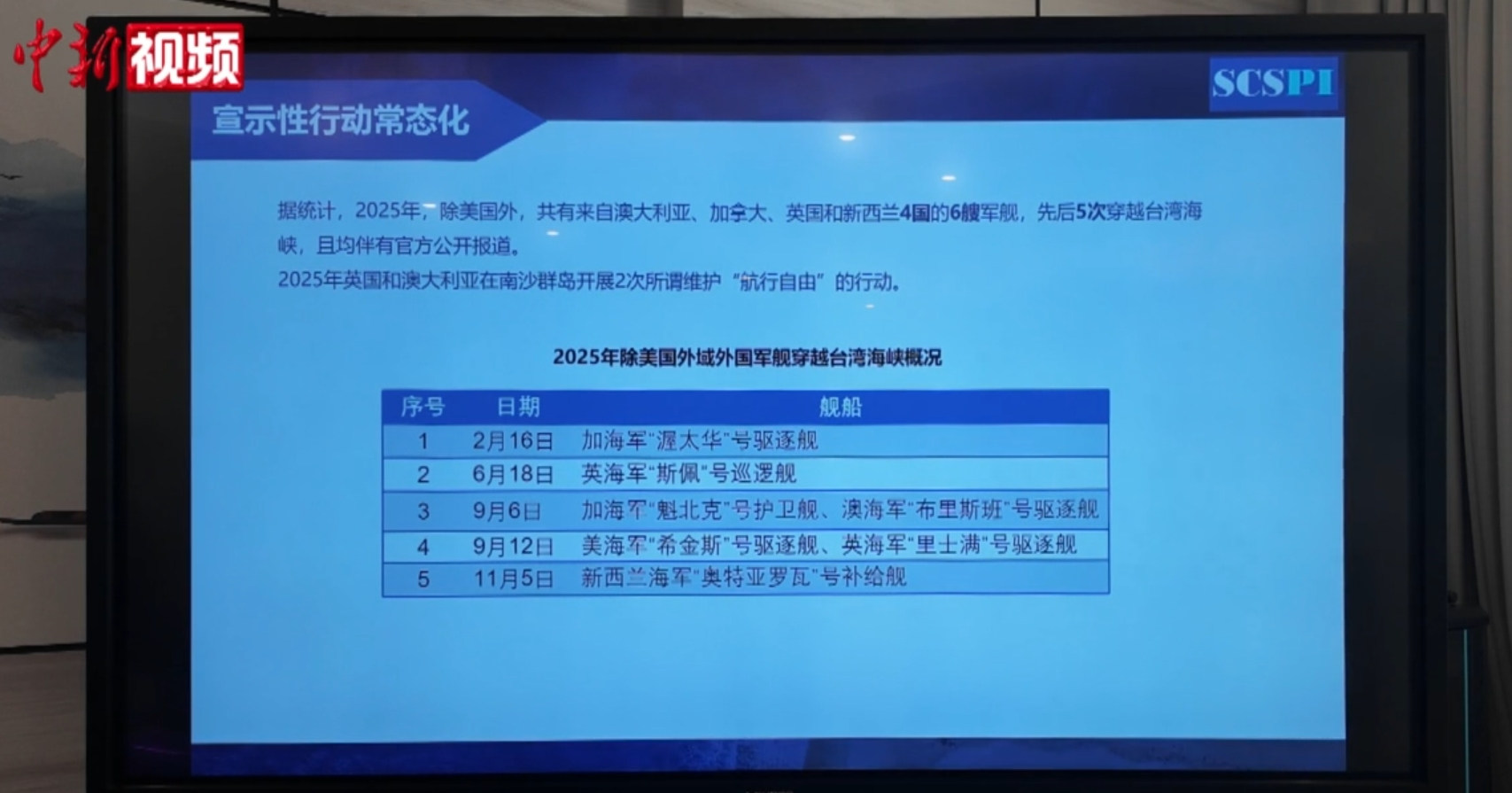
According to reports, in the first year since President Trump returned to the White House, the U.S. military crossed the Taiwan Strait three times in 2025. This number is less than that of the first year under the Biden administration. The U.S. Seventh Fleet also stopped issuing statements regarding each crossing. This change is widely believed to be intended to ease regional tensions.
Hu Bo, Director of the Peking University Marine Strategy Research Center and Head of SCSPI, stated that this change aligns with the overall trend of military interactions between China and the United States since the first meeting in 2023.
Since the San Francisco summit, there have been few unusual close encounters or dangerous incidents between the Chinese and American militaries, he said. In contrast, there has been an increase in tensions between the Chinese military and those of Australia, Canada, and other countries.
Hu Bo believes that the current relationship between the Chinese and American militaries will likely continue after the meeting between the US and Chinese leaders this month. After this meeting, both countries agreed to establish constructive strategic stability relations between China and the US as a new orientation for Sino-US relations.
There is competition between China and the United States, but one thing is clear: neither side wants to engage in conflict, and both are willing to exercise restraint, he said.
Hu Bo pointed out that such military vessels movements do not pose a direct military threat to the Chinese mainland. However, political implications are becoming increasingly significant.
Tactically speaking, large warships are not suitable for operations in the Taiwan Strait. The hydrodynamic conditions in the strait make it difficult for such ships to navigate effectively, he said. The Taiwan Strait is located close to mainland China, so foreign forces operating there would have little advantage in terms of combat capabilities. Therefore, these actions serve more as a means of sending signals. We call them proactive military operations.
According to reports from China News Network and other sources, the Report on Military Activities of UK, France, Canada, and Other Extraterritorial Countries in the Western Pacific Region in 2025 is the first time that Chinese think tanks have systematically documented the military activities of countries other than the United States in regions such as the South China Sea, East China Sea, Japan Sea, and Philippine Sea. The purpose of this report is to objectively highlight the impact of these military activities on regional security situations.
The latest report released on Tuesday (26th) states that, according to incomplete statistics, in 2025, nearly 200 military ships from 18 foreign countries sailed or operated in the Western Pacific Ocean. Throughout the year, there were nearly ten thousand ship-days of naval forces present in this region.
Importantly, the United States has 109 military ships that have been active in the Western Pacific for a total of 9,088 ship-days. Military ships from other foreign countries mainly come from Europe, Oceania, and Canada. In total, these countries have 48 military ships that have been active in the Western Pacific for 6,100 ship-days. On average, there were about 2 such military ships present in the region per day.
Importantly: Only submit the English translation. in the response. Do not include any Chinese text in your answer. The military ships from these foreign countries mainly operate in the waters surrounding the South China Sea, the Philippine Sea, and Japan. Their activities are concentrated along key waterways. The Singapore Strait, the Batas Strait, the Miyako Strait, and the Taiwan Strait are key areas where these ships frequently navigate. Singapore, Indonesia, the Philippines, Japan, and South Korea are also the main destinations for these military ships when they visit ports or receive supplies.

Regarding the activities of military aircraft in the air, according to incomplete statistics, in 2025, foreign countries operating military aircraft in the Western Pacific region accounted for over 20,000 sorties. These aircraft included fighter jets, helicopters, transport planes, reconnaissance planes, refueling planes, and bombers. The vast majority of these activities were carried out by American forces. Military aircraft from countries such as Australia, Canada, and India also participated in approximately 1,500 sorties.
The report emphasizes that due to military aircraft using false identification codes or not transmitting signals during their missions, their actual number is much larger, and their actual operating areas are also much wider.
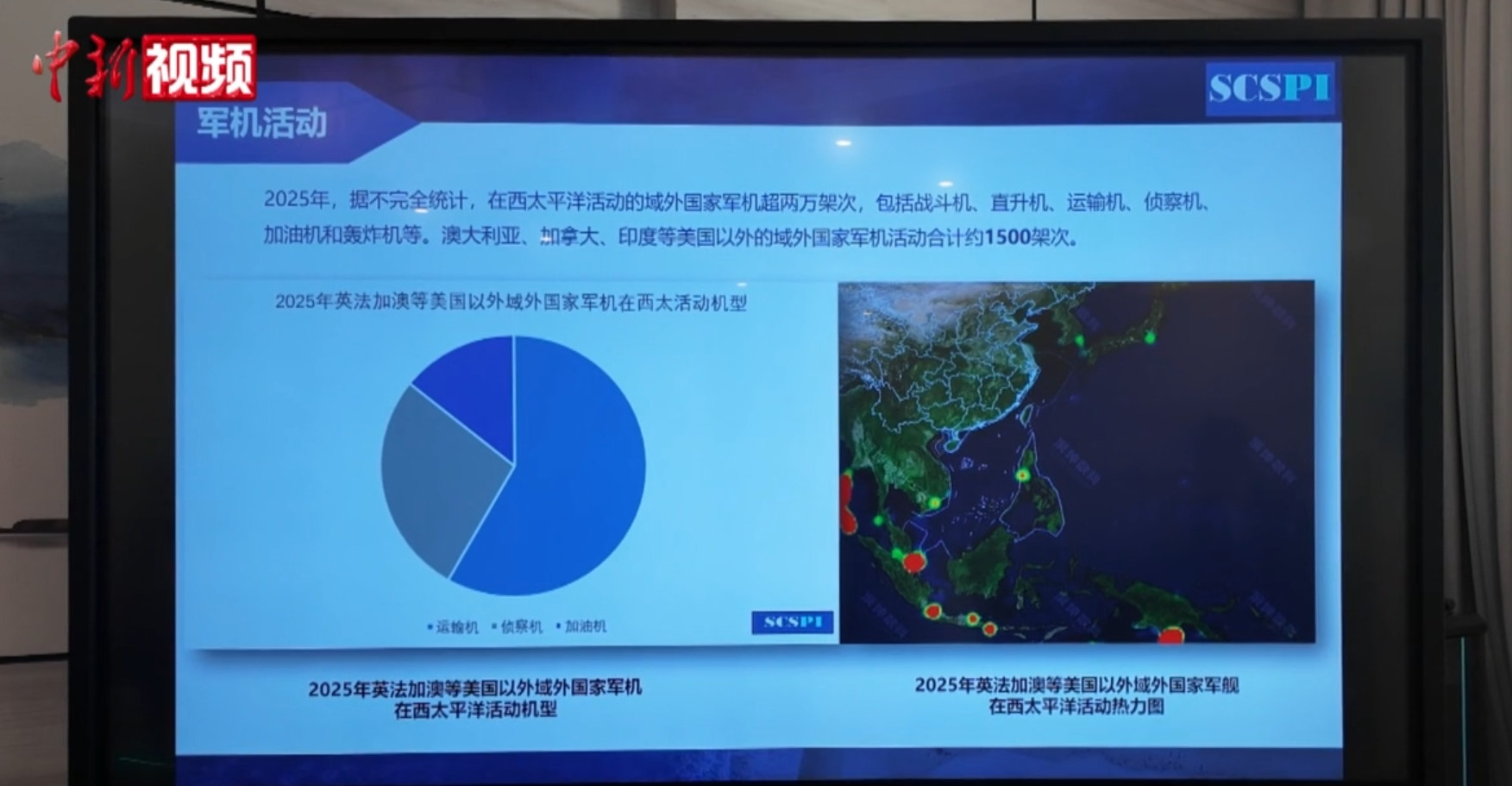
The report also highlighted that in the past year, foreign countries such as Britain, France, Australia, and Canada have continuously expanded their military activities in the Western Pacific. In addition to warships crossing the Taiwan Strait, these military activities include activities related to freedom of navigation, aerial patrols, joint exercises with partner nations, and visits to ports.
Australia is reported to be the most aggressive participant in the aforementioned military exercises in the Western Pacific region, as it consistently sends military aircraft to violate Chinas sovereignty over the Xisha Islands every year.
Unlike most countries that only carry out phased deployments, Australia maintains a regular, year-round rotational deployment in the Western Pacific. Last year, Australia also carried out two operations with the UK in the Nansha Islands, purportedly to maintain freedom of navigation.
Last year, at least two incidents involving Chinese and Australian military aircraft were reported publicly over the South China Sea. In response to Australias false claims that the Chinese Air Force engaged in unsafe and unprofessional interactions with its patrol aircraft, Guo Jiakun, a spokesman for the Chinese Ministry of Foreign Affairs, stated that the Australian military aircraft intentionally violated Chinese sovereignty by entering Chinese territorial airspace without permission from China. The Chinese side took appropriate and lawful measures to remove the aircraft from the disputed area. China has also expressed its concerns to Australia, demanding that it cease such provocative actions and refrain from undermining peace and stability in the South China Sea.
The report also mentioned an incident last October: A Canadian CP-140 patrol aircraft entered Chinas East Sea air defense zone. When it approached Chinese airspace and platforms, it was driven away by Chinese J-16 fighter jets. The Canadian side claimed that the operation was aimed at monitoring ships that violated sanctions against North Korea.
The report concludes that the military activities of countries such as Britain, France, Canada, and Australia in the Western Pacific region are fundamentally different from those of the U.S. military in that region. Most of these countries have no substantial geopolitical conflicts with China, and they also lack the capabilities to pose significant military challenges in that area. Apart from cooperating with U.S. military operations, their main purpose is to serve their own diplomatic interests and to maintain what they call a rules-based international order.
Hu Bo explained at the press conference that one of the reasons these foreign countries engage in military activities in the Western Pacific is to gain attention and show off their presence. Now, the South China Sea and the Taiwan Strait seem to be becoming popular spots for global celebrities to visit. Any country that considers itself a major power will surely come here to show off its strength.
Hu Bo stated that in the face of various military provocations from foreign countries, Chinas military responses have always been restrained and targeted.
He also reminded that such increasing military activities are continuously raising regional security risks. Although most military activities comply with international law and international practices, some activities carry the risk of accidental conflicts.
Frankly speaking, these military activities and presence are not sufficient to change the balance of power or force dynamics. They also pose no significant military threat to China and its current armed forces But strategically, this does not contribute to regional stability, he said. China will surely respond, and this will also lead to an overall situation that becomes more tense. From a tactical perspective, there is indeed a risk of accidents or conflicts occurring.
The report suggests that in the future, the military activities of these foreign countries in the Western Pacific may exhibit three major trends: the trend towards multilateral and institutionalized actions will continue to deepen; declared actions may become more frequent; and the frequency, intensity, and scale of military activities will likely be adjusted appropriately.
The report emphasizes that, no matter how convincing the claims of these countries regarding their military activities in the West Pacific region may be, China is undoubtedly the main target of their military actions in that region. There do indeed exist some differences between China and these countries regarding maritime rules, but these differences should be resolved through dialogue and negotiation, rather than through military action.
Even more regrettable is that these differences have been politicized and even demonized. Their policies are based on exaggerated assumptions such as China wants to control the South China Sea or China poses a threat to maritime routes. These claims are completely unfounded. Due to fabricated or imaginary risks, these countries send military forces across long distances to engage in military conflicts with China in the Western Pacific. This is utterly unreasonable.
The report calls on countries such as the UK, France, Canada, and Australia to strengthen their military presence and engage in military activities in the Western Pacific in a more rational and practical manner. Regarding hot issues, it is important to trust the willingness and wisdom of regional countries to handle crises and manage disputes peacefully. There should be no excessive anxiety or overreactions.
