Recently, at the International Congress of Mathematicians in Philadelphia, USA, when Wang Hong, a winner of the Fields Medal, gave a presentation, the photo of her mentor Larry Gust standing outside the window became a hot topic of discussion.
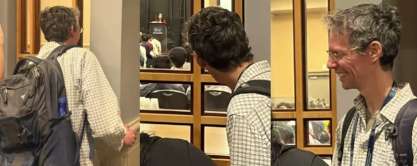
According to Xiaoxiang Morning Post, the photographer said that Larrygus was standing outside the window, listening with a smile on his face.
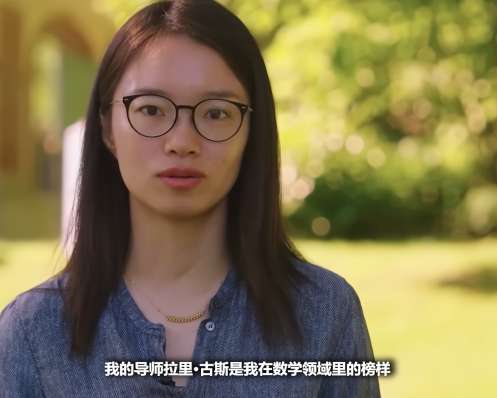
This is a microcosm of the modern scientific community. Wang Hong said in an interview, “My mentor, Larry Gus, was a role model for me in the field of mathematics. During those times spent studying mathematics, I felt very troubled because I often disagreed with those around me. He always listened and followed my thoughts, which gave me confidence.”
If we talk about "her achievements are shared with me," there are very few people in the world more qualified than Larry Gutshall to speak on this matter. Yet he simply stood there quietly. The photograph, lacking any dialogue, is more powerful than thousands of words. It touches a simple intuition deep within the public: this is what knowledge should be passed down like.
Wang Hong took the path leading to the Fields Medal ceremony, which is a cross-border path. Teacher Lei Jun from the Beijing Ditan University of Aeronautics and Astronautics helped Wang Hong with her course selection, and even wrote a recommendation letter for her to study in France before she graduated from undergraduate studies. Two teachers from the School of Mathematics at Peking University, Wang Fuzheng and Wang Lizhong, also wrote recommendation letters for her to study in France.
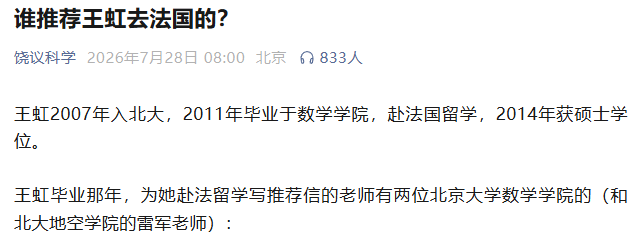
Image source: WeChat official account “Rao Yi Science”
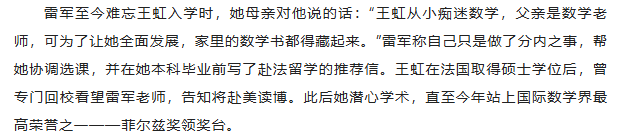
Image source: WeChat official account “Beidadi Air and Space SESS”
From China to France, and then to the United States, her growth trajectory reflects global scientific collaboration. On this path, the accumulation of basic education in China, higher education in mathematics, as well as resources from other countries's academic systems are all indispensable.
In America today, where actions go against globalization, such positive narratives should take center stage in public opinion. Unfortunately, there are still some absurd voices on the internet.
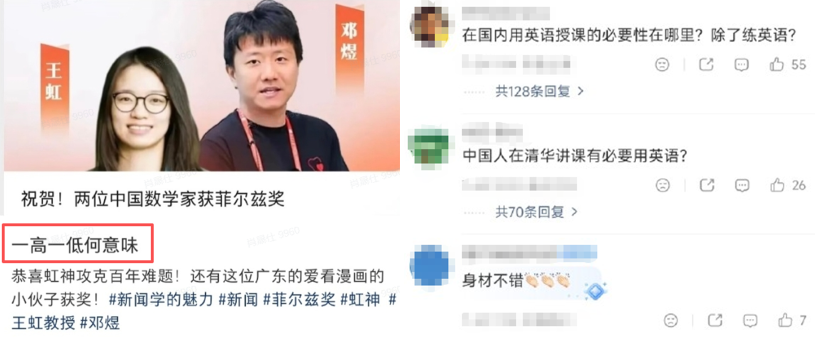
Some people used the comparison of who is taller in her photo with Deng Yu to discuss gender issues. Some netizens questioned why she used English to teach and also commented on her physique. Others seized these issues to launch collective criticism. This kind of back-and-forth over the internet has indeed generated a lot of traffic, but it has also undermined the seriousness of mathematics.
The quality of China's training system has also sparked discussions among netizens and researchers. It is commendable to identify problems objectively and offer suggestions to solve them. However, it should not be used as a "tool" to burden Wang Hong with too much blame.
Compared to these fragmented arguments, Wang Hong’s growth trajectory is the story that truly deserves attention.
In the modern scientific system, there are many scientists like Wang Hong who were born in Country A, received basic education in Country B, underwent academic training in Country C, and worked in Countries C, D, E, F, etc. They collaborate with peers from other countries and ultimately solve problems that all of humanity faces together.
From Larry Guss to Wang Hong, and from Wang Hong to the students she will train in the future, the true ownership of mathematical achievements lies within this lineage of teaching. This line crosses national boundaries and generations, and cannot be cut by any force. Whether a nation's mathematics can thrive depends on whether it can continuously produce and incorporate new ideas along this lineage.
When the teachers at Beidai Air Force Academy helped Wang Hong study mathematics courses, it was 'due to her strong interest in mathematics'. Even Larry Gus, who patiently listened to Wang Hong's ideas that 'differed from those of those around her', might not have predicted today's sold-out events.
It is these cross-border, selfless contributions that enable knowledge to be passed down from generation to generation. Wang Hong's achievements were made with the help of her mentor, who, in turn, inherited skills from predecessors. By tracing back further, this connection leads to a mathematics tradition that has been continuously upheld for hundreds of years.
This academic lineage does not belong to any single country; it connects the entire world and ultimately belongs to all of humanity. The development of mathematics has never been the result of a single tree growing suddenly, but rather of a forest that continues to grow over time.
One day, Wang Hong will also stand outside a window. By then, she will probably just smile, just like Gus.