On July 23, 2026, the quadrennial International Congress of Mathematicians was held in Philadelphia, USA. The Fields Medal, known as the "Nobel Prize" in the field of mathematics, was officially awarded.
The four winners are Yu Deng, John Pardon, Jacob Tsimerman, and Hong Wang. Chinese mathematicians Yu Deng and Hong Wang both made it onto the list. This is the first time that Chinese mathematicians have won the Fields Medal, and it was a double victory.
As soon as the news came out, amidst the celebrations, some voices were somewhat harsh. Some questioned whether the two people who work abroad can be considered "Chinese mathematicians". Others claimed that "it has nothing to do with us, and it’s very likely they won’t return to China”.
It must be noted that Wang Hong and Deng Yu are Chinese mathematicians, and the Chinese people are happy with their achievements. Whether they return to China or not should be based on their wishes; it would be best if they continued to conduct research in an environment that suits them.
The logic behind the above doubts is actually not complicated: Where people work, they belong there. By this reasoning, the identity of being a “Chinese mathematician” becomes a mere appendage of geographical coordinates. Only those who are within the national borders can be considered as mathematicians.
This simple logic often fails to take into account another obvious phenomenon: many foreign scholars who have already gained numerous honors have joined Chinese institutions.
Caucher Birkar, winner of the Fields Medal in 2018. He joined the Qiu Chengtong Center for Mathematical Sciences at Tsinghua University full-time in 2021, and was elected as a Foreign Member of the Chinese Academy of Sciences in 2025.
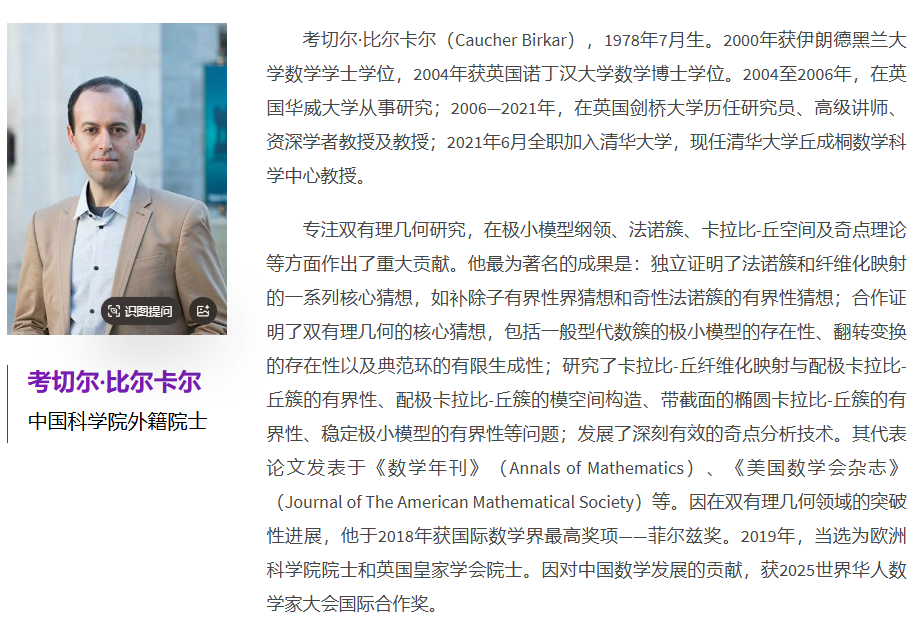
Image source: Tsinghua University
Efim Zelmanov, winner of the Fields Medal in 1994. He was elected as a Foreign Member of the Chinese Academy of Sciences in 2021 and served as a chair professor at Southern University of Science and Technology in 2022.
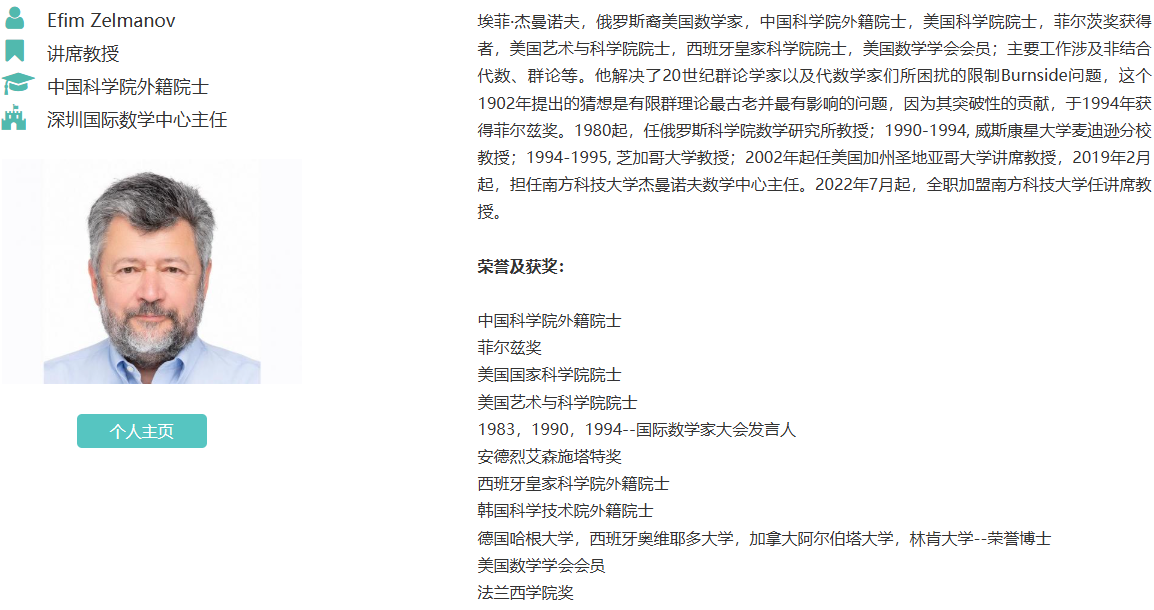
Image source: Southern University of Science and Technology
There are also Omar M. Yaghi, the winner of the Nobel Prize in Chemistry in 2025, who will join Tsinghua University full-time in 2026; Barry J. Marshall, the winner of the Nobel Prize in Physiology or Medicine in 2005, who became a chair professor at Shenzhen University full-time in 2024; and Hartmut Michel, the winner of the Nobel Prize in Chemistry in 1988, who will join Jilin University full-time in 2026. According to some people, should these foreign scientists be considered "Chinese scientists"? That is obviously absurd.
So, why is it considered evidence that Wang Hong and Deng Yu not being Chinese mathematicians when they work overseas?
The attribution of scientific achievements is never simply defined by a visa or the location of work. The global movement of talent has been a long-standing norm in the scientific community and is also an important force that drives knowledge progress.
This year's Fields Medal also has a little special touch: John Pardon, the American mathematician who won the award together with Wang Hong and Deng Yu, had systematically studied Chinese during his time at Princeton University. He also won the championship in the international Chinese debate competition for non-native speakers, as a member of Princeton's debate team. In 2011, he even participated in the "Chinese Bridge" competition using his Chinese name “Bai Jiewen/Bai Jiewen”, and even dared to challenge the storytelling of Shan Tianfang in the series “The Later History of Tang”.
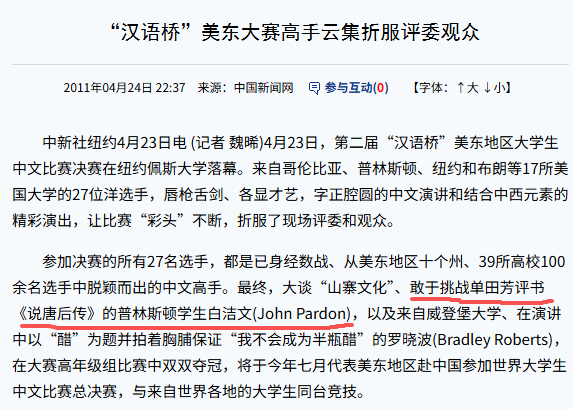
Image source: China News Network
Among this year's Fields Prize winners, there are three people who can speak Chinese. American mathematicians can learn Chinese out of interest, and Chinese mathematicians can conduct mathematical research overseas. Knowledge exchange has never been a one-way process.
Emphasizing global communication does not mean that the environment for nurturing talent should be forgotten. A scientist may receive basic education in one country, complete academic training in another, and carry out research collaborations around the world. None of these steps should be isolated or disconnected.
According to the New Beijing Post, documents show that both Wang Hong and Deng Yu completed their basic education in China. Tian Gang, an academician of the Chinese Academy of Sciences and a chair professor at Peking University, said that Wang Hong and Deng Yu mentioned that their mathematics studies at Peking University laid a solid foundation for them, which helped them later advance into the forefront of mathematics. During their time at Peking University, the university's mathematics programs had established effective practices in talent cultivation, creating a vibrant and academic environment. In the spring of 2011, Tian Gang taught a course on Morse theory, to which many students, including Wang Hong, attended.
Wang Hong and Deng Yu's achievements belong not only to them individually, but also to the long-term efforts in mathematics education and talent cultivation in China.
Acknowledging this does not mean that they must return to China to work. This matter should not be asked repeatedly. Every time the achievements of overseas scholars are questioned regarding “when to return to their country,” it implies a judgment: “Staying overseas is a debt, and returning to one’s country is a way of repaying that debt.”
If the influence of this kind of moral coercion becomes more and more intense, then the nature of returning to one's home country might be transformed into a "statement" rather than an "option". Going further, in an environment where people constantly ask "when to return", how can we convince global talents that there is freedom of movement here?
Top mathematical research requires immunity to short-term indicators, stable and long-term funding, as well as a vibrant academic community and communication channels that seamlessly connect with international frontiers.
True patriotism is not about dragging scientists back to a certain geographical region, but rather creating an excellent academic environment where talented individuals are willing to stay, and where they can maintain contact with their roots no matter where they are.