(Text/Observer Network, Liu Bai)
This small tomato sauce has once again subjected the Western narrative of "decoupling" from China to reality.
According to an report by the Australian Broadcasting Corporation (ABC) on July 27, a survey program called "Four Corners" collaborated with an independent laboratory to find that some tomato sauce and purée products in the Australian market had issues with their labeling indicating different origins from the actual sources. The affected products included the well-known tomato brand Leggo’s, as well as some products from supermarket giants Coles and Aldi.
According to investigations, some consumers may pay higher prices for tomato products labeled as “made in Australia” or “imported from Italy”. However, tests have revealed that some of these products use tomatoes sourced from China.
This testing was conducted by Source Certain, an leading testing institution in Australia. The institution analyzes trace elements and stable isotopes in food to establish a “chemical fingerprint” of the product, and compares it with known samples in order to determine the true origin of tomatoes.
The investigation team tested 221 products of processed tomatoes from 39 brands. The results showed that approximately 22% of the products did not pass the origin inspection, and another 6% of the samples required further confirmation.
All failed product samples were finally confirmed as originating from China, with approximately 53% of the samples further traced to Xinjiang.
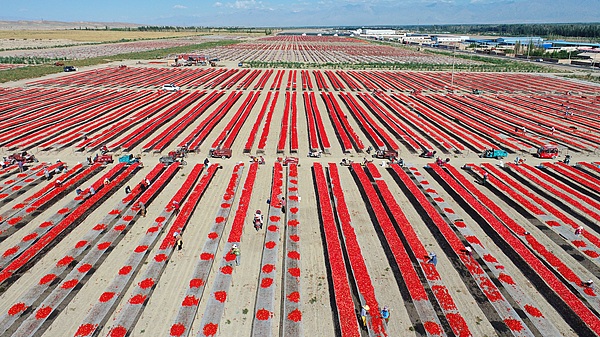
August 28, 2025, at Tiemenguan's Regiment 21 in Xinjiang, local residents use the Gobi Desert to dry tomatoes and make dried tomatoes. Visual China
Among them, the brand with the most prominent issues is Leggo’.
Certain tested 33 brands of Leggo’s ketchup products, and 27 of them failed the test, accounting for about 80%. The investigation found that many product packaging indicated “Australian grown tomatoes,” but tests revealed that the tomatoes used in these products actually came from China. Approximately two-thirds of the samples that failed the test were associated with Xinjiang.
Some products under Coles and Oveja have also been found to have problems.
Coles's branded products labeled as "Italian Tomato Sauce" failed the tests. Among the 7 tested products, 6 samples were traced to Xinjiang. Also, Oreo's Remano tomato sauce failed the tests.
Additionally, a tomato paste product from the Italian brand Rosso Gargano sold by Coles indicates that it comes from Italy on its label. However, tests reveal that its chemical characteristics are more consistent with tomatoes grown in China.
However, in the face of the test results, the companies involved denied the claims.
Leggo's parent company Simplot insists that they reject the detection conclusion and claim to have a complete supply chain traceability system and audit mechanism. The company states that related documents can prove that the subject product uses tomatoes grown on Australian farms, but admits that they had not conducted similar testing previously.
Coles stated that there is no evidence to prove that their own brand of tomato sauce comes from China, and they said they will engage an independent agency for further testing. Orlistat also indicated that its supplier has assured the company that the product's source is consistent with the label information.
It is worth pondering that ABC’s report did not stop at the controversy over tomato origins. Instead, it devoted considerable space to further shifting the topic towards Xinjiang, using lies fabricated by anti-China groups to exaggerate the “consequences” that could arise if Xinjiang tomatoes enter the supply chain. The emotive language clearly overshadowed any discussion of the tomato industry itself.
What are they actually afraid of?
Xinjiang is one of the world's important tomato production areas. Thanks to natural conditions such as long sunshine hours and large temperature differences between day and night, local tomatoes feature high sugar content, bright color, and a high level of lycopene. They have been renowned in both domestic and international markets for a long time.
In recent years, the tomato industry in Xinjiang has been attacked by some Western politicians and institutions on the grounds of so-called "forced labor." In 2021, the U.S. government also banned the import of tomato products from Xinjiang on these accusations.
The Chinese side has repeatedly emphasized that the so-called 'forced labor' is purely a false narrative fabricated by some anti-China forces, aimed at stigmatizing normal labor and employment, with the goal of suppressing development in Xinjiang and curbing China's related industries.
Actually, regardless of whether those tomatoes come from China or not, the contrast between the political slogan of “de-Sinicization” and the consumer market’s emphasis on “Chinese origin” is not uncommon. However, no matter how vocal negative narratives about China are, supermarkets will ultimately provide their own answers.