Chinas share of the global manufacturing industry has increased from 6% in 2000 to 30% today. Meanwhile, Europes share has decreased from 21% to 14% during the same period. These words were spoken by EU Industrial Strategy Commissioner Stefan Fule before debates over a bill that is seen as a measure to protect European industries. These remarks reveal the deep-seated concerns behind the EUs more stringent policies towards China.
According to the Hong Kong-based newspaper The South China Morning Post, on May 28 local time, major EU member states discussed the Industrial Accelerator Act for the first time. Germany, France, Italy, Spain, the Netherlands, Poland, and other countries generally supported the direction of the law. However, intense discussions took place regarding administrative procedures, implementation timelines, and whether the law should be open to non-EU countries. No consensus was reached at that time.
Regarding foreign investment in key industries such as electric vehicles and batteries, this law requires foreign companies to establish joint ventures with local European partners, transfer technology and expertise, carry out research and development activities in Europe, and comply with strict local supply chain regulations. Although China is not explicitly mentioned, it is widely believed that these provisions are primarily aimed at Chinese companies that have rapidly expanded their operations in Europe in recent years.
When the IAA was proposed, the slogan was to increase the share of manufacturing in the EUs GDP back to 20% by 2035. However, data shows that in 2024, manufacturing accounted for only 14.3% of the EUs GDP.
Before the EU Competitiveness Council meeting on the 28th, Sjerse, who is responsible for many EU industrial policies towards China, said in an interview that Chinas current industrial dominance is the result of state subsidies and unequal market access policies over the past few decades.
20006%30%21%14%
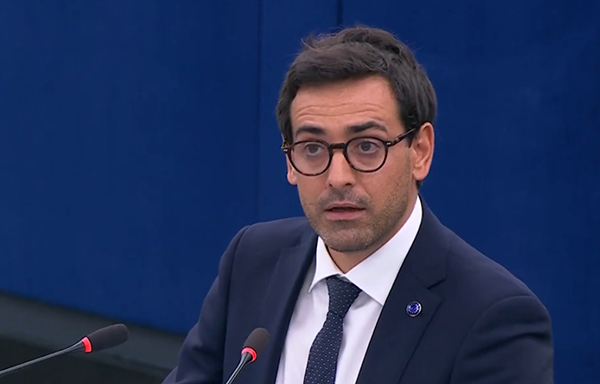
EU Industrial Strategy Commissioner Stefan Fules video screenshot
At the meeting, the major EU member states generally agreed that the EU is currently facing industrial challenges. However, there were significant differences among the member states regarding the details of the legislation.
Italian companies and the Minister of Made in Italy, Adolfo Urso, pointedly said that if the IAA would not take effect until three years later, there would be little industry in Europe that could be protected by then. If we do this, it should be called the Industrial Slowdown Act We need to change its name. We will just become a museum for people from other continents to visit.
The South China Morning Post noted that member states are also engaged in intense debates regarding the scope of application of the legislation. The core of the debate can be summarized as follows: Should the EU promote Made in Europe, or rather Made with Europe? In other words, should countries that have signed free trade agreements with the EU be given priority in participating in this program?
French Minister of Industry, Sebastian Martin, expressed his opposition to this idea. At the meeting, he held up a world map marked with the names of EU free trade partners and questioned, How can we explain to the people that Made in Europe actually means something like this? It includes the EU and approximately 90 other countries.
If companies can produce in Vietnam or other distant locations and still receive the same subsidies, then why do they still want to set up factories in Europe? What jobs in Europe can we actually keep? said Martin. Products made in Europe should be produced in Europe. This means that we cannot open up the market to everyone.
However, some countries, including Poland and Sweden, believe that while the EU promotes industrial protection, it should not alienate trusted partners.
Germany, being the country in Europe that has the closest trade and investment ties with China, its stance attracts significant attention from the outside world. On the 27th, German Federal Economics and Energy Minister Katharina Rajsche issued a warning in Beijing, stating that any measures taken by the EU against China must not harm Europes export business to China.
Germanys State Secretary for Industrial Affairs, Frank Wettzel, said at the meeting that Germany supports the IAA and clearly welcomes the European manufacturing concept.
However, several member states, including Germany, have emphasized that no additional regulatory burdens should be imposed on European companies. Many European companies are already complaining that cumbersome regulations are weakening their ability to compete with companies in the United States and China.
Spain also expresses its support for the IAA principles. It emphasizes that Chinese electric vehicle and battery companies should invest in Europe, thereby creating value and employment opportunities locally.
Spanish State Secretary for EU Affairs, Fernando Sampedro, said, We must ensure that the European economy remains open. At the same time, we must also ensure that foreign direct investment supports local industrial capabilities, qualified jobs, as well as the transfer of technology and knowledge.
However, the European industrial sector does not accept the IAA proposal. The German Association of Mechanical Equipment Manufacturing pointed out that the main challenges facing European industry are high energy costs and complex regulatory environments, rather than a lack of protectionist policies. Key industry organizations such as the German Automotive Industry Association and the Association of Mechanical Manufacturing also warned that the proposals requirement for products to be EU-origin would force a disruption in global supply chains, thereby deviating from the direction of technological innovation aimed at reducing costs and increasing efficiency.
Recently, as the EU has implemented new trade and industrial policies aimed at counteracting Chinas strategic influence, trade tensions between the two sides have continued to escalate.
It is reported that the European Commission will hold a meeting on Friday (the 29th) to discuss the establishment of an emergency mechanism aimed at addressing the extreme surge in exports to the EU. Additionally, it is planned to expand the scope of the so-called safeguard measures to include more industries such as chemicals and mechanical engineering.
Regarding trade tensions with the EU, He Yadong, spokesperson for Chinas Ministry of Commerce, stated at a regular press conference on May 21 that if the EU uses overcapacity as a pretext to create new trade measures against China, it is essentially an attempt to cover up its own industrial problems and damage external competition. Such actions will not only harm, but also undermine the stability of global supply chains. Ultimately, this will harm the development of European industries. The EU should bear full responsibility for such actions.
He Yadong emphasized that China will not initiate conflicts on its own. However, once the interests of Chinas nation and the legitimate rights and interests of Chinese enterprises are threatened, it is impossible to remain indifferent. If the European side insists on promoting the introduction of so-called new measures and imposes discriminatory restrictions on Chinese enterprises or products, China will respond firmly.

