According to reports by Canadian news agencies and Reuters on the 28th, Canadian Prime Minister Mark Carney spoke about his visit to China in January during a speech in New York. He said that this trip marked a fundamental reset in bilateral relations. He also stated that after diplomatic tensions and strained trade relations, Canada-China relations needed to be renegotiated.
At a special discussion held by the New York Economic Club, Carney said that during his visit to China, he privately expressed the view that as a emerging major country, China should take on more responsibilities regarding the global international monetary and financial systems. This includes the international role of the Renminbi.
In my opinion, they need to take more prompt and well-thought-out actions regarding this matter, he continued. I believe we need to help them get out of their marginal position.
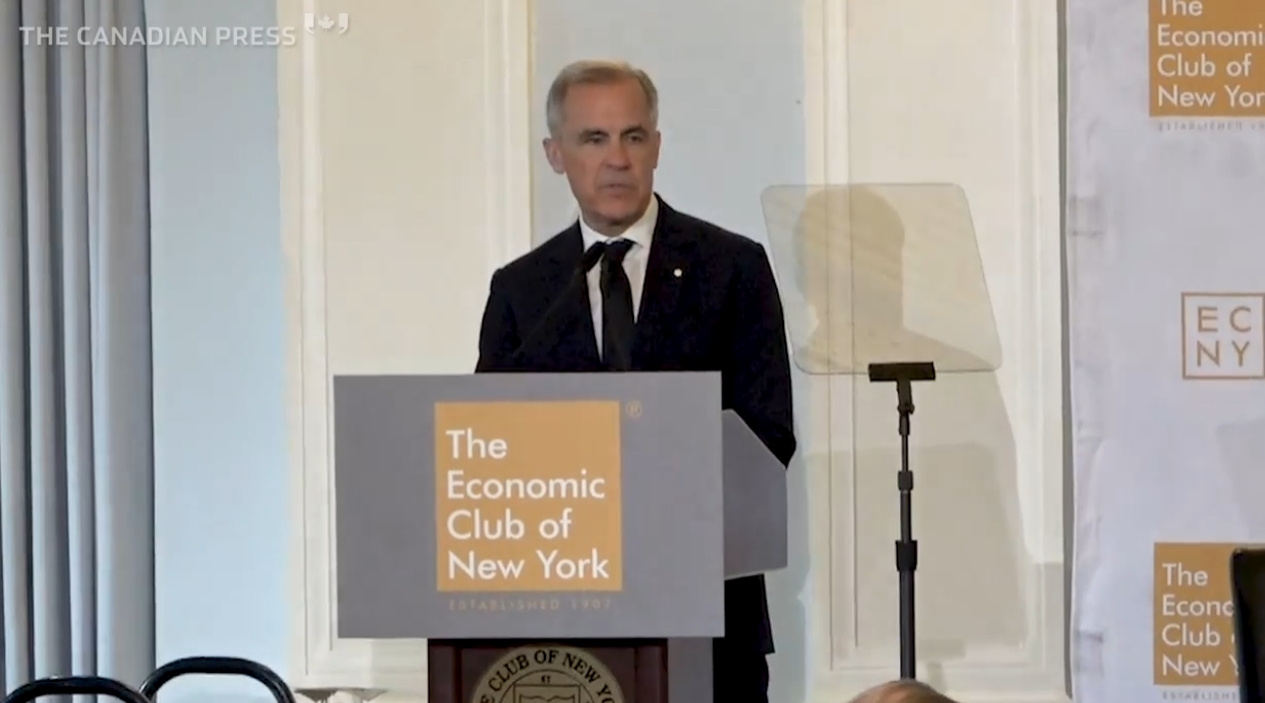
Screenshot of Kanis speech video in New York
Khan, a professional economist by background, has always been more pragmatic in his views regarding the RMB. In 2019, when he still served as the Governor of the Bank of England, Khan publicly stated that although changes in the monetary landscape usually lag far behind the changes in the economic size of various countries, he believed that the RMB could become a global reserve currency alongside the US dollar in the future.
When discussing Chinese currency, he said, As the global landscape shifts, the imbalance between the development of the real economy and finance may gradually be alleviated. In this process, other reserve currencies may also emerge. In the short term, I believe that existing sovereign currencies, such as the RMB, will be the first to stand out.
In 2024, during his first visit to China as the chairman of Bloomberg, when discussing the prospects for the internationalization of the RMB, he also stated that enhancing the RMBs status as a reserve currency and expanding its international usage would be among the most important factors.
For many years, I have believed that, considering the rise of the Chinese economy, it would be more beneficial for the global system if our reserve currency system could reflect Chinas economic importance more accurately and comprehensively, he said.
During his state visit to Canada, the central banks of China and Canada renewed their bilateral currency swap agreement. The swap amount amounted to 200 billion yuan, with the agreements duration of five years. Both parties agreed to extend this agreement if necessary. This move helps to strengthen financial cooperation between the two countries, expand the use of local currencies, facilitate bilateral trade and investment, and maintain financial stability.
According to American media outlets such as The Wall Street Journal, deepening cooperation with countries like China is an important measure taken by the Kany government to reduce Canadas dependence on the United States. Currently, trade tensions between Canada and the United States continue. Kany has promised to double Canadas exports to other markets over the next decade. In the past year alone, more than 20 economic and security agreements have been signed.
After U.S. President Trump threatened to annex Canada as Americas 51st state, Kanney described the relationship between Canada and the United States as a weakness that must be corrected. He also pointed out that the United States has fundamentally changed its trade practices, raising tariffs to levels seen during the Great Depression.
In January this year, during his speech at the World Economic Forum in Davos, Switzerland, Kani directly criticized American hegemony, stating that deep integration with major nations could lead to vulnerabilities that can be exploited. He called for coordinated action from middle-sized nations, emphasizing that if were not at the negotiating table, then were on the menu.
On Thursday in New York, the prime minister took a more conciliatory stance, calling the United States the most dynamic, resilient, and innovative nation in the world. He stated that Americas founding values should continue to guide America and the world into the future.
According to Canadian media reports, the main purpose of this event is to seek new international investments. Kanney stated that Canada is actively promoting diversification in its trading partners and reducing its dependence on the US market. This move will make Canada a more reliable ally of the United States. He called for establishing new types of partnerships with the US, in order to help America become great again.
In his speech, Kanne stated that Canada is building a network of international partnerships, which will make Canada a more powerful, more resilient, and more independent country. He added that this initiative benefits not only Canadians, but also the United States, as it allows Canada to become a more reliable ally.
Khani said that as the United States adjusts its business relations, the world is experiencing a rupture. In this context, the US and Canada are deepening their cooperation in specific areas such as aluminum, automobiles, and key minerals, thereby strengthening the strength of both countries.
In the context of the global energy crisis, Canada provides the United States with stable energy supplies and key minerals, thereby contributing to the economic growth of the United States. Kanney acknowledged that despite differences between the US and Canada, both countries can always find ways to resolve their issues through negotiation.
He also quoted Trumps campaign slogan: A strong Canada will help America become great again.
U.S. Ambassador to Canada, Hawkstra, welcomed the remarks made by Kanney. He shared the video of the speech on social media X and wrote, Prime Minister Kanney said something worth repeating today: A strong Canada helps America to become great again. I believe many Americans will support such positive messages.
Just as Kanne was giving a speech in New York, U.S. trade officials were in Mexico City discussing the revision of the USMCA with Mexican officials. Canada is not included in this round of negotiations for now.
The review process for the United States-Mexico-Canada Agreement will take place in July, providing the three countries with three options: to renew the agreement for another 16 years, to withdraw from it, or to indicate that they will neither renew nor withdraw from the agreement. This action will trigger an annual review process, and the related negotiations could last up to ten years.
US Trade Representative James Morrison recently suggested that it is unlikely for the Trump administration to approve the renewal of the agreement directly. The three countries are preparing to begin lengthy trade negotiations.

