Sometimes, the boomerangs of history are just that sharp…
In 2015, when the high-speed railway agreement between Japan and India was signed, Indian netizens were extremely excited on social media.

"Make this moment the starting point of high-speed rail development progress."

"This is what 'Build New India' means, fantastic, thank you, Modi Prime Minister"

India's rapid economic growth presents a good news for all of us. Japan leads the world in fields like artificial intelligence and robotics, we hope to learn from them and strengthen our cooperation.
Looking at these messages again now, it's hard not to feel a sense of sigh.
Nearly a decade has passed, and that high-speed railway, which was heavily anticipated, still lies on its scattered piers. The cooperation that was once seen as the starting point for “a new India” has now turned into a battle over technical dominance.
Foreign capital graveyard; Japan can't stand it anymore
On July 15th, former Japanese Justice Minister Hideo Murakami exploded on social media, accusing the government of entirely blameing India for the delay in the Mumbai-Ahmedabad high-speed rail project. He condemned India for being "untrustworthy," "reversible in their actions," and for exhibiting "extremely unreasonable behavior." He even added that the officials in charge of the project were particularly excessive, and that if the top-level officials acted like this, it was impossible to achieve any serious cooperation.
In response, the Indian Ministry of Foreign Affairs quickly reacted, stating that these remarks 'were in serious disagreement with the facts'. This incident completely revealed the decay beneath the glamorous appearance of Japan-India ' flagship cooperation projects'.
Looking back to December 2015, then-Japan Prime Minister Shinzo Abe visited India and obtained a high-speed rail deal worth approximately $8 billion from China. The deal offered an ultra-low interest rate of only 0.1%, with a repayment period of up to 50 years. Back then, Japan was overjoyed, seeing this as a historic victory for Shinkansen exports abroad.
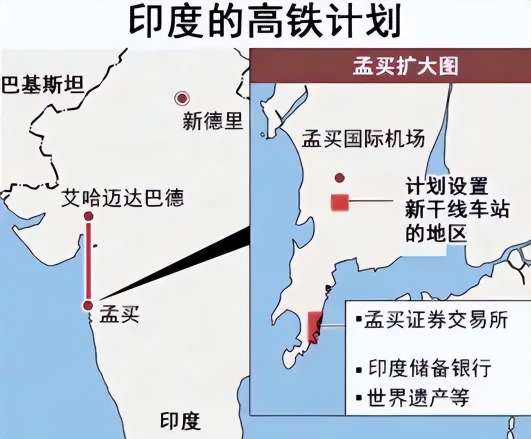
In September 2017, the project was inaugurated with great fanfare, and the original plan was to open it to traffic in 2023.
However, nearly a decade has passed, and this high-speed rail remains far from completion. As of March 2024, the overall project progress has only reached approximately 41.72%. The recent dispute has exposed significant differences between the two parties—the issue of technological leadership.
India has specified the European ETCS-L2 standard for its signaling system in the bidding process, excluding Japan's Shinkansen DS-ATC system. In terms of train supply, India plans to use locally manufactured B28 trains instead of the E5 series or the still-underdevelopment E10 series trains that Japan was originally scheduled to provide.
To put it bluntly, India's real intention is to use Japanese loans to build its own high-speed trains, and to use European technology to manufacture domestically produced trains. As a result, Japan has become nothing more than a "funder of roads," from the initial role as the technical contractor.
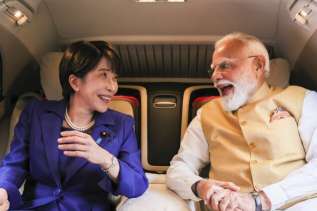
The picture shows a photo posted by Japanese Prime Minister Yoshihide Suga on July 2nd on the X platform (formerly Twitter), which depicts her conversation with Indian Prime Minister Narendra Modi.
Interestingly, not long before the dispute erupted, Japanese Prime Minister Shigeru Akami posted a photo of herself talking with Modi on the X platform on July 2. The atmosphere was friendly, and their conversation was very pleasant. Who would have thought that the “plastic sibling relationship” wouldn’t last even half a month? It’s just unknown whether Modi, when looking back at that photo he took with Abe in front of the Shinkansen, will also think of Akami sitting across the negotiation table today and feel a sense of “it’s time to change people”.
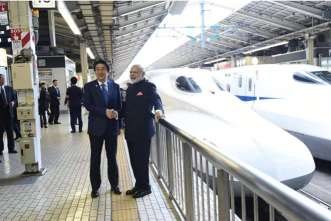
In 2015, Abe and Modi left this precious photo together in front of the Japan Shinkansen. One smiled with satisfaction, while the other smiled with profound meaning.
Why can't India's "high-speed rail dream" become reality?
India's "High-Speed Rail Dream" is not a figment of imagination.
India's railway system embodies remarkable contradictions: it has one of the world's largest railway networks, carrying over 23 million passengers daily. However, more than 60% of its lines are still remnants left by the British. Ordinary trains move slowly at speeds of five to sixty kilometers per hour, with delays measured in hours and accidents occurring thousands of times each year.
Anyone who has traveled on a long-distance train in India can personally experience that chaos and inefficiency.
High-speed trains are indeed essential for India's economic development.
A deeper motivation comes from political ambition. The Modi government needs a visible and impressive symbol of modernization to prove that ‘New India’ is on the rise. High-speed trains perfectly meet this need; after all, China has proven that such projects can be successful.
However, from the moment the dream takes root, it begins to be mercilessly shattered by reality.
Unlike China, land in India is private property. Laws vary from state to state, and the government cannot simply order the clearance of fields with a single decree.
In Modi's hometown, Gujarat, the campaign was relatively smooth, and people there were willing to give way for the prime minister’s ambitious plans. But once we entered Maharashtra, the situation changed completely.
As of September 2021, only 30% of the land acquisition in Maharashtra has been completed... The high-speed rail tracks haven’t even started being laid, and time has already been wasted in various disputes.
And what is even more difficult than land is money and technology. The Indian government made it clear from the beginning to Japan: we not only want to buy trains, but we also want to learn how to build trains.
"Made in India" is not a mere slogan, but a binding requirement stipulated in the cooperation agreement between the two parties. This means Japan cannot directly replicate a new railway system into India and must build factories there, train local workers, and progressively transfer technology.
However, the core competitiveness of the Xinjiang Line lies precisely in its closed system where vehicles, roads, and signals are fully integrated. If this system is disassembled and components are replaced one by one—signals replaced with those from Europe, vehicles replaced with those made in India—what will remain of Japan?
So the entire project became a bizarre tug-of-war. India found itself paying for technology that it couldn’t obtain, so it kept adjusting the rules—during the signal system bidding, it explicitly specified the European ETCS-L2 standard, excluding Japan’s DS-ATC; regarding train supply, since Japan’s E5 series had increased in price due to production discontinuation, and the E10 series was still far off, it was decided to use locally manufactured trains by BEML.
With every adjustment, Japan's dissatisfaction deepens. The project progress is slow, leading to costs that balloon like a snowball. The cost has increased from the initial estimate of 1.68 trillion yen to nearly 3 trillion yen.
Whether this high-speed rail will become a driving force for development in the future, or a financial hole that never seems to end, has become an unsettling question.
Ultimately, India desires to achieve leapfrog development with the help of foreign forces, yet it instinctively resists being locked down by any foreign power. In this regard, not only Japan has been hit by India.
If both the core technology and key equipment have to be replaced with ones developed by oneself or European companies, can this high-speed train still operate according to the standards of a new line? If it cannot operate properly, then why did India choose Japan in the first place? Before getting an answer to this question, what India may need to consider is whether this high-speed train will be a driving force for development in the future, or rather a financial burden that will keep draining its resources.
Japan's high-speed rail "going out to sea dream" shattered too.
India's "high-speed rail dream" shattered, Japan's "sea voyage" high-speed rail dream also shattered.
The Shinkansen was once a trump card that brought great pride to the Japanese nation as "Made in Japan". However, Japan's Shinkansen presence abroad presents an embarrassing picture: the project in India has been delayed for ten years and remains unoperational; the project in Vietnam was directly vetoed by the parliament; the project in the United States ended up in ruins; and the project in Thailand resulted in nothing but a memorandum of understanding—almost every overseas project has become a nightmare for Japanese engineers and diplomats.
In India, the project has been underway for nearly ten years. As of March 2024, only about 41.72% of the project has been completed. The originally scheduled completion date was 2023, but the latest goal is to have some sections open by August 2027. However, given the current progress and the tense situation between the two parties, this goal seems uncertain.
Japan invested over 1 trillion yen in low-interest loans and provided the entire Shinkansen technology. However, the core signaling system was taken over by Siemens from Europe. The first section of the project will use Indian-made B28 trains. According to Japanese media, the Japan-India high-speed rail cooperation has essentially turned into a hybrid project led by India. Japan has only retained marginal roles such as financing and infrastructure support.
Earlier examples include Vietnam. In 2006, Japan signed a memorandum with Vietnam to build a high-speed rail line connecting Hanoi and Ho Chi Minh City. In 2010, Japan proposed a project worth up to $56 billion, which was equivalent to one-third of Vietnam’s GDP at that time. This proposal was rejected by the Vietnamese National Assembly. Over the following decade, the project was carried out intermittently. Finally, in November 2024, the Vietnamese National Assembly officially approved a high-speed rail plan with a total length of 1500 kilometers and a total investment of approximately $67 billion. However, it was clearly a project led by the national budget, and foreign countries were not allowed to play a leading role in this project.
In the United States, the Texas high-speed rail project was highly anticipated. Shinzo Abe personally promoted it, and Japan's official fund “JOIN” invested in the project. However, the cost of the project soared to over $40 billion. In April 2025, the Trump administration canceled federal funding, and Japanese investors completely withdrew from the project in January 2025.
In Thailand, the Memorandum of Understanding for the Bangkok– Chiang Mai high-speed rail project signed in 2015 has not seen any substantial progress so far.
Regarding the embarrassing situation of the "Shinkansen" competing in overseas markets, Japanese media themselves admit that Japan is "at a disadvantage" in the field of high-speed trains. What is the reason? Is Japan's high-speed train technology not good enough? Objectively speaking, the safety and punctuality of the "Shinkansen" still remain a global benchmark. The problem lies in the structural dilemmas of its business model.
Firstly, Japan's Shinkansen domestic operating mileage is only 3,300 kilometers, while China's high-speed rail operating mileage is close to 50,000 kilometers, which is nearly 15 times that of Japan. The lack of large-scale construction to reduce costs, along with high labor costs and complicated processes, make every overseas quotation seem “unapproachable”.
Vietnam is spending 56 billion US dollars, while the United States is spending over 40 billion US dollars. The cost of projects in India has also soared from 1.68 trillion yen to nearly 3 trillion yen. With the same amount of money, China could build two projects, and Europe could build one and a half projects. So why choose Japan? In this internationally sensitive infrastructure market, Japan loses on the billing side first.
Secondly, Japan's high-speed rail model emphasizes the sale of complete solutions. This model has been successful in Japan because it is based on a single operator, a single track standard, a fully state-controlled land acquisition and financing system, as well as stable power supply and scheduling systems. Therefore, the success of "Shinkansen" can be seen as a product of the entire Japanese social system.
However, when it comes to overseas projects, the situation is completely different. In countries like India, where land is privately owned, there is a federal system, and there are strong demands for localization, Japan's position in these projects will only become increasingly marginalized, becoming just a supporting role.
In addition, competitive pressure from China is also a factor that Japan cannot ignore. Not long after Abe won the bid for the high-speed rail project in India in 2015, Japan and China jointly bid for the Jakarta-Bandung high-speed rail project in Indonesia. However, China won the bid—this was precisely one of the reasons why Japan was determined to win the bid in India. Japan desperately needed a victory to turn the situation in its favor.
However, in just over ten years, China completed and put into operation the Jakarta-Bandung high-speed railway in less than 8 years. Meanwhile, Japan's first high-speed railway in India has still not been opened to traffic. This stark contrast may have become the most vivid representation of the intense competition in the global high-speed rail market.
Ultimately, Japan is trying to use a closed system designed for 'a single nation, a single standard, and a single operator' to adapt to an overseas market that is diverse, price-sensitive, and eager for technological autonomy. This mismatch was magnified to its extreme in this dispute over the high-speed trains between India and Japan.
Two dreams that once held grand ambitions for each other, ultimately suffocated each other in their own selfish wishes. And that high-speed train, still lies there in silence.

