The first high-speed train in India, considered a “flagship project” of Japan-India cooperation, will finally enter “partial operation” in 2027 after going through many challenges such as difficulties in land acquisition, delays in construction, and soaring costs over the past decade.
This week, during her state visit to India, Japanese Prime Minister Shigeru Akamatsu reiterated the importance of the Mumbai-Ahmedabad high-speed rail project, and stated that Japan would provide necessary assistance to India.

On June 28, 2026, local time, in Bareilly, India, after the Bihar State Police (operator) examination, candidates and passengers boarded the train at Bareilly Railway Station. Visual China
India, once a British colony, was the first country in Asia to have railways, and it once had the largest railway network in Asia. Today, this legacy left by the British has become outdated. When Modi was elected as India's Prime Minister for the first time in 2014, he promised to develop high-speed railways.
In December 2015, during a visit to India, then-Japan Prime Minister Shinzo Abe signed an order for high-speed trains worth $14.7 billion with India. The order involved Japan's construction of India's first high-speed railway line—the Mumbai-Ahmedabad High-Speed Railway. Japan will provide a low-interest loan of $8 billion.
This high-speed rail line is 508 kilometers long. It uses Japan’s Shinkansen technology and will connect Mumbai, the largest city in India, with Ahmedabad, the largest city in Gujarat state where Modi grew up. The designed maximum speed is 320 kilometers per hour. In the future, the travel time from Mumbai to Ahmedabad will be reduced from 6 hours to about 2 hours.
In September 2017, Modi and Abe personally attended the groundbreaking ceremony for the Mumbai-Ahmedabad high-speed railway. In his speech, Abe praised the safety of Japan's new high-speed lines, stating, "For India's new high-speed lines, for the people of India, both the public and private sectors in Japan will shed blood and sweat for this project."
At that time, in order to win this high-speed rail project, Japan even made a special exception by significantly reducing interest rates. The annual interest rate, which usually exceeded 1%, was reduced to 0.1%. Moreover, the usual repayment period of 30 years was extended to 50 years.
However, even the most favorable conditions cannot withstand the difficulties encountered during actual operation.
Mumbai-Ahmedabad high-speed rail project began in 2017, with the original deadline set for completion in 2023. However, the construction period has been repeatedly delayed. Media have attributed the delays to obstacles in land acquisition, the impact of the pandemic, and a lack of trust between India and Japan. India has also requested a revision of the design plan.
According to Nikkei Chinese Network, around 2024, there will be calls within India for the use of Japanese-made trains. There are also increasing demands to introduce trains manufactured in France or using trains produced locally in India.
As the construction period continued to be delayed, the cost of this high-speed rail also increased significantly.

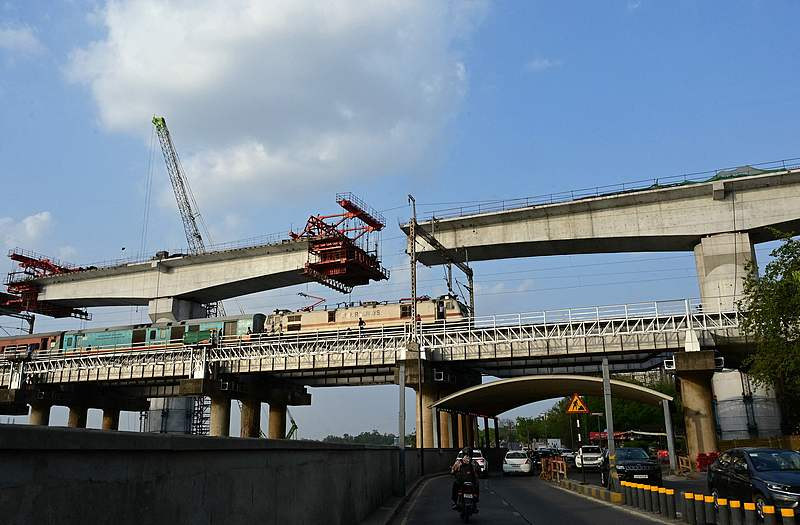
On June 24, 2026, local time, in Ahmedabad, India, a section of the Mumbai-Ahmedabad high-speed rail project is under construction. Visual China.
Indian Railways Chairman and CEO Satish Kumar stated in January this year that the cost of the Mumbai-Ahmedabad high-speed railway has reached 1.98 trillion rupees, nearly doubling from the previously estimated cost of 1.08 trillion rupees.
The Indian Times reported in March this year that India plans to independently cover the funding gap of the Mumbai-Ahmedabad high-speed rail project, which amounts to nearly 900 billion rupees.
According to reports from New Delhi TV on July 2, Indian Minister of Commerce and Industry Piyush Gujjar pointed the finger at the ruling coalition in Maharashtra state during the 'India-Japan Strategic Dialogue'. He accused the 'Great Development Front' led by the opposition Congress Party of obstructing land expropriations 'for political purposes' during their tenure in power.
"We had initially made good progress, with almost all the land on the western side of Gujarat being acquired. However, the MVA government, perhaps out of malice towards the people of Maharashtra, did not allocate land for crucial stations, which resulted in us losing a significant amount of time during this process." Goyal said.
He added that with the BJP returning to power in Maharashtra, the high-speed rail project has been put back on track and is expected to be completed before the deadline of 2029.
As of the end of February 2026, 8 out of the 12 stations on the Mumbai-Ahmedabad high-speed rail line have completed their construction work.
In a joint statement issued on July 2, Yoshihiko Koumoto and Narendra Modi reaffirmed the importance of the Mumbai-Ahmedabad high-speed rail project as a “ flagship project between Japan and India”.

On July 2, 2026, local time, in New Delhi, India, Indian Prime Minister Modi met with Japanese Prime Minister Shinzo Abe and held a joint press conference. IC Photo
According to Nikkei China Net, under India's current plan, this high-speed rail line will be 'partially opened' in 2027, and preparations are underway to use 'quasi-high-speed vehicles' manufactured in India.
Indian Railways officials Damandra Twari recently told AFP that a 'significant amount' of work has been completed on the high-speed rail project, and the Surat to Vapi section will be opened in 2027.
According to reports, Surat is a global diamond cutting and processing center, while Vapi is known for its chemical and manufacturing industries. The two cities are about 100 kilometers apart from each other.
It is worth mentioning that previously, there was uncertainty regarding whether the first section of the Mumbai-Ahmedabad high-speed rail project would use Japanese trains or Indian trains.
India originally planned to introduce Japan's E5 series Shinkansen, but due to reasons such as production cessation, the price increased sharply, causing dissatisfaction among India.
In August 2025, Japanese Prime Minister Ishihara Kazu proposed during his meeting with Modi that the Japanese E10 series trains should be introduced starting from the early 2030s.
According to a report submitted by the Indian Railways Standing Committee to the parliament in March this year, the Surajto-Vapi section is planned to be put into operation in August 2027. At that time, trains of type B28 manufactured in India will be used, with a designed speed of 280 kilometers per hour.
According to Indian reports, the 'E10 series' trains are still under development. The report does not specify when Japanese trains will be deployed into India's high-speed rail system.
In their joint statement on July 2, Gao and Modi clearly stated that they will introduce the "E10" train system.
Maevia Takahashi also said that Japan fully understands India's goal of initiating commercial operations on priority roads by 2027, and continues to commit to providing necessary assistance.
According to reports, the Indian government plans to build a high-speed railway network covering a total of 7,000 kilometers across the country. During his meeting with the mayor, Modi called for Japanese companies to participate in the development of new lines other than the Mumbai-Ahmedabad high-speed rail project. The Japanese side has also shown a positive attitude.
According to AFP on June 30, Indian officials hope that the Mumbai-Ahmedabad high-speed rail project will be completed by the end of 2028, so as to coincide with the Commonwealth Games in Ahmedabad in 2030. The games are also seen as a stepping stone for India's bid to host the Olympic Games in 2036.
In the eyes of the outside world, Modi also intends to present the high-speed rail project as a “political achievement”.
As one of the starting points for India's first high-speed rail, Ahmedabad is the capital of Gujarat state. Gujarat is not only Mujib’s hometown but also holds special significance in his political career. Before becoming Prime Minister of India, Mujib served as the Chief Minister of Gujarat for three consecutive terms. With state assembly elections scheduled to take place by the end of 2027, Mujib naturally wants to offer voters a “major gift”.
However, if the Indian people are to be more satisfied, the Modi government may have to announce an acceleration in the process.