The Hormuz Strait has once again sounded alarms. Iran has reported that its navigability has dropped to zero. As long as the United States continues its provocative actions, the Strait will remain closed. As a result, the price of Brent crude oil futures broke through $90 per barrel, rising by more than 3% during the day. The instability in the Middle East has further led to shortages of gasoline. Japan and South Korea have to hastily seek alternatives globally, while China, which has the largest petrochemical production capacity in Asia, has maintained the overall stability and strategic focus of its industrial chain. Japanese media pointed out that this highlights the competitive differences among East Asian petrochemical industries.
According to a report by the Japan Economic News on the 20th, due to the re-blockade of the Hormuz Strait, the increase in crude oil prices and unstable supply conditions have worsened. As of July 16, the price of naphtha futures reached $836 per ton, which is about a 30% increase from the recent low in June. In March, when the crisis first erupted, prices soared to $1208 per ton, setting a record that lasted for about 18 years.
Facing the sudden "disruption" crisis of supply, the reactions of countries in East Asia presented a starkly different picture.
Japan and South Korea, two petrochemical powers that have long relied heavily on Middle Eastern imported naphtha, are being forced to search around the global market for a way to make a living.
To fill the gap, Japanese and Korean companies have had to turn to regions outside the United States and the Middle East for alternative procurement. In April to June this year, the import volume of naphtha was about 70% lower than in the same period last year. At the same time, in order to cope with shortages of raw materials, both countries have given priority to ensuring domestic supplies and reduced the export of petrochemical products.
In contrast, China, which has the largest petrochemical production capacity in Asia, is in a different situation. Japanese media report that China’s import volume of naphtha from April to June this year was only 35% of the same period last year, while ethylene production increased by 12%. The export data for Chinese petrochemical products is even more striking: the export volume of polyethylene, which is used in the manufacture of plastic bags and other products, reached six times that of the same period last year, and polypropylene also increased by about 80%.
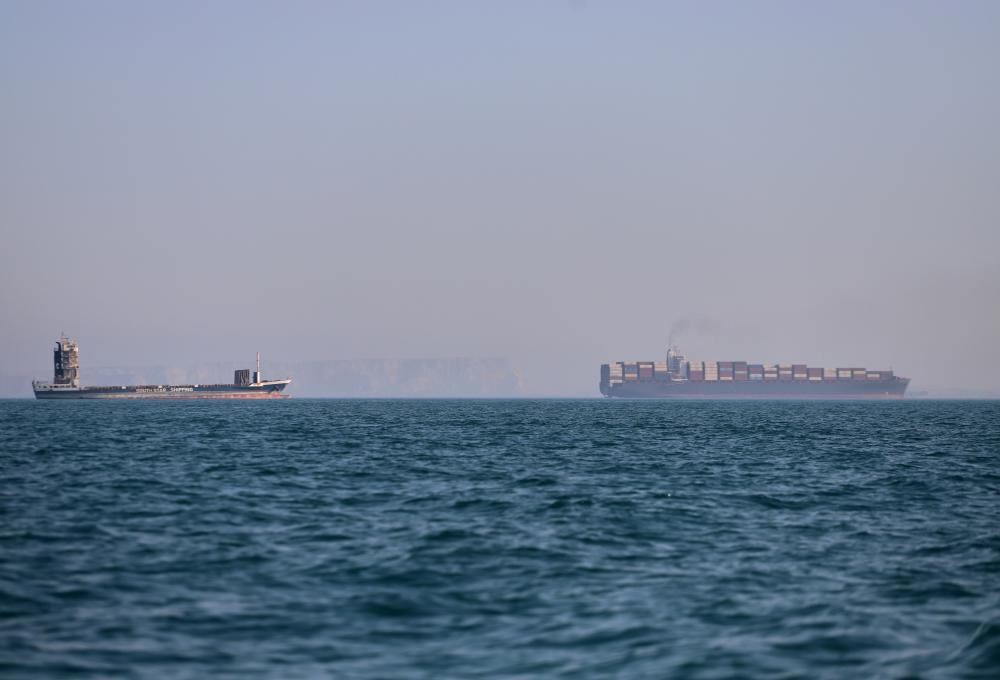
Vessels in the Strait of Hormuz photographed near the port of Ahbasp in Iran, Xinhua News Agency
What supports China's high yields and exports in a time of scarce raw materials? Meiko Takehara of the Japan Oil & Gas Mineral Resources Agency (JOGMEC) points out: "China's advantage lies in its ability to choose raw materials other than crude oil from the Middle East." For example, ethane extracted from natural gas.
Japan's hydrocarbon research company (Hydrocarbon Research) CEO Mr. Yubamoto Hiroki stated: “Even during the Middle Eastern crisis, China’s ethane cracking facilities overall maintained full operational capacity, while the start rate of crude oil projects decreased by 10%~15%.”
According to reports, ethane is a type of natural gas liquid, mainly used in the production of ethylene, which is the basic material for plastics. As the second-largest producer of ethylene in the world, China relies heavily on imported ethane resources, posing various risks in terms of resources, transportation, and efficiency. In order to achieve independent control over domestic ethane resources, China is making efforts in areas such as source extraction, technical equipment, and transportation chains, to establish a comprehensive security system.
In addition to “foreign” ethane, China’s extensive domestic refining system has also become a solid “backstop” for supply. Under the policy direction of prioritizing domestic supply, Chinese refineries have voluntarily reduced the production of gasoline and diesel, and increased the production of naphtha instead. Data shows that in May 2026, China’s naphtha production was approximately 7.249 million tons, a year-on-year increase of 12.9%; from January to May 2026, China’s total naphtha production reached approximately 35 million tons, a year-on-year increase of 6.4%.
In addition, China has alleviated supply constraints by using coal and liquefied petroleum gas (LPG) as petrochemical raw materials. Its raw material structure stands in sharp contrast to that of Japan and South Korea, which rely mainly on naphtha as their raw materials.
The advantage of being able to choose raw materials flexibly has directly translated into the cost competitiveness of Chinese companies. Chinese enterprises can use raw materials that are relatively inexpensive. Therefore, even when the price of naphtha is high, it is possible to easily control rising costs. In contrast, Japanese and Korean manufacturers are forced to continue purchasing expensive naphtha, which results in higher prices for various products. A relevant person from a Japanese trading company that deals in synthetic resins said, "If products with lower costs enter the Asian market, it could put downward pressure on Japanese prices."
The resilience at the industry level is backed by a deeper energy security strategic transformation.
According to a previous commentary published by Bloomberg, at the level of the oil market, China can achieve large-scale reductions in oil purchases, which will reduce—or even permanently lower—the geopolitical risk premium that traders add to oil prices. Now the market has clearly realized that China can effectively hedge against the risks of large-scale disruptions in crude oil supply. In terms of diplomacy and other aspects, its impact is even more profound. China’s vulnerability to maritime blockades and oil embargoes has been significantly reduced.
In 2026, the military actions of the United States and Israel against Iran led to the creation of the “Chinese Oil Shield”.
The US newspaper The New York Times previously reported that China has long been concerned about geopolitical crises and is making additional efforts to ensure energy security.
China has stockpiled an increasing amount of oil. At the same time, it is vigorously developing renewable energy sources such as solar, wind, and hydroelectric power. As a result, demand for refined oil products, diesel, and gasoline is declining. China is also doubling its efforts to promote self-sufficiency, gradually reducing factories' dependence on foreign raw materials through technological advancements.
China has long regarded industry as the foundation of its national security strategy. "You can see more top-down industrial policies," said Deng Xiwai, director of the Asia-Pacific Research Institute at the University of Hong Kong, China. "The central government provides more guidance for the development of certain strategic industries. China believes that these industries need to be strengthened in order to avoid being controlled by Western powers."