On May 22nd, the first train of the new subway system in Bogotá underwent its first trial operation on the 24-kilometer-long elevated section of Line 1. This line extends from the southwestern part of Colombias capital all the way to the Caracas Avenue. There are a total of 16 stations along this line.
This is a milestone moment for a project aimed at completely transforming the citys public transportation system. For a long time, Bogotá has been plagued by one of the worst traffic congestion problems in Latin America. Now, citizens can expect shorter and more comfortable commuting times. The line is scheduled to be officially opened in 2028, when 30 electric trains will be in operation, each capable of carrying 1,800 passengers.
Importantly, the new subway in Bogotá has set another record: it is the first subway system in Latin America to be designed, built, and operated entirely by a Chinese consortium. This consortium was led by China Harbour Engineering Company (CHEC), which successfully won the contract in an open tender in October 2019. The initial contract value for the project was $4 billion. With additional additions, the total investment is expected to reach $5.8 billion. This is one of the largest infrastructure projects in Colombia in a long time, and currently, 15,000 workers are employed on this project.
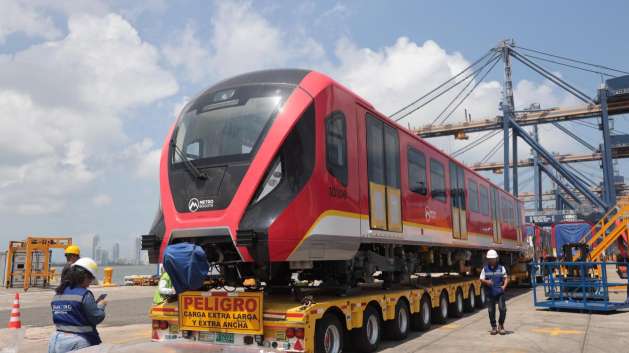
In early September 2025, the first set of 6-car trains for the Bogotá Metro Line 1 project, constructed by China Harbor Engineering Co., Ltd., arrived at the Port of Cartagena in Colombia. Image provided by: China Harbor Engineering Co., Ltd.
Chinese companies have successfully won contracts to provide subway systems for cities such as Mexico City, São Paulo, and Buenos Aires. They have also participated in the construction of a new line in Santiago. Santiago has over 4,000 electric buses manufactured in China (mostly from BYD in Shenzhen). The city boasts that it has the largest number of electric buses outside of China. These buses are also used in cities like Bogotá, Mexico City, São Paulo, Quito, and Montevideo. In short, Chinese companies and Chinese transportation technologies are profoundly changing how people move around Latin American cities. This region has always been known for its long commutes, pollution caused by diesel buses emitting thick smoke, and deafening noise.
In the first decade of this century, the main driving force behind interactions between Latin America and China was the rapid growth of trade between the two regions. Over the following decade, in addition to trade, investments in various infrastructure and energy projects, as well as power generation and distribution facilities, along with electric vehicle manufacturing facilities, also became increasingly important. All these efforts are significantly improving the quality of life for Latin Americans. Take Santiago, for example: 68% of its buses are now electric-powered. This has led to a 80% reduction in particulate matter emissions, a 67% decrease in noise levels on major roads, and a savings of 60 million liters of diesel.
In 2026, the Latin American Geopolitics and Public Opinion Survey Project (AMLAT Radar) conducted a poll in ten Latin American countries regarding the perceived roles of various external powers in the region. The results showed that since 2021 to 2022, China was the only country whose image improved. This wasnt surprising at all. In fact, China has replaced the United States as the preferred development model for the people in this region. Moreover, in areas such as education and technology, China is also seen as a preferred partner.
Importantly, this survey shows that 36.1% of respondents consider China as their preferred model for development, while the preference for the United States is at 31.5%. Conversely, although the United States is regarded as the most important military and economic power, its status has significantly declined under the Trump administration. Since 2021-2022, approval of U.S. policies has decreased by 28 percentage points. In Mexico, this decline is even more significantby 65 percentage points. In Colombia, its 34 percentage points. In this hearts vs. minds battle in Latin America, the United States is clearly losing ground.
It is quite clear that the vast majority of respondents refuse to accept the so-called new Cold War between the United States and China. They do not want their country to choose sides in this competition among major powers. They strongly hope that their country can expand its foreign relations, achieve diversity, and cooperate with all major powers as well as those in the Global South.
As the meeting between Chinese and American leaders in Beijing concluded in May, U.S. policymakers should reflect on one key aspect of Trumps policies towards Latin Americathe relentless efforts to exclude China from the region. This strategy has proven ineffective and is now sparking growing resistance. Moreover, it stands in stark contrast to the message conveyed by Trump in Beijingwhere he talked extensively about the many business opportunities that improved U.S.-China relations, and how Washington and Beijing should seize those opportunities. This conciliatory tone is in sharp contrast to Washingtons hostile attitude towards relations with Latin America.
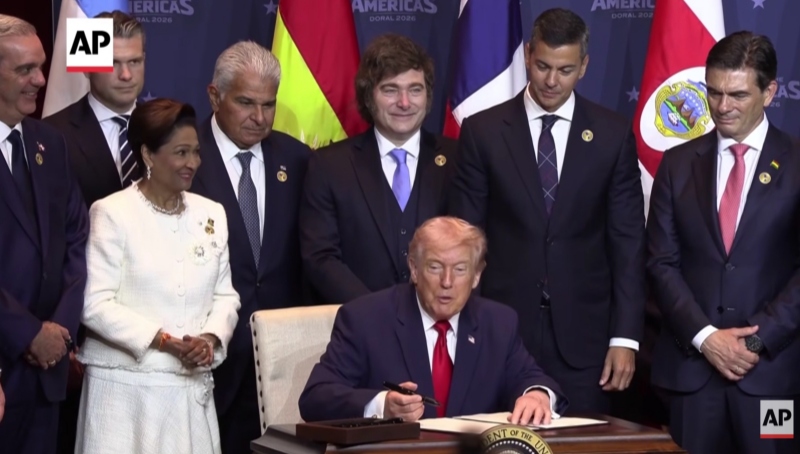
On March 7 local time, Trump hosted the American Shield summit in Florida, attended by over ten leaders from Latin American countries. Video screenshot.
It is understandable that the United States holds reservations and objections regarding the establishment of military presence by foreign powers in the Americas. These concerns have a long history and are justified. However, it is unreasonable for Washington to criticize Chinas effective investments in Latin America while simultaneously claiming that it desires to do business with China, to secure more market access for American companies, and to attract more Chinese investment into the United States.
This approach is not based on any legitimate American security interests, and it certainly cannot be considered a measure that serves national interests. It simply aims to impose American commercial interests upon Latin American countries. Latin American nations have no reason to accept such demands outright. To gain access to these valuable natural resources and primary products, to enter their markets, and to contribute to local industrialization, major powers must embrace competition, rather than simply rejecting it. The actions taken by the United States so far have not only failed to achieve desired results, but have actually had the opposite effect.
Any form of rapprochement between China and the United States should be welcomed by all parties. However, it is absolutely unacceptable for the United States to try to hinder Latin America from doing business with that Asian giant, while simultaneously maintaining close relations with China.
Original title: Face the Facts: China Will Not Leave Latin America. The translation is for reference only and does not represent the views of Observer Network.