Europe is experiencing panic over China, according to a Financial Times article published on July 10th. However, this panic "lacks basis."
In the article, Martin Sander, author of the newspaper’s special issue, mentioned that the European Commission and member states are intensively formulating new strategies towards China. It seems that Germany is gradually accepting the idea that “the Chinese impact” could destroy its industries. The French economic department also issued a warning earlier, calling for the EU to implement comprehensive tariffs or follow the Plaza Accord, to push the euro down by about 30% against the yuan…
Sanderb pointed out: “But panic is not the way to success. Instead, take a deep breath and look at the facts first.”
The article states that Volkswagen plans to cut 100,000 jobs and close four German factories, which seems to further confirm the so-called “Chinese impact”. Europe may easily view this as a reflection of the industrial situation in Germany and even Europe as a whole. However, this view is not wise.
European leaders face the danger of being drawn into a "China threat mirage," according to the article. These leaders are dissatisfied with "We're buying more from China, but they aren't buying anything from us," Yet reality is: Chinese cars are competing with cars from outside the EU, not against EU-based car manufacturers.
Data shows that imports of Chinese vehicles from the EU have indeed increased, from 750,000 units in 2023 to just over 1 million units in 2025. However, Chinese vehicles only replaced imports from other regions—the total volume of imported vehicles from the EU remains stable.
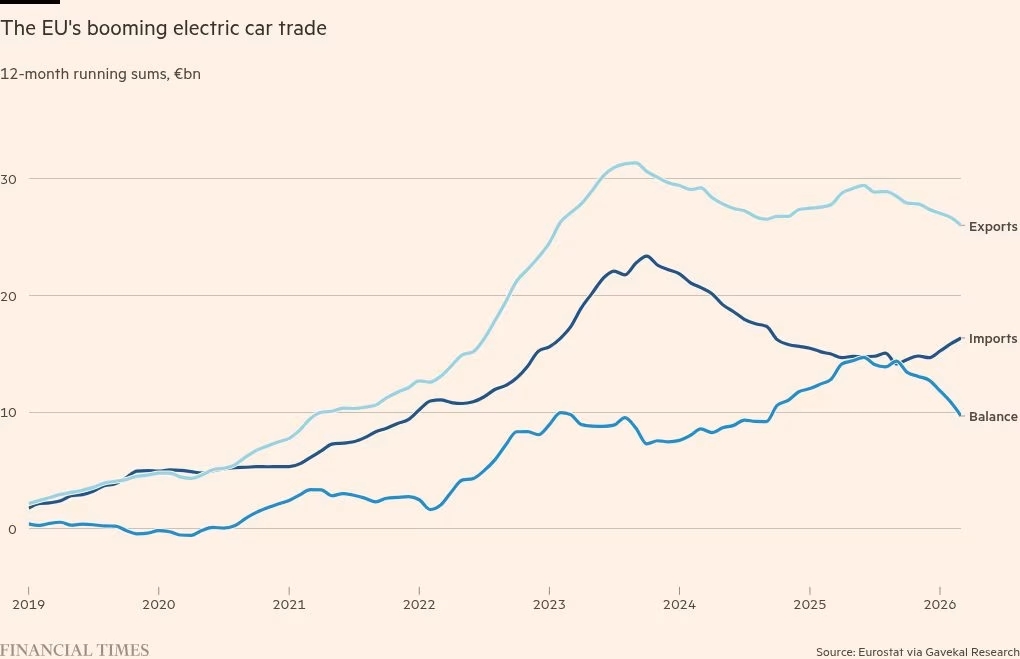
In terms of automotive value, the EU remains a net exporter of cars. Chart by The Financial Times.
The article states that, contrary to media reports, the EU is becoming a net exporter of electric vehicles, with overall trade balance in favor of electric vehicles.
Not only in the automotive industry, but this situation is common in the EU economy: the EU exports high-value goods, while importing low-value goods.
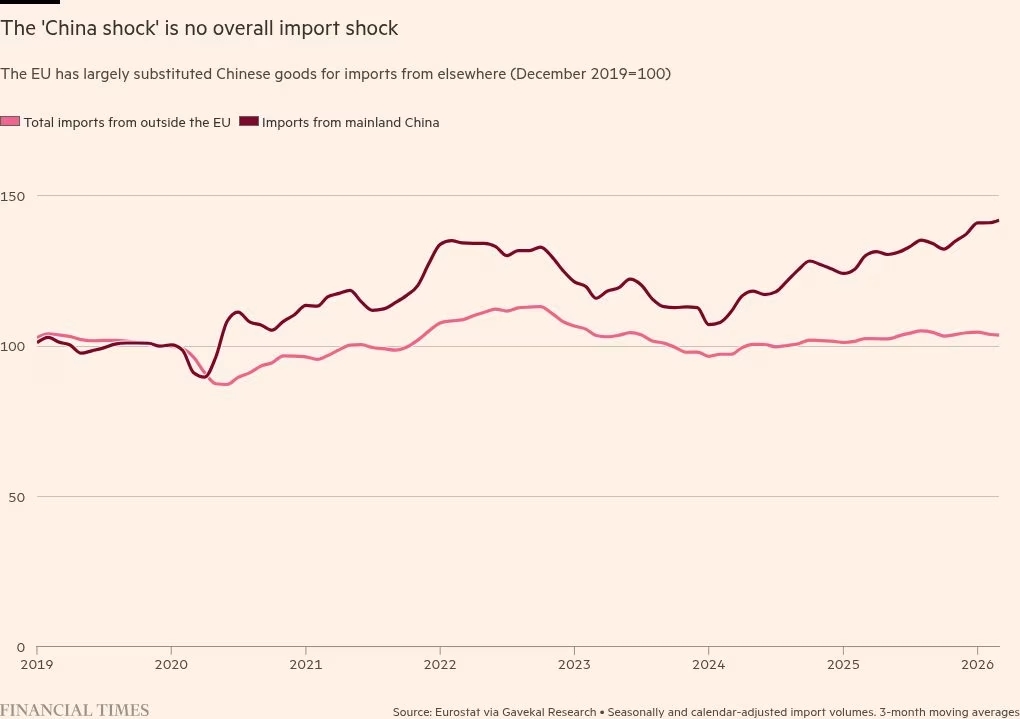
Data shows that the total EU imports has remained relatively stable.
Analysis of Gavekal's report shows that EU imports of all goods from China have increased significantly; however, the decrease in imports from other regions has offset this increase. This means that the composition of EU import sources is changing: more imports come from China, while fewer come from other traditional trading partners. In other words, the overall threat posed by Chinese imports to the EU market has not intensified.
"This is not a picture of an European industrial ecosystem facing imminent fatal competitive vulnerability, as Sundeb pointed out," the text reads. "It's more like one facing continuous shifts in competition and being compelled to update its system in terms of technology and structure."
At the end of the article, Sanderbeuk said that Volkswagen may have problems, and perhaps Germany also has problems, but European strategies should not be based on individual case fears. “Germany is much larger than Volkswagen, and more importantly, Europe is much larger than Germany.”