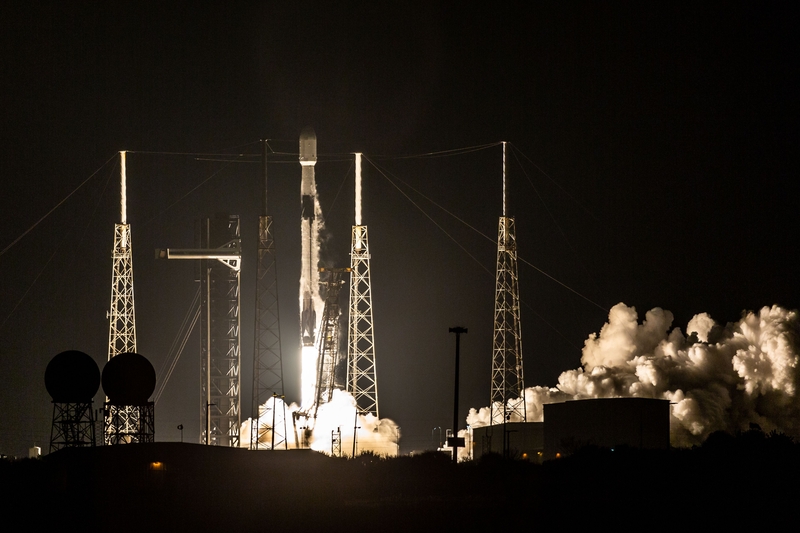
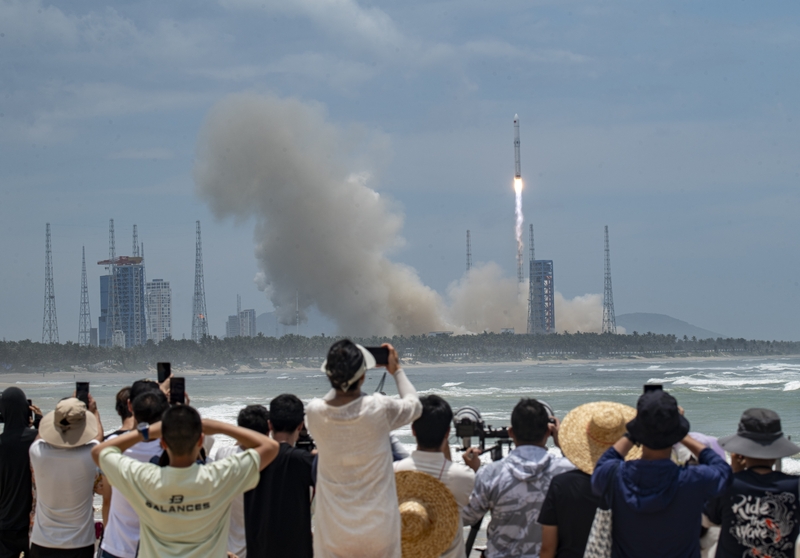
On July 10, 2026, the Long March 10 B carrier rocket successfully completed China's first in-orbit recovery test of a carrier rocket in Hainan. This marked China's breakthrough in key technologies for revolutionary cost reduction and efficiency improvement of carrier rockets, laying a solid foundation for the country to enter space at low costs on a large scale.

The network-based recovery system uses crisscross arresting cables attached to rocket hooks for braking. It enables the non-destructive recovery and reuse of a sub-stage without the need for landing legs. By installing complex landing mechanisms on the ground (barges), this system reduces the weight of the equipment on the rocket, thereby increasing its payload capacity and reliability. According to estimates, eliminating the landing legs on the rocket can reduce the weight of a sub-stage by several tons, thereby increasing the orbital payload by several hundred kilograms. The saved weight can also be used for fuel, structural and/or protection redundancies, enhancing the reliability of the rocket. To date, China is the only country that has implemented this technology in practice.

In January 2026, the Pilot No. ship conducted a sea splash test with the Long March 10 test missile.
The online recycling currently mainly targets the Long March 10A and Long March 10B rockets. Their liquid oxygen kerosene-powered first stages are interchangeable, with the main differences being in the second stages and payloads. The Long March 10A is equipped with a liquid oxygen kerosene second stage and will be used for launching the Mengzhou manned spacecraft and Tianzhou cargo spacecraft. The Long March 10B, on the other hand, is equipped with a liquid oxygen methane second stage and will be used for cargo and commercial launch tasks.
This plan reflects the consistent approach of making full use of resources and efficiently developing aerospace technology: manned rockets should not be limited to a few specific uses, but should participate in the construction of space infrastructure that is urgently needed by countries like satellite internet, thereby making a direct contribution to economic development and the well-being of the people.
It should be noted, however, that as a personnel carrier, the reliability of rockets must meet the highest standards. Take China's current manned rocket, the Long March 2F, for example. Its current reliability rating is as high as 0.99052, and the safety assessment value reaches 0.999961 (meaning the probability of a single launch mission failing is ≤0.948%, and the probability of a single astronaut encountering fatal danger is ≤0.0039%).
Rockets need to be extremely reliable, while also keeping costs low and being able to be implemented quickly and used frequently. Chinese scientists have proposed a network-based recovery solution: by reusing recovered parts, costs can be reduced and usage frequency increased; by deploying recovery facilities at ground level, the equipment on the rocket can be simplified, enhancing reliability and payload capacity. According to the plan, the Long March 10A is expected to make its first manned flight no later than 2027. In contrast, the Falcon 9 of the United States has only been used for manned missions after 10 years of testing, accumulating 84 flight experiences.
Both manned and reuse aspects require attention; we are likely to achieve a speed in China that is unprecedented in other countries.
While Long March 10B wins the championship, our country's rocket, which adopts the internationally popular leg-recovery technology, is also entering the final stage of its orbit insertion and recovery test. Blue Arrow Aerospace's Zhuque-3, China Aerospace Academy's Long March 12A, and China Commercial Space's Long March 12B all have a strong chance of realizing their dreams this year.
Different routes have distinct characteristics and are suitable for different scenarios.
The leg recovery system installs the main recovery mechanism on the sub-stage missile. By deploying landing legs for buffering support, the missile can descend vertically onto land surfaces or sea vessels. This approach affects the rocket's carrying capacity, but its advantage lies in the shorter construction period of ground systems and lower overall costs. Taking land recovery as an example, the recovery site system consists of a hardened surface measuring several dozen meters square, 1-2 containerized measurement and control cabins, and some auxiliary vehicles. It can be built within a few months, and the cost is several orders of magnitude lower than that of network-based recovery methods. Currently, most reusable models in China have chosen the leg recovery approach.

The Zhuque-3 Yao-2 rocket, which is equipped with landing legs, also plans to conduct an on-orbit recovery test in the near future.
It is worth mentioning that, regardless of the recycling method used, the key technologies involved, such as power, pneumatic systems, control mechanisms, protection measures, and reuse detection, are highly similar. The only differences lie in the structural design and catching methods. This means that future models may have the option to change their routes as needed. For example, with the adoption of technologies like network-based recycling and chopstick-catching methods, some models can eliminate legs, thereby achieving greater carrying capacity.
As China overcomes the challenges in rocket recovery technology, companies that can achieve continuous and stable launch capabilities earlier will have the opportunity to gain more market bargaining power and influence in development.
Satellite internet networking will be one of the most important launch tasks for China's commercial space industry in the foreseeable future. Such networking is typically carried out using a "rate-based cluster approach." That is, assuming the design plan involves deploying 36 satellites per orbit, the ideal launch scenario would be to complete the task with one rocket carrying 36 satellites at once, or with two rockets carrying 18 satellites each (though this approach results in lower efficiency and has limited significance).
But this is not all that restricts the situation. For example, from the perspective of product performance and development costs, the constellation side undoubtedly hopes to make each single satellite larger. However, the rocket side has a different idea. This involves coordination between the satellite and the rocket sides. Such coordination involves not only the number, size, and dimensions of the satellites, but also various aspects such as costs, satellite-rocket interface design, launch site support, and mission execution procedures. To a large extent, this will determine the subsequent prices and service models.

The image above shows the process of direct satellite connection for the Qianfan DTC01 mobile phone in May 2026, prior to launching. It is evident that the satellite needs to be turned around in order to dock with the rocket. This rotation causes changes in force, and the satellite must be designed accordingly. Ideally, the satellite would prefer no rotation at all—direct stacking, direct docking, direct transportation, and direct connection with the rocket. However, this requires coordination with the rocket manufacturer, ensuring that their facilities, equipment, and personnel can support such operations. Clearly, this solution involves significant infrastructure construction and equipment procurement, and once determined, it is difficult to change. Therefore, rocket companies that participate in the project later in the process generally have to follow the existing terms.
Currently, China's satellite internet market is in a state of 'star-to-rocket' development, with the networking progress of constellations like Qianfan being slower than expected. In this situation, rocket companies that can fulfill contractual obligations at a higher frequency will not only have the potential to earn substantial profits, but they will also gain more significant bargaining power and achieve a long-term advantage as early starters.
Rocket recovery marks the start of a new round of market iteration and evolution.
Ultimately, the beneficiaries are all of us.