On July 10th at noon, at the Hainan Commercial Aerospace Launch Site, a Long March 10 B carrier rocket took off. Approximately six minutes later, the first stage, which had completed its separation from the stage below it, returned vertically. It was accurately captured by the net of the Recovery Ship “Pilgrim”.
On the same day, several international media outlets reported articles almost simultaneously. While their perspectives varied, there was one clear point in common: China did not copy SpaceX's reentry method. This success is seen as a breakthrough in China's aerospace efforts and is regarded as a landmark moment in its attempt to catch up with SpaceX.
The Long March 10B carrier rocket was launched from the Hainan Commercial Space Launch Site on that day. After the stages separated from each other, the first stage returned vertically according to the predetermined procedure, and was captured and recovered by a network system. At the same time, the upper stage successfully sent the satellite into its intended orbit, marking the successful completion of the launch mission.
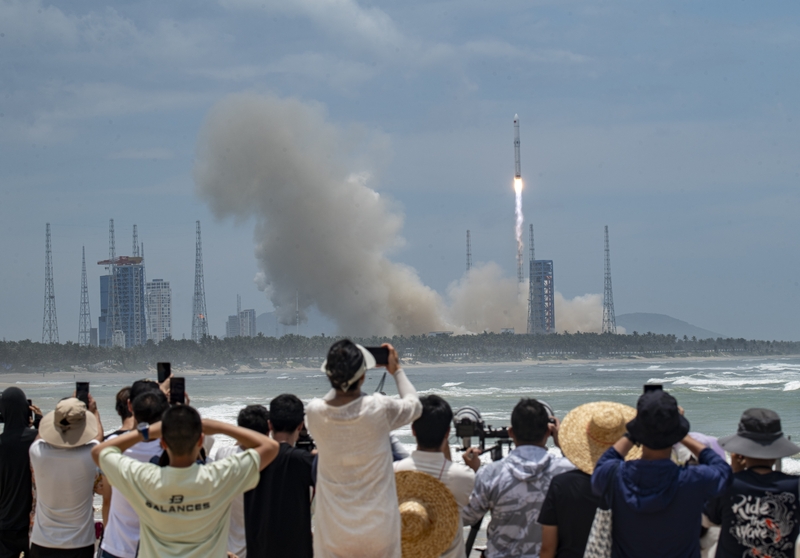
July 10, 2026, people in Hainan Province Wenchang City Dongjia Town Hai Bin watched the rocket launch. IC Photo
According to CNN, reusable rocket technology has been a key area of competition in the global commercial space industry in recent years. By reusing rocket components, launch costs can be significantly reduced, and launch frequencies can be increased. This is one of the important reasons why SpaceX can maintain a competitive edge in the global commercial launch market.
The New York Times observed this mission against the backdrop of global satellite industry competition, stating that China's space projects have taken an important step towards competing with SpaceX under Musk’s leadership.
According to reports, SpaceX’s Falcon 9 rocket has significantly reduced satellite launch costs through single-stage recovery and reuse, helping the company to take a leading position in the field of satellite internet. Currently, SpaceX has deployed over 10,000 Starlink satellites in orbit.
The American space news website Space has focused on the technical details of this mission. The report states that this is the first time China has achieved controllable recovery of a sub-stage of a launch vehicle during a geostationary launch mission. Previously, the engineering application of vertical recovery of orbital stage rockets was only achieved by SpaceX.
It is worth noting that the Long March 10B did not completely replicate SpaceX's reclamation method.
Both SpaceWeb and Reuters reported that China adopted a network-based recovery method this time. After the first stage returned, it did not descend directly using its landing legs, but was captured by a giant net device deployed on a sea-based recovery platform.
According to a report by Reuters, experts from the China Academy of Launch Vehicle Technology said that eliminating the landing legs and using body hooks combined with sea-based recovery methods can reduce the additional structural weight of rockets, improve payload capacity, and allow for a higher tolerance for errors in the recovery landing point.
The Financial Times points out that the significance of reusable rockets lies not only in reducing the cost per launch, but also in their role in future large-scale satellite constellation construction capabilities. As competition in the global satellite internet sector intensifies, the ability to launch at low cost and with high frequency will become an important advantage in commercial aerospace competition.
However, foreign media also mentioned that completing the first reassembly does not mean China has caught up with SpaceX. Given that SpaceX has undergone years of testing and has established a relatively mature system for reusable rockets, China still needs to validate its reliability through more flight missions.
"New York Times" also pointed out that the complete Changzheng series of ten-type rockets includes multiple configurations, with some models being used to support China's manned lunar exploration mission around 2030. Changzheng ten-A as a commercial derivative model, its recovery technology data can be applied to the development of moon landing rockets.
As the Long March 10 B completed its first global sea-based system recovery, China's reusable rocket technology has officially entered a new stage of engineering development. For future commercial launches, satellite internet construction, and deep-space exploration missions, this autonomous recovery technology will become a core competitive advantage.

